The crisis within the Obi-Kwankwaso (OK) Movement has taken a fresh turn following the resignation of its Director-General, High Chief Peter Ameh.
Ameh announced his resignation in Abuja on Tuesday, stepping down from the position with immediate effect.
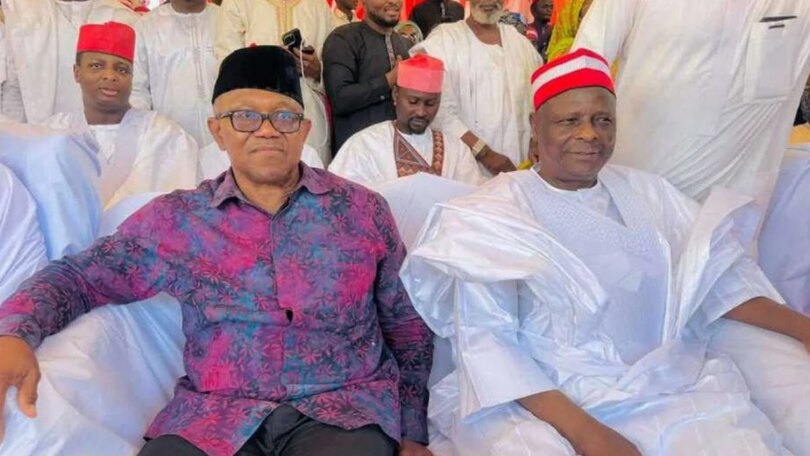
His departure comes at a sensitive time for the movement, which is working to build a political structure around Nigeria Democratic Congress (NDC) presidential candidate Peter Obi and his running mate, Senator Rabiu Kwankwaso, ahead of the 2027 general elections.
Ameh said his decision was not connected to any withdrawal of support for Obi or the political project being promoted by the OK Movement.
Rather, he explained that he needed to concentrate on his own political ambition ahead of the 2027 elections.
In a resignation letter sent to Vanguard, Ameh said he was leaving the position to focus on his campaign for the Kogi East Senatorial District, where he is seeking election on the platform of the NDC.
He wrote, “I hereby formally tender my resignation as Director-General of the OK Movement, effective immediately.
“This decision will enable me to devote the necessary time and energy to my campaign for the Kogi East Senatorial District, where I am the candidate of the Nigeria Democratic Congress, NDC.”
Ameh also made it clear that leaving his position within the movement would not affect his loyalty to Obi.
He referred to Obi as “My leader” and maintained that his commitment to the political ideals behind the movement remained intact.
The former DG further said he was prepared to accept whoever Obi chooses to appoint as his replacement.
“I humbly accept any individual appointed by my leader to succeed me in this role,” Ameh stated.
He also thanked Obi for what he described as his leadership qualities and political credibility.
“I wish to express my profound gratitude to my leader, Mr. Peter Obi, for his exemplary leadership, unwavering integrity, and enduring credibility. These qualities inspired the formation of the OK Movement and have continued to shape its vision and purpose.
“I remain firmly committed to the ideals that united us and wish the OK Movement every success in its future endeavours.”
Ameh’s resignation comes less than a month after he was appointed to lead the movement’s national structure.
The OK Movement had appointed the former National Chairman of the Inter-Party Advisory Council (IPAC) as its National Director-General in July.
The appointment was presented as part of efforts to strengthen the organisation’s mobilisation and expand its structures ahead of the 2027 elections.
The movement emerged in 2026 as a platform bringing together supporters of Obi and Kwankwaso.
Its stated objective is to create a wider grassroots political structure around the two politicians as they pursue the NDC platform for the 2027 presidential election.
The group has sought to build structures across the country, with its activities centred on mobilisation, political awareness and support for the Obi-Kwankwaso agenda.
Its emergence followed the movement of Obi and Kwankwaso into the NDC after both politicians left their previous political platforms.
However, the movement has faced internal disagreements in recent weeks.
In a related development, Kwankwaso’s spokesman, Ladipo Johnson, had disclosed that Obi was unhappy with the crisis within the OK Movement.
Johnson described the disagreement as a “distraction” but said it should not be allowed to damage the political project being built around Obi and Kwankwaso.
For Ameh, however, the next phase of his political career will be focused on Kogi East.
His decision to pursue the Senate seat means his attention will shift from managing the national structure of the OK Movement to building support for his own candidacy in the district.
He has also indicated that his resignation should not be interpreted as a break with the movement or with Obi.