The trial of former Kaduna State Governor, Nasir El-Rufai, over allegations of treason and breach of national security continued on Monday at the Federal High Court in Abuja, with the prosecution presenting its first witness and playing a 43-minute television interview in which the former governor allegedly admitted that someone had wiretapped a private conversation involving the National Security Adviser (NSA), Nuhu Ribadu, and forwarded it to him.
The proceedings before Justice Joyce Abdulmalik saw the prosecution build its case around what it described as an “open confession” made by El-Rufai during an appearance on Arise News Television, while the defence exposed significant gaps in the investigation, including the absence of any forensic analysis, device examination, or IP address tracing to corroborate the alleged interception.
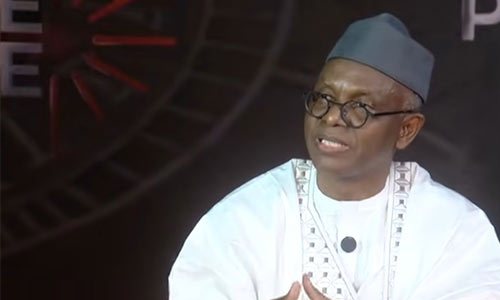
The centrepiece of Monday’s proceedings was a 43-minute interview granted by El-Rufai on Arise News Television, which the prosecution played in open court. In the interview, the former governor allegedly stated that someone had wiretapped a conversation involving the NSA and forwarded it to him. El-Rufai was also said to have defended the act during the broadcast, arguing that governments routinely monitor the communications of others.
The prosecution presented the interview as direct evidence of El-Rufai’s involvement in the interception of a classified communication between the NSA and the Chairman of the Independent Corrupt Practices and Other Related Offences Commission (ICPC) an act the prosecution argues constitutes a breach of national security.
A prosecution witness told the court that following the broadcast of the interview, investigators interviewed NSA Nuhu Ribadu, who verbally confirmed that the conversation referenced by El-Rufai during the television appearance had indeed taken place between him and the ICPC Chairman.
According to the witness, the ICPC Chairman also confirmed having such a discussion with the NSA after portions of the interview were played to him.
The confirmations by both the NSA and the ICPC Chairman established, in the prosecution’s view, that the conversation El-Rufai claimed to have received was real thereby lending credibility to the allegation that a genuine security-level communication was intercepted and passed to a civilian who then discussed its contents on national television.
The prosecution witness further testified that the anchor of the Arise TV programme, Charles Aniagolu, activist-lawyer Deji Adeyanju, and a cameraman, Ugochukwu Agalayana, were all invited for questioning by investigators.
Aniagolu reportedly confirmed to investigators that El-Rufai admitted during the interview that someone intercepted the NSA’s conversation and passed it to him, while also insisting that governments regularly engage in such surveillance practices.
Statements obtained from Aniagolu were tendered and admitted by the court as Exhibits C and C1, while Adeyanju’s statement was admitted as Exhibit E. All three exhibits were admitted without objection from the defence.
The cameraman, Agalayana, confirmed setting up the equipment used during the interview but told investigators that he did not pay attention to the substance of the conversation itself. His statement was admitted as Exhibit D.
According to the prosecution witness, investigators concluded that El-Rufai made what they described as an “open confession” during the television interview regarding the interception of the NSA’s conversation. The investigation team considered the act capable of undermining national security and subsequently recommended prosecution.
A preliminary investigation report tendered by the prosecution was admitted as Exhibit F, completing the documentary foundation of the prosecution’s case from its first witness.
Under cross-examination by defence counsel, Chief Paul Erokoro, SAN, significant weaknesses in the prosecution’s investigation were exposed.
The prosecution witness acknowledged that investigators did not examine any communication devices belonging to the NSA, did not obtain any IP addresses related to the alleged interception, and did not conduct any forensic analysis of the alleged wiretapping. These are the standard investigative steps that would ordinarily be required to establish that an interception actually occurred, identify the method used, and trace the chain of transmission from the point of interception to the recipient.
The witness maintained, however, that such technical steps became unnecessary after the NSA reportedly confirmed the authenticity of the conversation referenced in the interview. In effect, the prosecution’s position is that verbal confirmation by the NSA that the conversation was genuine rendered forensic corroboration superfluous.
This is a legally significant point. The defence may argue that without forensic evidence establishing that an actual interception took place — as opposed to the conversation being disclosed through other means, such as a willing participant sharing the details — the prosecution cannot prove the essential element of the offence, which is the unlawful interception of a communication.
The cross-examination also highlighted another critical issue: El-Rufai never specifically stated during the interview that he personally carried out the interception. The prosecution witness agreed with this characterisation under cross-examination but insisted that the former governor repeatedly stood by the claim that the conversation had been tapped and forwarded to him.
The distinction between personally intercepting a communication and receiving an already-intercepted communication from a third party is legally significant, as the two acts may attract different levels of liability depending on the specific provisions of the law under which El-Rufai is charged.
In one of the more striking exchanges during cross-examination, defence counsel Erokoro asked the witness whether the defendant could merely have been boasting during a politically charged television appearance — suggesting that El-Rufai’s statements may have been political bravado rather than a genuine admission of involvement in wiretapping.
The witness rejected this suggestion, responding that he considered El-Rufai “a person of integrity” and believed the former governor meant what he said during the broadcast.
The response is notable because the prosecution witness effectively vouched for the defendant’s character to support the credibility of the alleged confession an unusual dynamic in which the prosecution is arguing that the defendant should be believed when he made statements that incriminate himself, while the defence may argue that the statements were exaggerated or taken out of context.
By the close of Monday’s proceedings, the prosecution had successfully tendered and secured the admission of multiple exhibits without objection from the defence. These include the statements of Arise TV anchor Charles Aniagolu (Exhibits C and C1), the statement of cameraman Ugochukwu Agalayana (Exhibit D), the statement of Deji Adeyanju (Exhibit E), and the preliminary investigation report (Exhibit F).
The admission of these exhibits without objection suggests that the defence may be reserving its challenges for the substantive arguments rather than contesting the admissibility of the documents at this stage.
Following the conclusion of the cross-examination of the first prosecution witness, Justice Joyce Abdulmalik adjourned further hearing in the matter to June 22 and 23, 2026.
El-Rufai, who served as Governor of Kaduna State from 2015 to 2023, has been one of the most prominent critics of the Tinubu administration since leaving office. His prosecution on charges bordering on treason and breach of national security has been viewed by his supporters as politically motivated, while the prosecution maintains that the charges are based on evidence of a genuine security breach.
The case centres on the allegation that the former governor received — and publicly discussed on national television — an intercepted private conversation between Nigeria’s National Security Adviser and the Chairman of the ICPC, two of the most senior security and anti-corruption officials in the country. The prosecution argues that the act of receiving, possessing, and publicly broadcasting the contents of such a communication constitutes a threat to national security.
The defence, led by Chief Paul Erokoro, SAN, appears to be building its case on the absence of forensic evidence proving that an interception actually occurred, the fact that El-Rufai did not claim to have personally carried out the interception, and the possibility that the former governor’s statements during the television interview were political rhetoric rather than factual admissions.
The trial continues on June 22 and 23, 2026, before Justice Joyce Abdulmalik at the Federal High Court, Abuja.