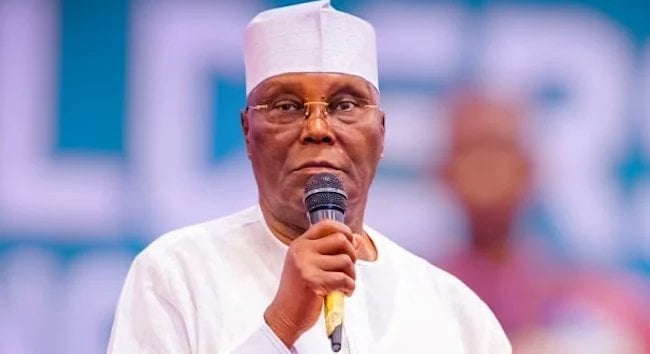
Former Vice-President Atiku Abubakar has accused the Tinubu administration of presiding over an increasingly hostile business environment, alleging that 767 factories had shut down while another 335 were operating under severe distress.
Mr Atiku said the closures and difficulties facing manufacturers contradicted the Federal Government’s claims that its economic reforms were restoring growth and improving the business environment.
The former vice-president, who is the presidential candidate of the African Democratic Congress, ADC, stated this in a response to the Presidency’s defence of President Bola Tinubu’s economic record.
In a statement issued by his Senior Special Assistant on Public Communication, Phrank Shaibu, Mr Atiku said the government’s claims of economic prosperity existed largely in official statements and had not been reflected in the experiences of businesses and ordinary Nigerians.
He said the administration was celebrating Gross Domestic Product, GDP, growth and other macroeconomic indicators while manufacturers, small businesses and households faced rising operating costs and declining purchasing power.
“The Presidency proudly announced that Nigeria’s GDP has increased significantly since the exchange-rate adjustment. We ask a simple question: Has the purchasing power of the average Nigerian increased?” Mr Atiku said.
“Are manufacturers paying less for energy? Have small businesses become more profitable? The answer, tragically, is no.”
He said the closure of hundreds of factories and the distress faced by many others reflected the pressure created by high energy costs, multiple taxes, expensive logistics, rising electricity tariffs and weak consumer demand.
Mr Atiku argued that government policies could not be described as successful if they increased public revenue while reducing the productive capacity of the economy.
“Government cannot tax its way into prosperity while simultaneously shrinking the productive capacity of the economy,” he said.
“Manufacturers are battling record energy costs. Small businesses face multiple taxes, rising electricity tariffs, escalating logistics expenses and declining consumer demand.”
The former vice-president said tax reforms should be designed to encourage production, create jobs and expand the tax base rather than place additional pressure on struggling businesses.
“A tax reform that expands government revenue while ordinary citizens become poorer cannot honestly be described as progressive,” he said.
He added that successful tax systems were built on productivity and economic growth, not by extracting more revenue from businesses and households already facing financial pressure.
Mr Atiku also questioned the government’s borrowing policy, saying the debate should not focus solely on Nigeria’s debt-to-GDP ratio but on the economic value generated by borrowed funds.
“No serious economist argues that borrowing is inherently wrong. Nations borrow. The real question is this: what has Nigeria obtained in return for the unprecedented debts accumulated under this administration?” he asked.
He said Nigerians had a right to demand evidence that borrowed funds were being used to improve infrastructure, create jobs, strengthen public services and raise living standards.
Mr Atiku noted that businesses continued to spend heavily on alternative sources of electricity, while high logistics costs and poor infrastructure remained major obstacles to production.
“After record borrowing and record budgets, businesses are still forced to spend enormous sums generating their own electricity,” he said.
“Logistics costs remain among the highest in Africa. Manufacturers continue to struggle under crushing operating costs, while many roads remain in deplorable condition.”