*Calls on NJC to Act Against Reckless Judges and Demands INEC Be “Unbundled” and Freed from Presidential Appointment Control
Former Chairman of the Independent National Electoral Commission (INEC), Prof. Attahiru Jega, has called for the urgent amendment of the 2026 Electoral Act, identifying three specific provisions that he described as “grey” and containing “issues of serious concern,” warning that regardless of the law’s lofty intentions to strengthen electoral integrity, it contains ambiguities and provisions that could be exploited to undermine the 2027 general elections if not corrected before voting day.
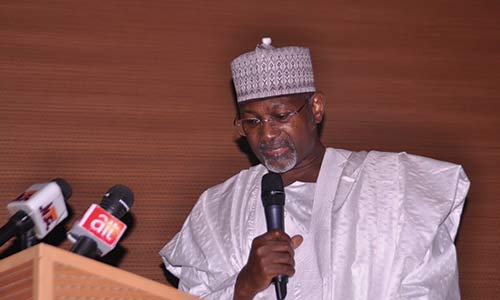
Prof. Jega made the observations in a paper titled “Some Reflections on the 2026 Electoral Act and Nigeria’s Electoral Democracy,” delivered at the public presentation of “A Collection of Essays: Readings on the Legislature,” authored by policy expert Prof. Ladi Hamalai, on Wednesday in Abuja.
The former INEC chair also called for post-2027 reforms including the removal of the President’s power to appoint INEC’s chairman and national commissioners, the “unbundling” of INEC to separate its election-conducting function from prosecution, delimitation, and party regulation, a downward review of campaign finance limits he described as encouraging “monetisation of the electoral process,” and swift NJC action against what he called “judicial rascality” that undermines both electoral integrity and the integrity of the courts.
The Three Grey Provisions
Prof. Jega identified three specific sections of the 2026 Electoral Act that require immediate review.
Section 60(3): Electronic Transmission and the Manual Fallback
Jega lauded the electoral law for mandating the electronic transmission of results but expressed serious worry over the clause that makes the result sheet, Form EC8A, the primary collation document where electronic transmission fails.
While acknowledging that the clause anticipates the need for a fallback mechanism, Jega warned it could be weaponised by politicians determined to manipulate election outcomes.
“Given what we know about the Nigerian environment and the desperation of the ‘do-or-die’ politicians, there shouldn’t be such a vague provision, which would be used to truncate electronic transmission, in favour of manual transmission of results, which is easier to fraudulently manipulate and exploit,” Jega stated.
He further challenged the Act’s emphasis on reliance on the IReV portal for final determination of results in case of transmission failure, pointing out a fundamental misunderstanding embedded in the provision.
“There is an undue emphasis on reliance on data on the IReV portal for final determination of results in case of transmission failure. If this is so, there is a misunderstanding of the fact that IReV transmitted data is for public ‘viewing’ purposes only,” Jega stated.
He explained the technical distinction: “The data to be relied upon in result declaration should be the backend result compilation database, which ideally is more secure, not publicly accessible, and less susceptible to fraudulent intrusion.”
The distinction between the IReV portal, which is a publicly accessible viewing platform, and the backend database, which is the secure internal system where results are compiled and stored, is critical. If the law directs reliance on the publicly accessible portal rather than the secure backend system, it creates a situation where the less secure data source takes precedence over the more secure one, a framework that Jega considers technically unsound and vulnerable to manipulation.
Section 83(5): Courts Barred from Internal Party Affairs
Jega described Section 83(5), which restrains courts from entertaining any suit on the internal affairs of a political party, as “a sweeping generalisation that needs to be moderated.”
He questioned how courts could be denied the power to adjudicate disputes involving the internal affairs of political parties where those affairs contradict constitutional provisions, particularly those relating to fundamental rights and the rule of law.
“How could courts be denied the power to entertain ‘internal affairs’ of a political party that contradict constitutional provisions, such as those bordering on fundamental rights and the rule of law?” Jega asked.
The concern is both practical and constitutional. Political parties are the primary vehicles through which citizens exercise their right to participate in governance. If courts are barred from reviewing how parties conduct their internal affairs, including candidate selection, leadership disputes, and disciplinary proceedings, party members who are denied their rights within the party have no external forum for redress, effectively placing parties above the law in their internal operations.
Section 138(1): Excluding Qualification Challenges
Jega questioned the constitutionality of Section 138(1), which excludes qualification as a ground for post-election challenge, citing Section 131 of the 1999 Constitution, which recognises at least a school certificate or its equivalent as part of the requirements for seeking elective positions.
“It is a very good provision in the previous acts, which has been put to good use, and there does not seem to be any rational justification for removing it,” Jega stated.
He added a pointed observation about who benefits from the exclusion: “Unless, of course, if some certificate fraudsters and qualification racketeers would like to have an unrestricted field day.”
The removal of qualification as a ground for post-election challenge means that even if a candidate who won an election is subsequently discovered to have presented forged certificates or false educational qualifications, the election cannot be challenged on that basis. The only options would be criminal prosecution for forgery, which operates on a different timeline and with different consequences from an election petition.
The Timeline Problem
Jega recommended urgent amendment of the 2026 Electoral Act “within the AU/ECOWAS protocols, which require all amendments to and reviews of the electoral legal framework to be completed at least six months to the general elections.”
However, the timeline is extremely tight. The 2027 presidential and National Assembly elections are scheduled for January 16, 2027, and the governorship and State Houses of Assembly elections for February 6, 2027. As of the date of Jega’s address, the presidential election was approximately six months and one week away, leaving virtually no margin for the kind of legislative process that a constitutional amendment or statutory reform requires.
The practical effect is that the grey provisions Jega identified may remain in the law through the 2027 elections unless the National Assembly acts with unusual speed, a prospect that the current pace of legislative business makes unlikely.
Post-2027 Reforms: INEC Independence
Jega identified several reforms that should be addressed “at the earliest opportunity” after the 2027 elections, drawing on persistent recommendations from panels including the Justice Muhammad Lawal Uwais Electoral Reform Committee.
On INEC’s independence, Jega argued that the power to appoint the chairman and national commissioners should be taken away from the President “to free the commission from the damaging negative perception of ‘he who pays the piper calls the tune.’”
The recommendation addresses a structural weakness that has plagued INEC since its creation. When the President appoints the INEC chairman and commissioners, the commission’s independence is compromised in perception even if individual appointees act with integrity. Every decision by INEC in favour of the ruling party is viewed through the lens of presidential appointment, undermining public trust regardless of the merits.
“Unbundle” INEC
Jega proposed that INEC should be “unbundled” to enable it to focus on its core function of preparing and conducting elections. Other functions currently performed by the commission, including the prosecution of electoral offenders, constituency delimitation, and registration and regulation of political parties, should be entrusted to separate agencies.
The unbundling proposal recognises that INEC is currently overburdened with functions that can conflict with one another. An institution that simultaneously conducts elections and prosecutes electoral offenders may face institutional conflicts. An institution that registers political parties and also conducts their elections has interests on both sides of the process.