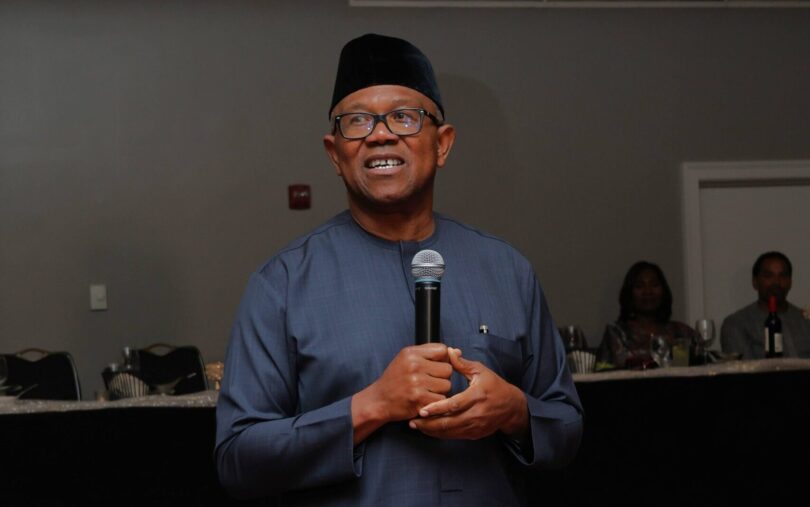
Mr Obi told opposition leaders that worsening economic indicators and insecurity reflect governance failures, calling for collective efforts to rescue the country.
Former Labour Party presidential candidate, Peter Obi, has warned that Nigeria is becoming increasingly divided and drifting towards deeper economic and security crises, urging citizens and political leaders to unite to reverse the trend.
In his address, the former Anambra governor stressed that national unity has become urgent, accusing the current administration of deepening divisions across the country.
“We need to work as a united Nigeria. For the sake of Nigeria, the country is so divided; we need unity. The present government has ensured that it remains more divided,” he said.
He warned that allowing the divisions to persist could worsen the country’s fragile situation, particularly in the area of security.
Citing global terrorism rankings, Mr Obi said Nigeria’s position has deteriorated since the current administration assumed office. According to him, the country has moved from eighth to fourth position, a trend he described as alarming and indicative of worsening insecurity.
“If this trajectory continues, in a few years, Nigeria could rank among the worst-affected countries,” he said, underscoring the urgency of decisive action.
On the economy, the former Anambra State governor painted a grim picture of rising poverty and debt.
He said Nigeria’s poverty rate has increased significantly, with millions more citizens pushed into economic hardship.
Mr Obi also questioned the management of public finances, particularly in relation to the removal of fuel subsidy. He noted that the policy was initially justified as a means of reducing borrowing and freeing up resources for development.
However, he argued that despite the removal of the subsidy, the country’s debt profile has worsened considerably, rising from about ₦87 trillion at the end of the previous administration to nearly ₦200 trillion.
He further alleged that the government is struggling to meet its financial obligations, including payments to contractors, and claimed that implementation of the 2025 budget has been weak, with limited funding for projects.
“We have huge debts, and we have borrowed more, and we are heading to disaster. The reason why I use these short figures is to show you we are drifting,” he said, adding that the figures point to a country in decline.
Mr Obi called for sacrifice and collective responsibility, urging Nigerians to act in the interest of future generations.
“We must now sacrifice for the sake of our children. If we don’t do anything, what is happening will take revenge on us and our children,” he said.
Also speaking at the event, a former National Chairman of the ADC, Ralph Nwosu, highlighted the party’s evolution and ongoing efforts to build a broad-based political coalition.
Mr Nwosu recalled the party’s early struggles, including its initial registration process with the Independent National Electoral Commission (INEC), noting that the ADC has grown from modest beginnings into a platform attracting prominent political actors.
He said the party has consistently prioritised national interest over personal ambition, recounting how its leadership previously opened its structure to broader alliances in a bid to strengthen opposition politics.
According to him, the current coalition efforts reflect years of groundwork aimed at building a credible alternative capable of addressing Nigeria’s challenges.
Mr Nwosu also praised the emergence of former Senate President David Mark as the party’s national chairman, describing his leadership as a turning point for the ADC.
“At this time, nobody is more qualified to lead the party and help deliver the country from its current situation,” he said.
He commended key political figures present at the convention, including former Vice President Atiku Abubakar, as well as other stakeholders, for their roles in strengthening the opposition coalition.