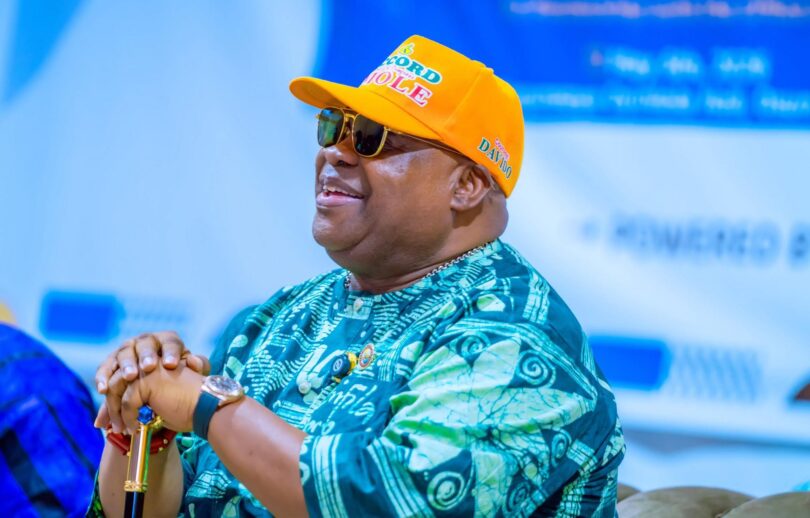
The Accord Party’s victory in Osun has created a new opportunity for the relatively small party to expand its influence ahead of 2027, but its continuing leadership dispute presents a major challenge to consolidating the gains from Adeleke’s re-election.
The Accord Party has emerged from the Osun governorship election with a political victory that could either strengthen its relevance ahead of the 2027 general elections or expose the internal weaknesses threatening its future.
However, while the result represents a major electoral gain for Accord, the party’s leadership crisis may be far from over.
Mr Adeleke’s victory appeared to settle the most important question before the election: who would govern Osun for the next four years?
Now, another question is emerging: What happens to Accord, the party that gave Mr Adeleke the platform on which he secured his re-election?
The question is significant because, days before the election, Christopher Imumolen, who leads a faction of Accord, announced that he was withdrawing the party’s support for Mr Adeleke and endorsing the All Progressives Congress (APC) candidate, Bola Oyebamiji.
The declaration was made at the APC campaign rally in Osogbo and appeared to suggest that Mr Adeleke had lost the support of the party on whose platform he was seeking re-election.
However, the announcement was immediately rejected by another faction of Accord led by Maxwell Mgbudem, who maintained that Mr Adeleke remained the party’s candidate.
Mr Mgbudem insisted that Mr Imumolen was no longer authorised to speak for the party. The party subsequently dismissed Mr Imumolen’s intervention as having no electoral value.
Operationally and for electoral purposes, the Independent National Electoral Commission (INEC) and the mainstream National Working Committee (NWC) have recognised the Maxwell Mgbudem-led structure, which backs Mr Adeleke’s candidacy.
Mr Adeleke subsequently won the election with 511,067 votes, defeating Mr Oyebamiji of the APC, who polled 444,815 votes. The victory secured Mr Adeleke a second term in office.
Rather than bringing the Accord leadership dispute to an end, the election has been followed by a renewed declaration from Mr Imumolen that the battle will continue in court.
Speaking at a press conference in Abuja on Friday, 21 August, Mr Imumolen said the outcome of the Osun governorship election could not determine who leads Accord at the national level.
He said the leadership dispute was a separate national and legal matter that predates Mr Adeleke’s entry into the party and would be pursued “to its logical and lawful conclusion” through the courts.
“The Osun election is an election. The Accord leadership dispute is a national party and legal matter. They are two different issues,” Mr Imumolen said.
He warned against attempts to use the election result, political pressure, media statements or unilateral declarations to settle the leadership dispute.
According to him, the conclusion of the Osun election had not altered the legal proceedings over the party’s leadership, insisting that his faction would continue to pursue the matter until the courts determine the legitimate leadership of Accord.
The leadership crisis within Accord did not begin with the Osun governorship election. The dispute between the factions led by Mr Imumolen and Mr Mgbudem dates back to controversies surrounding the party’s 2024 national convention and subsequent leadership arrangements.
The disagreement later moved into the courts, with the rival camps laying claim to the party’s leadership.
In August 2024, an Abuja High Court ordered INEC to recognise Mr Imumolen as Accord’s National Chairman pending the determination of a substantive suit.
Months later, the Mgbudem-led National Executive Committee announced the expulsion of Mr Imumolen and several other members, citing alleged anti-party activities, gross misconduct and breaches of the party’s constitution.
Mr Imumolen’s supporters rejected the expulsion, arguing that the leadership dispute was already before the courts and that the decision did not resolve the underlying disagreement.
The dispute subsequently spilled into preparations for the Osun governorship election, with competing factions challenging the authority of the Mgbudem-led leadership and seeking to influence the party’s primary and candidate selection.
It was against this backdrop that the disagreement over Accord’s support for Mr Adeleke emerged.
Despite the competing claims, INEC and the Accord Party’s mainstream National Working Committee recognised the Maxwell Mgbudem-led structure as the party’s legitimate leadership. It was this structure that backed Mr Adeleke’s candidacy and operated the party’s machinery for the Osun governorship election.
Mr Adeleke has now won. That victory has changed the political calculation.
For Adeleke, the result could hardly have been better.
He not only retained the Osun governorship, he did so after moving away from the PDP and choosing a party that has historically had a much smaller political footprint.
His victory has, therefore, given him something more valuable than another term in office.
It has given him political leverage.