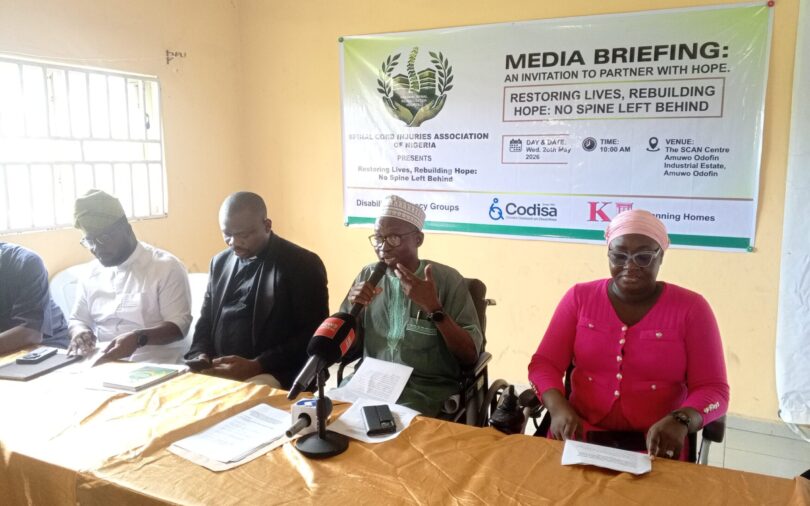
The group urged the government to set up a rehabilitation facility for victims of spinal cord injuries.
The Spinal Cord Injuries Association Centre (SCIAN) has appealed to the Nigerian government to establish a dedicated hospital for the rehabilitation of those with spinal cord injuries.
Mr Matepo highlighted the neglect and lack of attention to rehabilitation issues in Nigeria despite the high incidence of spinal cord injuries due to road crashes, violence and other causes.
“I did my own (rehabilitation) in Germany. She (secretary) did hers in India. You have people like that. If you ask anybody who has done rehab, it’s either India, Germany, the UK, the US, or South Africa,” the disability rights advocate said.
“ There’s no simple rehab work facility for us in Nigeria.”
He noted that disability is a universal possibility that can impact any individual at any moment, highlighting the critical necessity for accessible rehabilitation services.
Spinal cord injury occurs when the spinal cord is damaged, disrupting communication between the body and the brain. It damages the nerves in the spinal column, leading to varying degrees of permanent motor, sensory, and functional impairment.
To help survivors of violence, falls, and road traffic accidents in Nigeria regain their quality of life, comprehensive rehabilitation is essential. Such services are urgently needed to foster independence and prevent potentially life-threatening complications.
Mr Matepo noted that the government allocated some hectares of land to the group for the construction of a rehabilitation centre, but their involvement seems to end there.
He, however, noted that the Lagos State government has contributed by fencing the premises and landscaping, but the purpose of the land has yet to be achieved.
According to Mr Matepo, adjusting to life after a spinal cord injury is difficult.
He noted that the absence of mental health resources and societal barriers to embracing this new reality exacerbate the risks of suicide and depression among survivors.
He explained that at the rehabilitation hospital, the spinal cord injury patients would undergo mental health, physical, occupational and vocational therapy, amongst others.
He said the physical therapy includes training in using wheelchairs and other assistive devices, which is often necessary but not always provided, while occupational therapy helps individuals learn new skills to maintain economic independence and community integration.
Mr Matepo added that mental health therapy is crucial for coping with the psychological impact of the injury, including depression, which is a significant issue amongst spinal cord injury survivors.
He also shared a personal experience of being advised to find ground-floor accommodation after he was discharged from the hospital, six months after the accident that left him wheelchair-bound.
The group’s president said that in 2017, the World Health Organisation (WHO) launched a programme called ‘Rehabilitation 2030,’ and developed a tool to assess how each country is performing.
The initiative aims to recognise rehabilitation as an essential service and integrate it into the healthcare system.
“Recently, they were in Nigeria to deploy the tool, and what they found was far below expectations,” Mr Matepo said.
He noted that Nigeria lacks a rehabilitation policy and that rehabilitation is not mentioned in its health policy.
On his part, David Majekodunmi, an architect and consultant, emphasised the role of a rehabilitation centre in restoring dignity, rebuilding independence and creating hope for individuals with spinal cord injuries.
Mr Majekodunmi noted that the proposed centre would feature a comprehensive range of facilities, including specialised spinal rehabilitation boards, physiotherapy and occupational therapy units, hydrotherapy and mobility training facilities, and vocational and skills-acquisition facilities.