The Senate leader said the period was not a pleasant one for the Senate leadership and the institution as a whole, as it diverted attention from governance and cast a shadow over the institution’s reputation.
The Senate Leader, Opeyemi Bamidele, has recounted the challenges he and other leaders of the upper chamber faced during the suspension of Kogi Central Senator, Natasha Akpoti-Uduaghan, describing the episode as a major distraction from the chamber’s legislative activities.
He maintained that the period was not a pleasant one for the Senate leadership and the institution as a whole, as it diverted attention from governance and cast a shadow over the institution’s reputation.
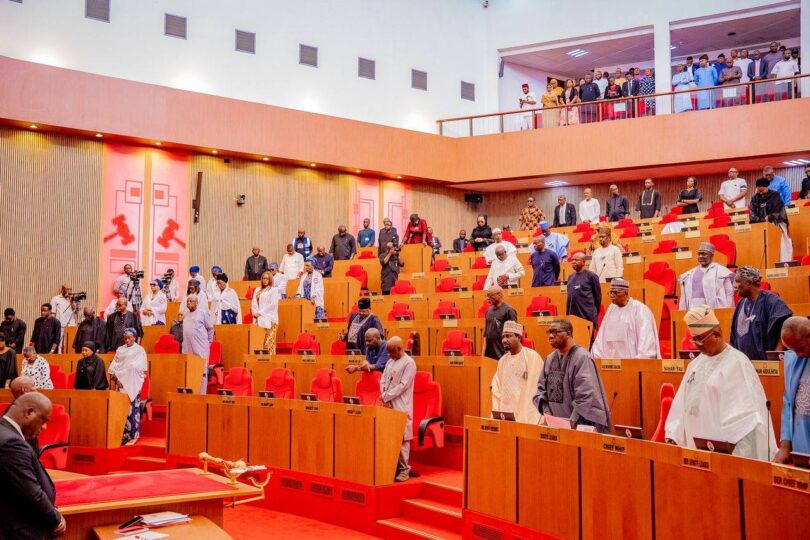
The Senate leader spoke on Monday at a media briefing, highlighting the 10th Senate’s achievements and challenges over the past three years.
Mrs Akpoti-Uduaghan was suspended from the Senate in March 2025 after the Committee on Ethics, Privileges, Code of Conduct and Public Petitions found her guilty of defying the Senate’s seating arrangement and engaging in alleged misconduct during plenary on 20 February 2025.
Before the committee recommended her suspension, the Kogi senator had accused the Senate President, Godswill Akpabio, of sexually harassing her despite his long-time friendship with her husband.
She alleged that Mr Akpabio had, on a separate occasion, insinuated that she should “take care of him” if she wanted her motions to receive favourable consideration on the Senate floor.
The allegation generated controversy both within Nigeria and internationally, casting the National Assembly in a negative light. The matter gained further global attention after Mrs Akpoti-Uduaghan reported the issue to the Inter-Parliamentary Union (IPU), the global organisation of national parliaments.
At an IPU meeting, she spoke emotionally about her suspension, stating that she had been denied d fair hearing and was unable to represent her constituents adequately.
The controversy subsequently led to multiple court cases.
Ekaette Akpabio, wife of the senate president, sued Mrs Akpoti-Uduaghan for allegedly damaging her husband’s reputation. Mr Akpabio also instituted legal action against the senator, while Mrs Akpoti-Uduaghan filed separate suits against both the Senate president and the Senate.
The period was marked by court drama, which many observers said tarnished the image of parliament and its leadership, particularly amid ongoing discussions about gender inclusion and equality in politics.
Mr Bamidele acknowledged that the episode was a significant distraction for the Senate.
“The lowest point was when it looks like there was no order on the floor of the Senate, when it looked like we have no respect for the female gender, when it looked like we were not together as an institution. It was at a time when a senator granted an interview to say the 10th Senate is the worst Senate that this country has produced. We witnessed it.
“It was at a point where rather than to talk about what we are doing about the Senate, the discussion on media platforms almost every morning was about whether or not we did the right thing by suspending a senator or whether the period of suspension was fair enough or was too long.
“So, essentially, that was a major distraction. It wasn’t a happy moment. The work that we were doing and how we were trying to make laws for good governance and the positive things I believe we were doing, that distraction became the news,” he said.
Despite the challenges, Mr Bamidele said the Senate had achieved significant milestones over the last three years.
He said lawmakers had provided effective representation and strengthened oversight of government agencies to ensure the proper utilisation of public funds.
“For achievement, I want to say that this Senate has done a lot working with the executive arm of government to stabilise this economy. We have offered effective representation of the people and at the level of oversight we have also done so much ensuring that agencies followed through monies appropriated to them,” he said.
The senate leader also said the upper chamber had contributed to economic reforms through legislation aimed at increasing government revenue and stimulating growth.
“We try to stabilise the economy. For instance, we made relevant laws to help shore up the revenue of this country, especially those tax reform bills, which, for me, were revolutionary and which, in a matter of years from now, would have helped to turn the economy around, especially in the non-oil sector.
“We had also worked with the executive arm to ensure that our laws in the areas of security exchange, forex exchange, banking and finance are modified in a way that those different industries and sectors would be stabilised.
“We have also made laws in virtually every sector to stabilise things in the economy, education, and health sectors. I have sponsored more than 70 bills, out of which more than 50 per cent are my own personal private member bills, and seven of my private member bills have led to the establishment of at least six federal institutions in this country in the last two years,” Mr Bamidele stated.