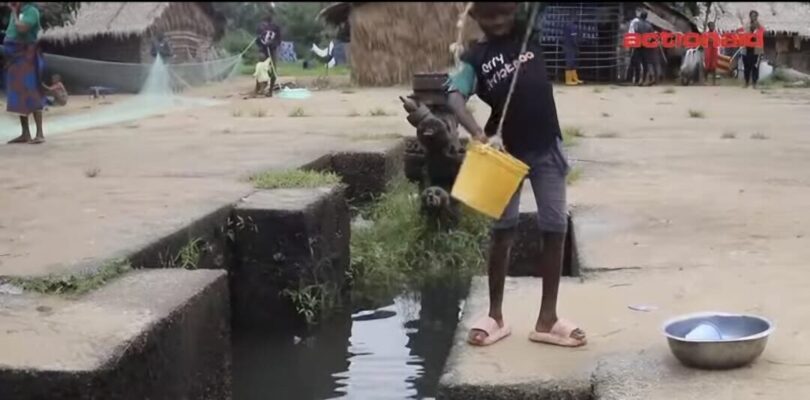
Despite hosting nine oil and gas assets in Akwa Ibom, one of Nigeria’s top oil-producing states, residents of Okoritak still rely on water from a corked oil well, raising fresh questions about how oil wealth translates into development.
Okoritak, an oil-producing community in Ibeno Local Government Area of Akwa Ibom State that hosts nine oil and gas assets operated by some of Nigeria’s biggest energy companies, still depends on water flowing from a corked oil well for drinking and other domestic uses.
The demand was contained in a communiqué issued after a stakeholders’ roundtable on sustainable development organised by the community with support from the Clement Isong Foundation and the Ibeno Youth Advocacy Network.
The meeting, held at the Ibeno Green Youth Hub in Ukpenekang, Ibeno, brought together representatives of Host Community Development Trusts (HCDTs), government institutions, civil society organisations, traditional leaders and community members to discuss practical solutions to the community’s longstanding development challenges.
The latest intervention follows growing concerns over the environmental and social conditions in Akwa Ibom’s oil-producing communities.
Okoritak is among the host communities to nine oil and gas assets operated by major petroleum companies. They include Exxon Mobil‘s Esso Exploration and Production Nigeria (Deepwater Ventures) operating OML 139; Seplat Energy, which operates OMLs 67, 68, 70 and 104; Sterling Oil, operator of OML 13; NEPL/Oando operations still within OML 13; TotalEnergies, which operates OMLs 99 and 100; and Tulcan Energy Exploration and Production Company Limited, operator of Petroleum Prospecting Licence (PPL) 244. Yet despite decades of petroleum production and the establishment of Host Community Development Trusts by some oil companies under the Petroleum Industry Act, residents continue to struggle to access safe drinking water.
Residents of Okoritak depend on water flowing from a corked oil well as their principal source of drinking and domestic water. During a visit to the community in 2024, this reporter witnessed women, children, and other residents fetching water directly from the capped oil well, underscoring the depth of the community’s water crisis despite the presence of multiple oil and gas facilities.
The newspaper has also reported extensively on environmental challenges in Akwa Ibom’s oil-producing communities, including how prolonged gas flaring in the neighbouring Onna Local Government Area has exposed residents to intense heat, environmental degradation and health risks, reinforcing concerns over the quality of life in host communities.
This contrast is more concerning given Akwa Ibom’s public finances. As one of Nigeria’s top oil-producing states, Akwa Ibom receives the largest share of its revenue from the 13 per cent oil derivation fund. PREMIUM TIMES reported that in the first 32 months of Governor Umo Eno’s administration, the state received N2.53 trillion in revenue.
Ibeno Local Government Area, where Okoritak is located, is also not gasping for revenue. Revenue reports from the Federation Account Allocation Committee show that between January and April 2026, the council received N1.914 billion, averaging N478.59 million per month.
Against this backdrop, participants at Thursday’s roundtable observed that despite Okoritak’s strong community leadership and social cohesion, inadequate access to safe drinking water remains one of its most pressing development challenges, with serious implications for public health, sanitation, livelihoods and socio-economic development.
They noted that the Host Community Development Trust framework established under the Petroleum Industry Act provides an important mechanism to address priority infrastructure needs through coordinated planning, targeted investment, and stakeholder collaboration.
The stakeholders stressed that sustainable development in Okoritak would require stronger collaboration among HCDTs, government agencies, traditional institutions, civil society organisations and residents to ensure that interventions are community-driven, inclusive and sustainable.
According to the communiqué, the IFUN Host Community Development Trust committed to undertaking a field assessment of the community to identify opportunities for immediate intervention.
IFUN is an acronym for Ibeno, Frontier, Universal Energy, and Network.
The Ibeno/Seplat Host Community Development Trust also pledged to review its development priorities and consider Okoritak for future potable water projects after confirming that the community’s water challenge remains unresolved.
Similarly, the Oando/NEPL Host Community Development Trust reaffirmed that potable water remains one of its intervention priorities and promised to explore opportunities for supporting water infrastructure in the community.
Participants further emphasised that women, young people and other community stakeholders should play active roles in planning and monitoring development projects to promote transparency, accountability and long-term sustainability.
Among the resolutions adopted at the meeting was a call for all Host Community Development Trusts operating in the Ibeno Local Government Area to prioritise investment in safe, sustainable drinking water as a critical intervention to improve residents’ well-being.
They also called on the Akwa Ibom State Rural Water Supply and Sanitation Agency, as well as relevant ministries and agencies,s to strengthen collaboration with host community development trusts to expand access to rural water infrastructure and other essential social services.
The stakeholders expressed confidence that the commitments secured during the roundtable could provide a practical foundation for resolving Okoritak’s longstanding potable water crisis if backed by concrete implementation.