At least 12 governors are approaching the end of their constitutionally allowed two terms, with many already positioning themselves for seats in the Senate.
With a few months to the 2027 general elections, Nigeria’s political class is already witnessing a familiar migration pattern: outgoing governors preparing soft landings in the Senate, the country’s highest legislative body.
For many of these governors, the question is no longer whether they will remain politically relevant after leaving office, but where they intend to relocate within Nigeria’s power structure. Increasingly, the preferred destination is the Senate, the upper chamber of the National Assembly.
The growing migration has become so pronounced that in the current 10th National Assembly, 14 former governors occupy seats in the Senate, reinforcing a long-standing pattern in which state executives move almost seamlessly from Government House to the Red Chamber.
This trend has transformed the composition and power dynamics of the upper chamber, where former governors now rank among the most influential blocs because of their extensive political networks, financial resources and executive experience.
The jostling has intensified following the conclusion of the APC senatorial primaries held on Monday, 18 May, where several outgoing governors either secured the party’s tickets directly or consolidated their grip on party structures ahead of the 2027 elections.
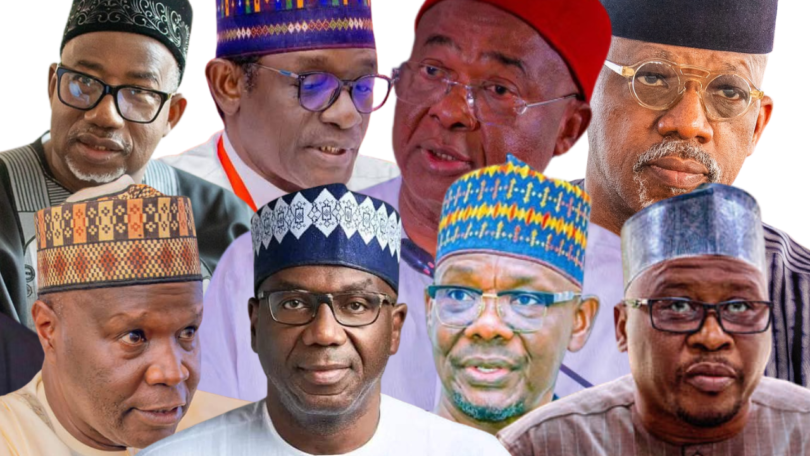
Among the governors nearing the end of their tenure are AbdulRahman AbdulRazaq (Kwara), Abdullahi Sule (Nasarawa), Ahmadu Fintiri (Adamawa), Babajide Sanwo-Olu (Lagos), Babagana Zulum (Borno), Bala Mohammed (Bauchi), Dapo Abiodun (Ogun), Mai Buni (Yobe), Inuwa Yahaya (Gombe), and Seyi Makinde (Oyo), who recently declared his intention to run for president.
Messrs Douye Diri and Hope Uzodimma will also conclude their second terms in January and February 2028, respectively.
Although not all have publicly declared senatorial ambitions, no fewer than eight governors have already entered the race either directly or through endorsements by political stakeholders, while at least seven APC governors have already secured senatorial tickets following the ruling party’s primary elections.
Among those with perhaps the clearest route to the Senate is Governor Fintiri of Adamawa State.
The governor’s ambition for the Adamawa North Senatorial seat received a major boost after the incumbent senator, Amos Yohanna, stepped aside in his favour.
Mr Yohanna announced his withdrawal during a stakeholders’ gathering in Mubi, where Mr Fintiri received his N20 million nomination forms.
“My resolve to support Governor Fintiri is guided by personal conviction and loyalty to our people,” the senator said.
The endorsement of Mr Fintiri, who recently moved from the PDP to the APC, demonstrated the immense influence sitting governors still wield within party structures and electoral calculations in their states.
It also highlighted a recurring political reality in Nigeria: lawmakers often struggle to withstand the political machinery of outgoing governors.
Mr Fintiri eventually emerged as the winner of the APC senatorial primary for Adamawa North, further consolidating his transition from Government House to the Red Chamber ahead of the 2027 general election.
A similar scenario is unfolding in Yobe State, where Governor Buni appears to be enjoying institutional backing for his Senate ambition.
The senator representing Yobe East District, Musa Mustapha, did not only withdraw from seeking a second term but also openly endorsed Mr Buni for the seat.
According to him, the decision followed a stakeholders’ meeting of the Yobe APC Critical Stakeholders’ Forum held at the Government House in Damaturu and convened by Mr Buni alongside the Minister of Police Affairs, Ibrahim Geidam, a former governor of the state.
“To exercise the spirit of integrity and responsibility, I hereby formally withdraw from the contest for the APC governorship ticket,” Mr Mustapha said.
“Additionally, to make it explicitly clear, I am not contesting the senatorial ticket; rather, I will fully support our leader, His Excellency, Governor Mai Mala Buni, to contest the senatorial seat.”
Following the APC primary, Mr Buni secured the party’s senatorial ticket for Yobe East after emerging unopposed.
Abdullahi Sule is also among the outgoing governors positioning strongly for a Senate return.
The Nasarawa governor is seeking the Nasarawa North Senatorial seat which is currently vacant as a result of the passing of Godiya Akwashiki who occupied the seat until his death on 31 December, 2025.
He eventually clinched the APC senatorial ticket for Nasarawa North following the party’s primary election.
The development in Imo State is uniquely interesting. Governor Hope Uzodimma purchased nomination forms under the APC to contest for the Imo West Senatorial seat, even though his tenure comes to an end in February 2028.
Mr Uzodimma previously represented Imo West in the Senate from 6 June 2011 to 9 June 2019 before becoming governor in 2020, making a possible return to the National Assembly both politically strategic and symbolically significant.
His contenders, a former governor and a former senator of Imo State, Rochas Okorocha and Osita Izunaso, also sought the APC ticket to represent the district in the upper chamber.
While Mr Okorocha represented the district from 2019 to 2023, Mr Izunaso is the incumbent senator. The trio are members of the APC.
Speculations have intensified that Mr Uzodimma had perfected plans to resign his position as governor to pursue his senatorial ambition, saying that he had struck a deal with his deputy, Chinyere Ekomaru, to resign her position, which will pave the way for the appointment of a new deputy governor.