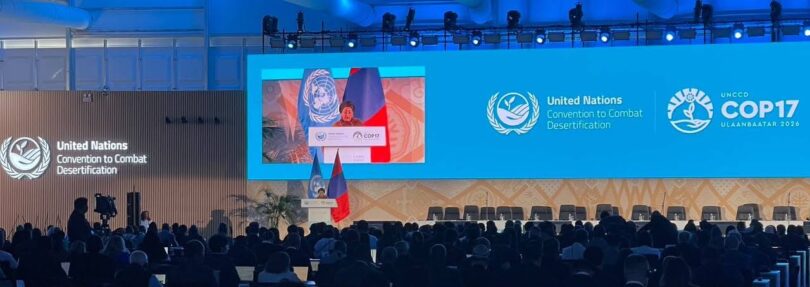
As UNCCD COP17 enters its final days in Ulaanbaatar, Mongolia, negotiators remain divided over a proposed global drought instrument, finance for land restoration, rangeland management and the participation of Indigenous Peoples and local communities.
It is the 10th day of the ongoing two-week negotiations at the 17th session of the United Nations Convention to Combat Desertification (UNCCD COP17), with the conference entering its final and most critical phase.
With less than 72 hours to the scheduled conclusion of negotiations on Friday, tensions and disagreements have emerged across the plenary and negotiation rooms as parties struggle to reach consensus on some of the key issues on the COP17 agenda.
The disagreements began early in the conference, with procedural and substantive differences among parties over several agenda items. Indigenous peoples, civil society organisations and young people have also raised concerns about their participation in the formal process, insisting that their voices must be heard in decisions that directly affect their communities and livelihoods.
COP17 kicked off in Mongolia’s capital, Ulaanbaatar, on 17 August under the theme “Restoring Land. Restoring Hope” and is scheduled to conclude on 28 August.
According to the United Nations, the conference brings together delegates from UNCCD’s 197 Parties, alongside government, business and civil society leaders, scientists, young people, Indigenous Peoples, pastoralists and smallholder farmers.
They are deliberating on solutions to the interconnected challenges of desertification, land degradation and drought, with a focus on how land restoration can reduce instability, prevent displacement and strengthen human and national security in vulnerable regions.
PREMIUM TIMES gathered that at least 60 delegates from Nigeria are expected to participate in the conference.
“Land is our most vital infrastructure — underpinning food security, water, livelihoods and stability. When land fails, insecurity rises — through lost livelihoods, forced displacement and increased competition over scarce resources,” UNCCD Executive Secretary Yasmine Fouad said.
“With UNCCD COP17, Mongolia is offering the world a powerful message: Restoring Land, Restoring Hope is not only an environmental agenda, but a development and resilience priority.”
She said that as drought intensifies and land degradation accelerates, the conference must promote practical, investable solutions, including restoring degraded land and soils and strengthening the land-water nexus, to enable communities to thrive.
According to the UNCCD Data Dashboard, approximately 11.96 per cent of Africa’s total land area was recorded as degraded in baseline reporting. In comparison, Nigeria reports roughly 23.41 per cent, or 21.07 million hectares, of its total land area as degraded.
In Nigeria, authorities have said more than 50 per cent of the country’s rangelands and grazing routes have been degraded, a development that has contributed to farmer-herder conflicts affecting communities across the country for decades.
Nigeria, alongside other African countries, is seeking progress towards a legally binding international instrument on drought management. The proposed instrument would establish a stronger framework for countries to anticipate, prepare for and manage drought.
Finance is another major issue. Nigeria’s focal point to the UNCCD has said increased financing is crucial to securing support for national needs, including implementation of the country’s climate and adaptation plans.
However, developments in the negotiating rooms indicate that parties remain divided over the scope and nature of the proposed drought framework, raising concerns that unresolved issues could be pushed to a future COP.
The major issues emerging from the negotiations so far include drought management and land degradation, finance, rangelands and pastoralists, Indigenous Peoples and local community participation, and procedural and geopolitical tensions.
Perhaps the most contentious issue is the push for a global framework or instrument on drought management.
African countries, small island developing states and other vulnerable countries have been advocating stronger international action, including a legally binding instrument.
However, some developed countries and other parties have expressed reservations about a binding agreement, citing concerns around its financial implications, implementation and the duplication of existing international frameworks.
The disagreement has raised the possibility that negotiations could extend beyond COP17 if parties fail to find common ground.
The UNCCD Deputy Executive Secretary, Andrea Meza, acknowledged the divergent positions during a press conference on drought.
“We’re in the middle of the negotiation and what we’re seeing is different positions,” she said.
“We’re hearing some positions that are saying this should be addressed as a local event and we’re just here to share certain experience, but this is more an issue that needs to be addressed at the national level.”
However, she said this was not the position of most parties.
“Most of the parties are recognizing that this is a global challenge, and it should require and bring global solutions.”
Ms Meza said she remained hopeful that countries would reach an agreement.
“Maybe we will not agree, but I’m hopeful that in this we will get an agreement because I feel, and I think that most of the countries, this year with Super El Nino, they’re facing a lot of challenges right now, and they cannot go back to their cities, to their constituencies, and say, uh, nothing is coming out as a negotiated outcome from this.”
She added that the negotiations were only one part of the solution.
“But as I was saying, more than just what happened in the negotiation is just one of the pieces. We also need the action.”