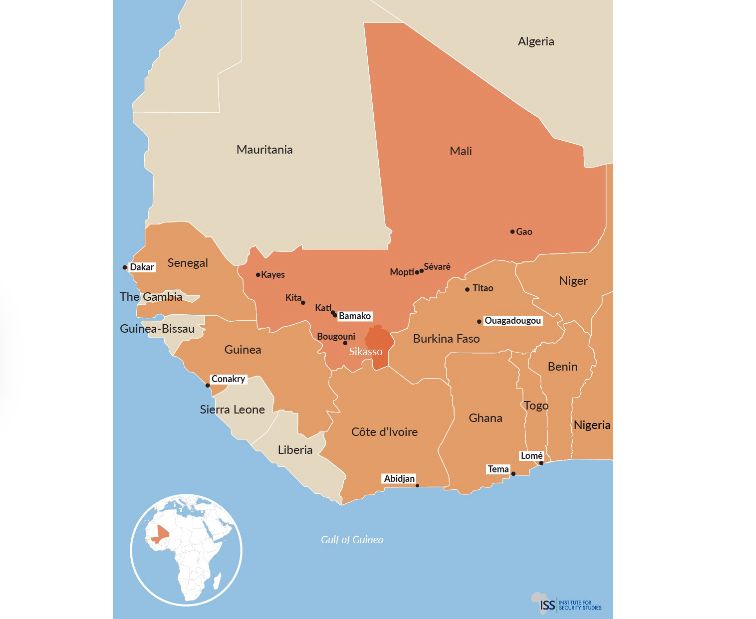
Recent terror attacks across Mali have intensified JNIM’s blockades of vital transport routes connecting port cities to Sahelian capitals.
On 25 April, Mali was struck by a series of coordinated attacks carried out by Jama’at Nusrat al-Islam wal Muslimin (JNIM) and the Azawad Liberation Front (FLA). The assaults targeted the towns of Kati, Mopti, Sévaré, Gao and the capital Bamako, resulting in numerous casualties, and the assassination of Defence Minister Sadio Camara.
Five days after the attacks started, JNIM imposed a blockade on the capital, specifically along western routes. The obstruction of the road between Kita and Bamako has trapped hundreds of people, making the supply of food and water difficult.
The siege also disrupts trade flows, which have been halted on the Kayes-Bamako axis. Intensification of the blockade is now resulting in attacks on transport convoys along the previously relatively safe Conakry-Bamako axis.
Since September 2025, Mali has been subjected to a strategy of asphyxiation aimed at cutting off essential supplies entering and circulating within the country. By intensifying offensives against fuel convoys in the south and west, JNIM is paralysing national commerce and trade. But this is extending beyond Malian borders, threatening regional economic activity.
West African countries are closely linked by trade. Coastal states’ ports are the primary gateways and exit points for the central Sahel. The road corridors connecting these ports to Sahelian capitals and beyond are lifelines – and most pass through JNIM operational zones.
The Dakar-Bamako corridor is a strategic axis for Senegal and Mali and appears most affected by insecurity in western Mali. Mali was Senegal’s top customer in 2024, accounting for 26.5 per cent of Senegalese exports (around 802.8 billion FCFA or $1.42 billion). During the first nine months of 2025, cumulative Senegalese exports to Mali were estimated at 662 billion FCFA ($1.17 billion).
Senegal’s Directorate of Forecasting and Economic Studies reports that JNIM attacks in western Mali have significantly impacted trade between the countries since 2024.
Between September and November 2025, the Port of Dakar recorded a daily blockage of around 120 containers bound for Mali – an estimated monthly loss for Senegal of 15 billion FCFA ($26.54 million). Over 2,000 containers were stranded in Dakar by late November 2025. By February 2026, around 4,000 empty containers were stuck in Bamako, with truck drivers too afraid to take the dangerous route back to Dakar.
This significantly reduces Mali’s supply of petroleum products, refined goods, hydraulic cement and food products. It also constrains the livelihoods of thousands of drivers, traders and freight forwarders. Other corridors, particularly those connecting ports in Côte d’Ivoire, Ghana, Togo and Benin to the Sahel, could face similar risks.
In 2025, Mali maintained its position as Côte d’Ivoire’s top customer in the West African Economic and Monetary Union (WAEMU). The Abidjan-Bamako corridor is vital for Mali’s supply of petroleum and food products. By the end of 2025, roughly 1.47 million tonnes of goods were transported via this corridor, which has come under JNIM attack in the Sikasso region.
Côte d’Ivoire is also Burkina Faso’s top African supplier of primarily petroleum products, electricity and fertilisers. Imports into Burkina Faso either originate from or transit through Côte d’Ivoire, Ghana and Senegal. On 14 February this year, seven Ghanaian tomato traders were killed in a JNIM attack in Titao, northern Burkina Faso, illustrating the security risks on the road connecting the two countries.
With the terror threat currently most prevalent in Mali, authorities have adopted several measures, including military-escorted fuel convoys allowing for the entry of around 200 to 300 tanker trucks a week since last November.
The government also signed a memorandum of understanding with Malian petroleum groups to streamline and accelerate customs procedures, and implemented a system to limit refuelling and curb the black market. Attempts are also being made to reduce trade loads in the Dakar and Abidjan ports by shifting trade flows to other harbours.
Le Monde reported a truce between Bamako and jihadist groups until Eid al-Adha in exchange for 100 detainees accused of terrorism. But attacks have continued, and Mali’s army has denied that negotiations ever took place.
The 25 April attacks show the limits of Mali’s military response to terrorism. And while JNIM and the FLA could set aside their differences to carry out these major incursions, the Sahelian and coastal states find it difficult to make alliances.
The regional implications of JNIM’s blockades highlight the need for joint protection of border trade corridors. Governments and regional institutions – such as the Economic Community of West African States, Alliance of Sahel States, Conseil de l’Entente, Mano River Union and WAEMU – need to prevent the expansion of JNIM tactics to other road corridors.
Counter-terrorism efforts could provide the impetus for revitalising much-needed regional cooperation between West Africa’s coastal and Sahelian states.
Felix Fodé Bongono is a Bosch Research Fellow in the Institute for Security Studies (ISS) Regional Office for West Africa and the Sahel.
(This article was first published by ISS Today, a Premium Times syndication partner. We have their permission to republish).