…Experts Fault Defence Spending Priorities, Seek Funding Overhaul
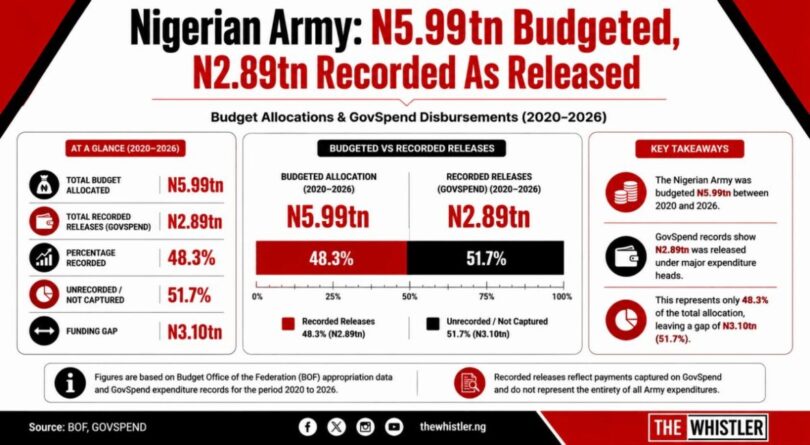
Between 2020 and 2026, the Nigerian Army received a total budgetary allocation of N5.99tn from the Federal Government, NEWSNGR investigations have revealed.
Yet, across battlefields in the North-East and other conflict zones, high-ranking officers—from lieutenant colonels to brigadier generals—have continued to die in insurgent attacks, ambushes and improvised explosive device (IED) explosions.
An investigation by NEWSNGR, based on an analysis of Budget Office of the Federation (BOF) appropriation data and GovSpend disbursement records, revealed that while the Army was allocated N5.99tn over the seven-year period, actual releases captured on the Federal Government’s expenditure portal stood at N2.89tn, representing less than half of the total allocation.
The BOF data showed that personnel costs accounted for N5.02tn of the Army’s budget between 2020 and 2026, overhead stood at N307.4bn, while capital expenditure totalled N667.9bn.
This places personnel spending at about 83.7 per cent of the total allocation, with overhead accounting for 5.1 per cent and capital expenditure making up 11.1 per cent, underscoring the heavy concentration of defence spending on salaries and personnel-related obligations.
A year-by-year breakdown also showed a steady increase in appropriations throughout the review period.
The Army received N463.4bn in 2020, rising by 10.2 per cent to N510.6bn in 2021. Funding increased further to N580.8bn in 2022 before climbing to N665.1bn in 2023.
The upward trajectory continued in 2024 when the allocation rose to N789.8bn, an 18.8 per cent increase from the previous year.
The biggest increase came in 2025 as the Army’s budget almost doubled to N1.48tn which is an increase of 88.1 per cent increase over 2024.
For 2026, the appropriation rose marginally to N1.50tn, bringing cumulative allocations for the seven-year period to N5.99tn, an overall increase of about 224.8 per cent from the 2020 figure.
However, GovSpend records tracking actual payments present a different picture.
An analysis of expenditure data on the Federal Government’s transparency portal showed that a cumulative N2.89tn had been released to the Nigerian Army under major expenditure heads during the period under review.
This represents about 48.3 per cent of the N5.99tn appropriated for the Army over the seven years.
The disbursement records show that Non-Regular Allowances accounted for the largest share of releases at N2.16tn, followed by Capital Expenditure with N483.55bn.
Overhead releases stood at N135.96bn, while Internal Security Operations received N117.37bn, bringing the total amount disbursed through the tracked expenditure heads to N2.89tn.
A comparison of both datasets revealed noticeable differences between budgetary provisions and recorded releases.
While N667.9bn was earmarked for capital projects over the period, GovSpend records showed N483.55bn in capital disbursements, leaving a gap of about N184.35bn.
Similarly, although overhead was budgeted at N307.4bn, releases captured on GovSpend amounted to N135.96bn.
Personnel allocations were budgeted at N5.02tn, while GovSpend specifically records N2.16tn under Non-Regular Allowances, a personnel-related expenditure category, though this does not represent the entirety of personnel payments.
The recorded amount is about 43 per cent of the budgeted allocation, leaving a difference of approximately N2.86tn (57 per cent)
The comparison illustrates that while appropriations outline government spending intentions, actual releases reflect the pace and extent of implementation.
These funding trends unfolded as the military continued sustained operations against Boko Haram and the Islamic State West Africa Province (ISWAP), alongside other internal security threats across the country.
However, NEWSNGR contacted the Nigerian Army’s Acting Director of Public Relations, Lt. Col Appolonia Anele, following its findings, but messages and calls sent via WhatsApp received no response.
Despite rising allocations and trillions of naira in recorded releases, the loss of senior officers has persisted, particularly in recent years, with insurgents increasingly targeting frontline commanders.
In April 2026, Brigadier General Oseni Braimah, commander of the 29 Task Force Brigade under Operation Hadin Kai, was killed during a Boko Haram attack on a military base in Benisheikh, Borno State.
The insurgents launched a coordinated assault on the installation, engaging troops in a fierce battle before the attack was eventually repelled.
Days later, Colonel I.A. Mohammed was killed after his vehicle struck an improvised explosive device while responding to an ongoing attack in Monguno, Borno State.
According to the Media Information Officer, Headquarters Joint Task Force (North East), Operation HADIN KAI, Lieutenant Colonel Sani Uba, the troops were successful in repelling the attack, prior to their death.
In March 2026 alone, multiple senior officers were killed in separate insurgent attacks across Borno State, highlighting the growing intensity of assaults on military formations.
Lieutenant Colonel Umar Faruq, commander of the Kukawa military camp, was killed after insurgents stormed the base under the cover of darkness, overpowering troops and setting military vehicles ablaze.
Within the same period, Lieutenant Colonel S.I. Iliyasu, commander of the 2nd Battalion in Konduga, was killed during a coordinated ISWAP attack that formed part of a broader wave of offensives against military formations in the state.
Also in March, Major U.I. Mairiga, commander of the Mayanti military camp in Bama, lost his life after insurgents overwhelmed the base during an overnight raid.
Earlier in January 2026, a Major who commanded the Damasak military camp was killed after troops were ambushed by ISWAP fighters. Reports indicated that he was later executed alongside other military personnel and members of the Civilian Joint Task Force.
The pattern had also emerged in 2025. In November, Brigadier General M. Uba, commander of the 25 Task Force Brigade in Damboa, was killed after insurgents tracked and ambushed his convoy along the Damboa–Biu road.