As the onslaught against the International Criminal Court continues, champions of justice must back global accountability through action.
On 17 July 1998 in Rome, the world made its support for international justice clear by adopting the statute establishing the International Criminal Court (ICC). Since 2010, the 17th of July has been commemorated as International Justice Day.
Yet, 28 years later, the ICC and international justice are in crisis – and hope for universal accountability is shrouded by the ICC’s operational and external challenges. The United States (US) has threatened to dismantle the court, and Burkina Faso, Mali and Niger have submitted their notices to withdraw from its statute.
Add to that an embattled ICC prosecutor, delays and cases collapsing due to non-cooperation and other targeted efforts to undermine the court’s work.
On 13 July, US Secretary of State Marco Rubio announced a ‘sweeping campaign to dismantle the threat posed by the ICC to US sovereignty.’ The campaign promises to ‘systematically disable the ICC’s ability to operate.’ Especially worrying actions include pressuring countries receiving US military or other support to reject the court’s authority.
The move has been widely criticised (including by the European Union) and reignited debates about international justice, the rule of law and the ICC’s role in ensuring accountability for grave human rights violations.
Washington’s campaign is not new. In the court’s early days, the US became the first country to ‘unsign’ the Rome Statute. Concerned that its own soldiers would be prosecuted for crimes committed abroad, George W Bush’s administration entered into over 100 bilateral immunity agreements to shield US citizens from ICC prosecution.
Subsequent administrations under Barack Obama and Joe Biden, while not endorsing the ICC, asserted support for global accountability, even appointing special war crimes envoys and establishing a global justice office.
Recent ICC cases against Israeli leaders for war crimes and crimes against humanity have hardened Washington’s position. President Donald Trump’s February 2025 executive order described ICC investigations as ‘illegitimate and politically motivated.’
His administration has since imposed sanctions on ICC judges and prosecutors involved in the cases, United Nations experts who have accused Israel of committing genocide against Palestinians and non-governmental organisations (NGOs) operating in the occupied Palestinian territories.
Niger, Mali, and Burkina Faso’s arguments for withdrawing from the ICC are also not new and have dogged the court for decades. They accuse the court of unfairly targeting Africa and serving as an instrument of neo-colonialist repression.
Rebuttals from the court’s supporters are consistent. By investigating international crimes in Africa (and elsewhere), the ICC serves victims and survivors and advances justice. But the current anti-ICC onslaught demands more than rebuttals and solidarity. It requires states that support the rule of law and accountability to be more assertive.
The ICC isn’t meant to be the sole court adjudicating international crimes. In a world where states investigated, prosecuted and adjudicated such crimes themselves, the court would operate only in exceptional cases – when states are unable or unwilling to act.
Being more assertive isn’t just about supporting the ICC’s work; it involves states ensuring accountability themselves, whether alone or collectively. It also requires law associations, NGOs and civil society to push back against backsliding.
Many efforts to advance justice are lost in the noise of attacks on institutions like the ICC. Support for the ratification of the crime of aggression is one example. Others include new international justice instruments, such as the Ljubljana-The Hague Convention (adopted in 2023) and the Draft Articles on Prevention and Punishment of Crimes Against Humanity (adoption expected by 2029).
These initiatives could enhance cooperation and support more effective state participation, both key to domestic justice efforts.
Many countries also apply universal jurisdiction to investigate and prosecute genocide, crimes against humanity and war crimes committed elsewhere, leaving alleged perpetrators fewer places to hide from accountability.
In Africa, there are some glimmers of hope. Many African countries, including states not party to the ICC statute, like Ethiopia and Zimbabwe, have domestic laws criminalising war crimes and genocide, enabling domestic prosecutions.
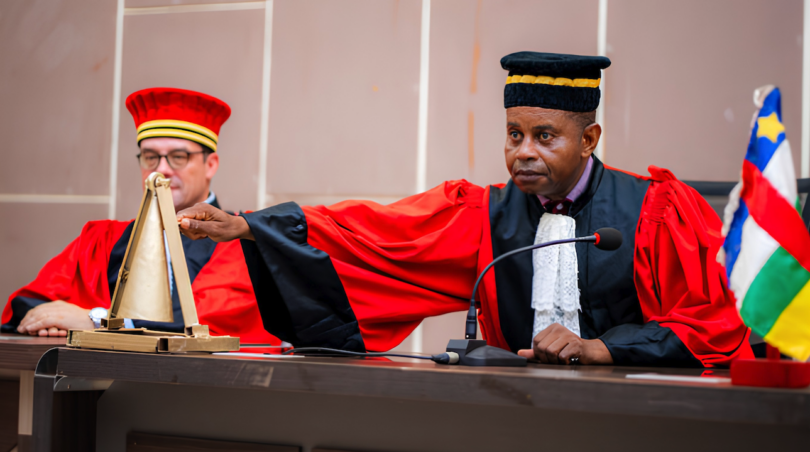
Last month, the Central African Republic’s hybrid Special Criminal Court opened the trial of former president François Bozizé and his co-accused, Eugène Ngaïkosset, Vianney Semndiro and Firmin Danboy, for crimes against humanity. Meanwhile, the DRC has formed a new international advisory council of senior war crimes lawyers to support its push for accountability for atrocities in its ongoing conflict.
South Africa has galvanised support for its case against Israel at the International Court of Justice, focusing on the Genocide Convention. Eighteen countries have submitted interventions backing South Africa’s case. Another 14 have formally voiced support, including Algeria, the Comoros, Djibouti, Egypt, Libya, Namibia, Western Sahara and Zimbabwe. The African Union, the Arab League, the Organisation of Islamic Cooperation, and the Non-Aligned Movement also officially support the case.
Elsewhere in Africa, lawyers are pushing for the application of universal jurisdiction to address crimes committed outside their own jurisdictions. In Kenya, the Office of the Director of Public Prosecutions is assessing a request from Legal Action Worldwide and the African Centre for Justice and Peace Studies to investigate members of Sudan’s Rapid Support Forces for war crimes and crimes against humanity.
As states take greater ownership of accountability for international crimes, sustained financial and political support for investigations, together with stronger cooperation with international accountability mechanisms, is needed.
The ICC may be under threat, but the international justice system mustn’t crumble as a result. Wider efforts to advance accountability for international crimes are a reminder that the global justice system extends far beyond the ICC. States are responsible for closing the impunity gap – and doing so reinforces justice.
Ottilia Anna Maunganidze is Head of Special Projects at the Institute for Security Studies (ISS).
(This article was first published by ISS Today, a Premium Times syndication partner. We have their permission to republish).