The summit arrives against a paradox that has long defined African agriculture: a continent rich in arable land, labour and appetite, yet still dependent on imports to feed itself
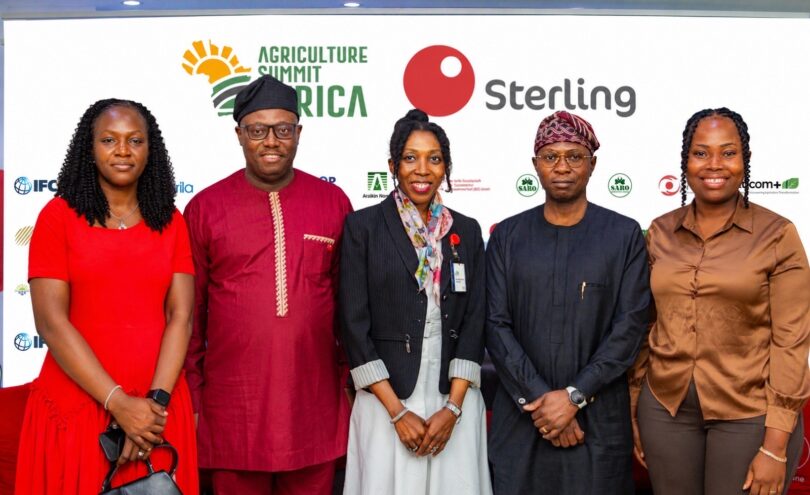
Africa’s drive to transform from a net food importer into a global agricultural powerhouse takes center stage this September as Agriculture Summit Africa (ASA) returns for its ninth edition. Operating under the theme “Building the Next Superpower: Africa’s Food Power Play,” the continent’s premier agricultural event will hold in Abuja on 15 and 16 September 2026. Convened by Sterling Bank, the summit was unveiled at a high-profile press conference in Lagos, where the bank’s leadership united with public sector representatives, development partners and agribusiness pioneers to set the agenda for the continent’s food future.
In his remarks, Dele Faseemo, Group Executive, Corporate and Investment Banking at Sterling Bank, located agriculture at the centre of the bank’s HEART strategy, covering Health, Education, Agriculture, Renewable Energy and Transportation. He noted that in 2025, Sterling’s financing across these sectors grew by 39 percent to ₦331.7 billion, with agriculture recording one of the sharpest increases.
“When Sterling talks about agriculture, we are speaking as a bank that puts its balance sheet where its convictions are; behind the farmers, processors, off-takers and agribusinesses doing the hard, unglamorous work of turning Nigeria’s land into livelihoods,” Faseemo stated, emphasising the Bank’s active role.
Speaking to the strategic importance of ASA 2026, Dr Olushola Obikanye, Group Head, Agric Finance and Solid Minerals at Sterling Bank, framed the continent’s food story as a massive economic opportunity, pointing out that Africa holds roughly 60 percent of the world’s uncultivated arable land yet spends tens of billions of dollars every year importing food it could produce itself.
“Food is jobs. Food is trade. Food is foreign exchange, industrial policy, climate resilience, and increasingly, geopolitical power. Hence, the continent that feeds itself and competes globally will hold real strategic weight. That is Africa’s food power play,” he said.
Turning to Nigeria, the speakers acknowledged the constraints still facing farmers including finance, quality inputs, mechanisation, storage, logistics and market access, alongside persistently high post-harvest losses. They welcomed the Federal Government’s positioning of food security at the centre of its agenda, citing the National Agricultural Mechanisation Policy and a 10-year agrifood system strategy aligned with the African Union’s Kampala Declaration, but stressed that transformation would require a coalition beyond government or any single institution.
Christian Mulamula, Principal Country Officer for Nigeria at the International Finance Corporation, underscored that Africa’s agricultural transformation must go beyond increasing production to building an enabling ecosystem where farmers and agribusinesses can access the finance, technology, inputs, infrastructure, and markets required to thrive.
“ASA is a platform for bringing together policymakers, investors, financial institutions, agribusinesses, technology providers, and development partners to accelerate investment and strengthen Africa’s food systems. At the World Bank Group, we believe that accelerating sustainable development requires public and private sector solutions working together to translate development priorities into investable opportunities, mobilising capital to build stronger and more competitive businesses, and turn business growth into jobs, improved livelihoods, and greater economic opportunities for people.”
Reflecting this multi-sector backing, ASA 2026 brings together an extensive coalition of development finance institutions, agri-technology providers, private sector leaders, and government agencies to align around a shared ambition. Supported by a broad network of partners including the International Finance Corporation (IFC), IDH, Arila Group, Noor Takaful, Saroafrica International Limited, Propcom+, YAPU Solutions, GIZ, Sterling One Foundation, XtraLarge Farms, Maang Agric, Arzikinoma, Leadway Assurance, British American Tobacco Nigeria (BATN), Mastercard, FarmKart, EcoTutu, JR Farms, Lagos State Employment Trust Fund (LSETF), Lagos State Ministry of Agriculture and Food Systems (LSMAFS), Cavola, Agrify, EU–Nigeria Gateway, and Whole Eats, the summit underscores a unified vote of confidence in the continent’s agricultural future.
Designed as an action-oriented platform, Agriculture Summit Africa 2026 will serve as a marketplace of ideas, capital, and partnerships, where policymakers hear directly from the value chain, investors meet real opportunity, and the narrative of African agriculture shifts from crisis to enterprise and scale. The two-day gathering will feature high-level plenary sessions, strategic deal-making rooms, innovation showcases, and cross-border trade roundtables to turn conversation into measurable impact. Stakeholders, investors, and industry pioneers are invited to be a part of the engagement by registering atwww.agricsummit.org.