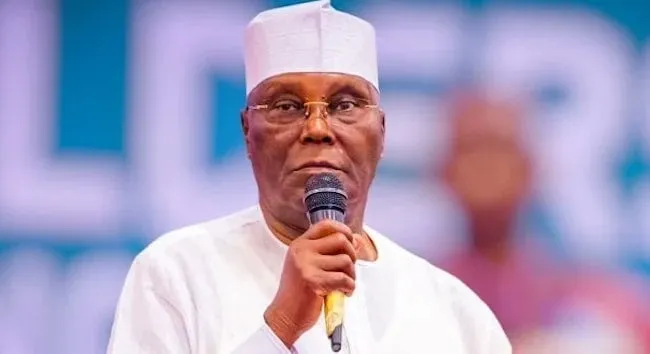
Former Vice President and presidential candidate of the African Democratic Congress, ADC, Atiku Abubakar, has launched a fresh attack on President Bola Tinubu, accusing his administration of being defined by recurring scandals rather than isolated controversies.
Mr Atiku, in a statement issued on Sunday by his Senior Special Assistant on Public Communication, Phrank Shaibu, argued that the Tinubu administration had reached a stage where scandals had become a pattern of governance, declaring that “the government itself has become the scandal.”
The former vice president’s remarks come amid the controversy surrounding the purported Presidential Foreign Intervention Promotion Council, PFIPC, which he described as the latest in a series of unresolved controversies under the current administration.
Drawing on an African proverb, Mr Atiku said when a man’s roof leaks every rainy season, people eventually stop blaming the weather and begin questioning the strength of the house.
“Nigeria has sadly arrived at that point. The issue is no longer one scandal or another. The issue is the pattern. And when scandals become a pattern of governance, the inevitable conclusion is this: you are no longer managing scandals; you have become the scandal itself,” he said.
According to him, the PFIPC controversy was not merely another embarrassment for the Federal Government but part of what he described as an expanding catalogue of unresolved scandals marked by investigations that begin with fanfare but end in silence.
The Waziri Adamawa said Nigerians should be more concerned about what he termed a recurring cycle in which allegations emerge, committees are set up, promises of accountability are made, only for investigations to fade from public attention without conclusive outcomes.
He cited the suspension of a former Minister of Humanitarian Affairs over allegations of financial impropriety, saying although investigations were announced and recoveries publicised, Nigerians were still waiting for a comprehensive account of the findings and measures taken to prevent future occurrences.
Mr Atiku also referred to lingering questions surrounding transparency and financial disclosures at the Nigerian National Petroleum Company Limited, NNPCL, alleging that repeated demands for greater accountability had remained unanswered.
He further listed what he described as unresolved controversies involving allegations of crude oil theft, illegal tanker releases, discrepancies in the 2024 budget, expenditure on refinery rehabilitation despite the continued poor state of public refineries, procurement issues involving major infrastructure projects, opaque contract awards and appointments of individuals linked to unresolved allegations.
According to him, the repeated emergence of such issues has eroded public confidence in government institutions.
“The pattern itself has become the scandal,” he said.
The former vice president alleged that government agencies often act swiftly when allegations involve ordinary citizens or politically vulnerable officials, but become slow and reluctant whenever investigations touch influential individuals.
He argued that such selective accountability creates the impression that Nigeria operates two different systems of justice—one for the powerful and another for ordinary citizens.
“A democracy is not measured by how quickly it moves past controversy. It is measured by how honestly it confronts it,” he stated.