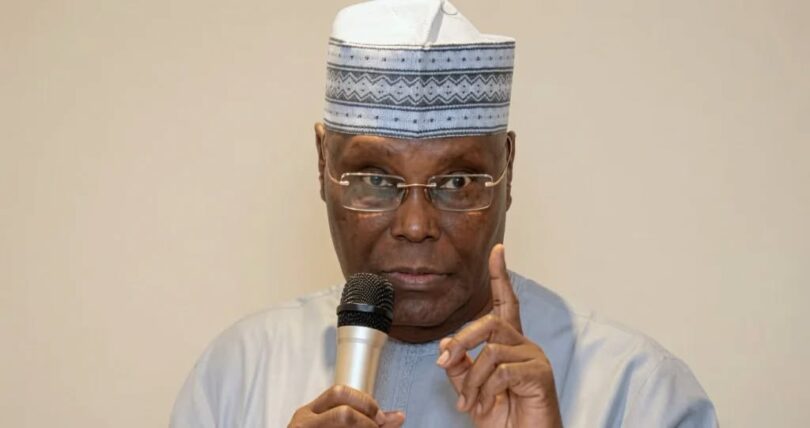
Former Vice President Atiku Abubakar has described the massive outflow of foreign portfolio investments from Nigeria as another indication of declining investor confidence in the economic management of President Bola Tinubu’s administration.
Mr Atiku, in a statement issued by his Senior Special Assistant on Public Communication, Phrank Shaibu, said data from the Nigerian Exchange showed that foreign investors withdrew N266.07 billion more from the Nigerian equities market than they invested between January and July 2026.
According to the statement, foreign investors brought N513.36 billion into the equities market during the period but withdrew N779.43 billion, resulting in a net outflow of N266.07 billion.
It said foreign outflows exceeded inflows in every month during the seven-month period, adding that the net outflow was about 11.7 times the N22.68 billion recorded during the corresponding period of 2023.
Atiku described the development as “not merely an investment statistic” but “a confidence verdict on the Tinubu economy.”
“Imagine a market where the shop owners are broke, customers have no money, the landlord keeps borrowing from everybody, and the few outsiders who brought capital are quietly carrying their money away. Only a foolish landlord would stand at the gate and call that prosperity. That is Tinubu’s economy,” he said.
The former vice president also criticised the Federal Government’s rising domestic borrowing, citing figures showing that government borrowing increased by 90.5 per cent to N24.7 trillion within eight months.
He said the development, coupled with faster growth in government credit compared with credit to the private sector, suggested that the government was crowding businesses out of the domestic credit market while foreign investors were withdrawing their funds.
“So the picture is now painfully clear: Tinubu’s government is crowding Nigerian businesses out of the domestic credit market while foreign investors are taking their money and heading for the exit,” Atiku said.
He further criticised the administration over rising food and transportation costs, arguing that households and businesses were being squeezed by the economic environment despite the government’s repeated claims of progress under its reform programme.
“Local businesses are suffocating. Foreign capital is fleeing. Government borrowing is exploding. Food prices have skyrocketed. Transportation costs are crushing families. Yet the same administration continues to congratulate itself on economic reforms,” he said.
Atiku questioned what he described as the government’s celebration of its economic performance, arguing that an economy could not be considered to be recovering when businesses struggled to access affordable credit, manufacturers faced high operating costs, households experienced declining purchasing power and investors remained reluctant to retain capital in the country.
He said investors were assessing the economy based on factors such as policy consistency, inflation, purchasing power, regulatory predictability and the prospect of earning sustainable real returns.
“And their verdict is increasingly unmistakable: take the money and run,” he said.
The former vice president called for economic policies that would restore investor confidence, reduce the cost of doing business, make energy and transportation more affordable, stimulate production and strengthen the private sector as the principal driver of economic growth.
“That is the fundamental difference between Tinubu’s economics of government consumption and Atiku’s economics of private-sector production and household affordability,” he said.
Atiku added that the government could not “borrow the private sector dry, impoverish consumers and then advertise yourself to the world as an investment destination.”
“The investors are already answering the propaganda. They are leaving,” he said.