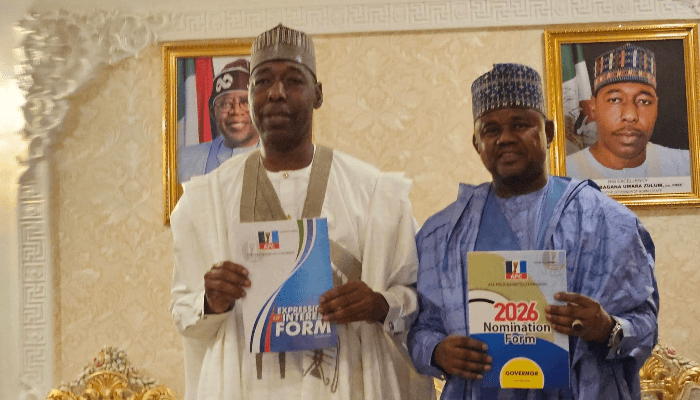
By endorsing his immediate past Commissioner for Works and Housing, Mustapha Gubio, Governor Zulum is not merely backing a candidate; he is setting the stage for a high-stakes test of the “Borno Model” of power sharing
In a move that has stirred significant debate within the North-east’s political landscape, Borno State Governor Babagana Umara Zulum has moved with uncharacteristic speed to signal his choice for the 2027 succession. By endorsing his immediate past Commissioner for Works and Housing, Mustapha Gubio, Governor Zulum is not merely backing a candidate; he is setting the stage for a high-stakes test of the “Borno Model” of power sharing.
The public presentation of the endorsement appeared carefully managed. Mr Gubio presented his nomination forms to Governor Zulum shortly after returning from the APC headquarters in Abuja. Crucially, the presence of Senate Chief Whip, Senator Mohammed Tahir Monguno, adds a layer of legislative legitimacy to the move.
However, sources within the Borno APC suggest that the “Abuja camp,” often associated with the Vice President’s wider national interests, may have expected a more consultative approach to the 2027 ticket.
A source close to Vice President Kashim Shettima, however, dismissed suggestions of any rift, insisting that “there is no daylight between the governor and the vice president on Borno’s political future,” and describing speculation of factional rivalry as premature.
“In Borno, the governor usually holds the local keys, but the Vice President holds the national map,” a high-ranking party chieftain told PREMIUM TIMES on condition of anonymity.
The groundwork for this move was laid on 30 March, when Mr Zulum dissolved the State Executive Council. At the time, the administration framed it as a move to provide an “enabling environment” for aspirants.
 Analysts now see that dissolution as a strategic “clearing of the deck.” By allowing Mr Gubio to resign and pick up the form first, Mr Zulum has effectively given him a “pole position” that other aspirants, including those potentially backed by Mr Shettima’s loyalists, will find difficult to overtake without appearing to challenge the governor directly.
The central question for the Borno APC is whether this endorsement represents a party consensus or a unilateral executive preference. History in Borno shows that succession is rarely a smooth sail:
The 2011 Precedent: The late Mala Kachalla’s friction with Ali Modu Sheriff fractured the state’s elite.
The 2019 Consensus: Mr Shettima successfully managed the transition to Zulum, but that was done under a unified command structure that currently faces the complexities of having a sitting Vice President from the same state.
If the “Shettima camp” feels sidelined by the Gubio endorsement, the APC could face a parallel primary or, worse, a quiet internal sabotage that could embolden the opposition PDP or NNPP in the state.
Beyond politics, there is the question of governance. Mr Gubio, as works commissioner, was the architect of Mr Zulum’s massive infrastructure projects. His candidacy suggests a “continuity ticket.”
But as the 2027 timetable accelerates, with primaries set for April and May, the Borno Government’s focus is likely to shift from project sites to political rallies. For a state still grappling with the tail end of a decade-long insurgency, the cost of a “fierce contest” within the ruling party may be more than just political; it could undermine the stability of the state’s reconstruction efforts.