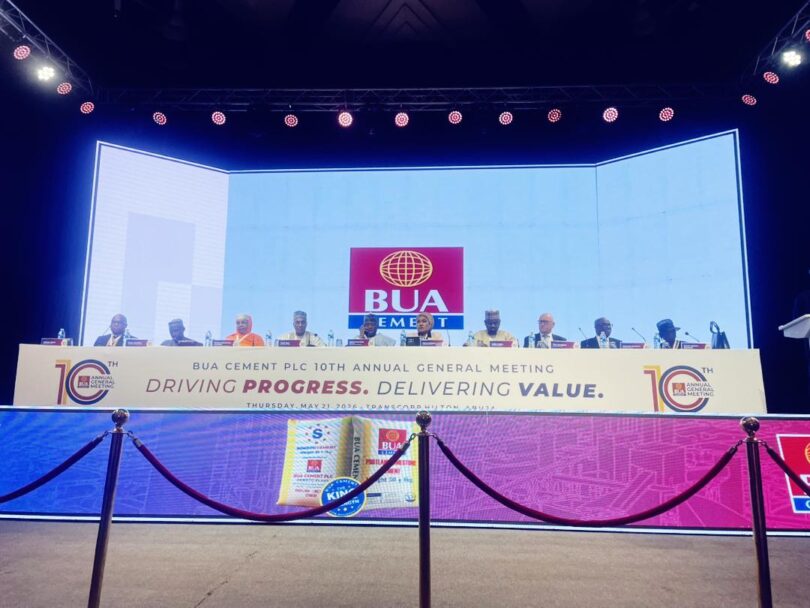
The company says rising energy, transportation, and foreign exchange-related costs remain major drivers of cement prices in Nigeria, although recent exchange rate stability is beginning to ease some pressures on manufacturers.
BUA Cement Plc has attributed the high cost of cement in Nigeria to rising energy, transportation, and foreign exchange-related expenses, saying the industry continues to face significant production cost pressures despite recent improvements in exchange rate stability.
The cement industry, he stated, remains heavily dependent on imported spare parts, equipment, and energy-related inputs, making it highly vulnerable to exchange rate fluctuations.
Mr Rabiu noted that although the naira depreciation created serious challenges for manufacturers, recent stability in the foreign exchange market had started easing some pressures, especially in shipping and logistics costs.
“The good news is that things are getting better because of the stability. You see, prices, especially shipping costs, are coming down,” he said.
He added that the reforms, though difficult initially, had created a more transparent market where manufacturers now have better access to foreign exchange.
“Today, whatever rate I get, it’s the same rate anybody gets,” he stated, noting that businesses could now plan several months due to improving exchange rate predictability.
Mr Rabiu said BUA remained focused on reducing operational costs through investments in energy infrastructure, local production, and logistics efficiency.
He highlighted that the company’s long-term strategy remained aligned with Nigeria’s industrialisation drive through expansion, operational efficiency, and increased local production. He also stated that its revenue rose to N1.2 trillion in 2025 from N876.5 billion in 2024, while profit before tax increased to N465.3 billion from N99.6 billion.
Profit after tax also rose significantly to N356 billion from N73.9 billion of the previous year.
The shareholders also approved a final dividend of N10 per ordinary share for the 2025 financial year, bringing the total dividend payout to N338.64 billion.
Speaking further about BUA’s pricing structure during a press conference after the meeting, Yusuf Binji, the Managing Director and Chief Executive Officer, said energy alone accounted for about 60 per cent of cement production costs.
“As you know, the price of cement, rightly or wrongly, is a consequence of input costs,” he said, and added that natural gas costs at one of the company’s plants in Edo State rose sharply following the naira devaluation.
“We were paying close to N4 billion for natural gas every month. At one point, it reached N16 billion a month. It became very difficult to absorb all these costs,” he said.
Mr Binji also linked rising diesel prices to recent tensions in the Middle East, and said the increase significantly affected transportation and distribution costs.
He further said diesel supplied to the company’s factories rose from about N930 per litre in March to nearly N1,850 per litre within two months.
“If you consider that we have to deliver cement to our customers using our own trucks that use diesel, even the price we are talking about, half of that price of a bag of cement is actually because of transportation.”
He also dismissed claims that cement was selling for between N13,000 and N15,000 per bag nationwide, insisting that prices in several regions remained lower.
“I have the prices from the northern region, and yesterday it was N11,100 a bag. So it is nowhere near the N13,000 or N15,000 a bag that was quoted,” he said.
Mr Binji, however, assured consumers that the company would continue reviewing prices in line with prevailing economic realities and changes in input costs.
“As we have favourable economic conditions in Nigeria, especially costs that are related to our input costs, we will adjust accordingly. Whichever way it swings, we will try to make sure that we give prices that are fair and decent to Nigerians.”
Despite current economic challenges, the company, he said, was continuing expansion projects to increase production capacity.
Mr Binji disclosed that BUA Cement’s new production line in Ososo, Edo State, was nearing completion, while another production line had been planned for Sokoto State.
He said the projects were expected to add about six million tonnes to the company’s annual production capacity, increasing total installed capacity to about 23 million tonnes per annum by 2027.
He noted that the company had invested heavily in bulk cement distribution by acquiring 500 specialised trucks to support major infrastructure projects across Nigeria.
“We are even thinking of buying another 500 more,” he said, citing rising demand linked to ongoing highway and infrastructure projects, such as the Lagos-Calabar Coastal Highway.
The company added that it had temporarily reduced exports to prioritise local supply amid growing domestic demand.
Despite insecurity and broader economic pressures, Mr Binji said the company would continue expanding its operations nationwide.
“Our major aim is to be able to deliver cement everywhere in Nigeria at affordable prices, and that is what we will continue to do,” he said.