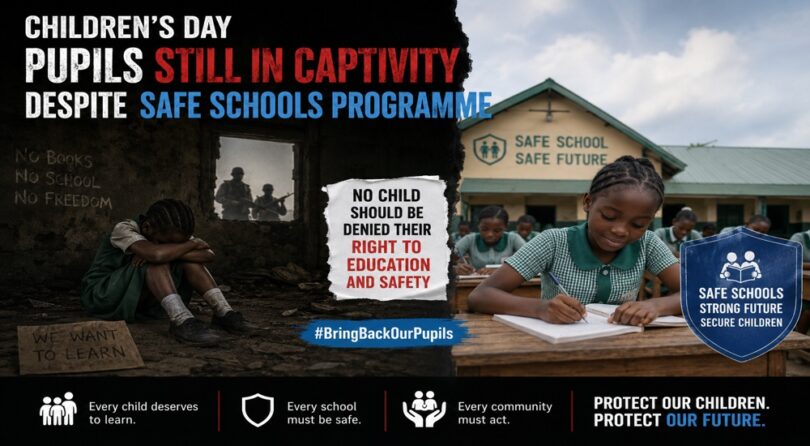
While Nigerian children mark Children’s Day with celebrations across the country, over 80 pupils remain in captivity from two school attacks on May 15, 2026. Their families mark the day in anguish while keeping vigil for their return.
Both attacks happened on the same day. In the Northeast, suspected militants took 42 to 50 children from Central Primary School and a junior secondary school in Mussa, Askira-Uba, Borno State during class hours, including toddlers from the nursery section. The same morning, in the Southwest, bandits kidnapped 39 students from three schools in Ahoro-Esiele, Oriire, Oyo State. The children from both attacks have not been rescued.
The May 15 abductions are the latest in a wave of school attack in the country. Between November 2025 and May 2026, gunmen have hit schools and orphanages across five states. The kidnappers have taken 432 to 440 children from classrooms, dormitories, and nurseries.
On November 17, 2025, bandits scaled the fence of Government Girls Comprehensive Secondary School in Maga, Kebbi in the Northwest of the country. They abducted 25 female students and killed the vice-principal. The girls were freed eight days later.
Four days after that, the attack went to the North-Central. At 2:00 a.m. on November, armed men stormed St. Mary’s Catholic Primary and Secondary School in Papiri, Niger State. They took 303 students and 12 teachers. About 50 children escaped. The rest were released in batches by December.
In April 2026, the crisis reached an orphanage for the first time. On April 26, heavily armed men raided the unregistered Daarul-Kitab Islamic Orphanage in Lokoja, Kogi. They kidnapped 23 children and the proprietor’s wife. Fifteen were rescued within 24 hours. The Nigerian Army freed the last nine on May 6.
Then came May 15, and two attacks in one day. In the Northeast, suspected militants attacked three institutions, including Central Primary School and a junior secondary school in Mussa, Askira-Uba, Borno State during class hours. They took 42 to 50 children, including toddlers from the nursery section.
The same morning, in the Southwest, bandits invaded three schools in Ahoro-Esiele, Oriire, Oyo State before dawn. The attackers simultaneously targeted Baptist Nursery and Primary School, Ayawota; Community Grammar School; and L.A Primary School, Esiele in the area.
They kidnapped 39 students and seven teachers. One mathematics teacher, Joel Adesiyan, was killed in his classroom. Michael Oyedokun, another teacher who was among the dozens of hostages abducted during the raid, was subsequently beheaded by the captors. The children are still not home.
The abductions came even after the Federal Government launched responses to secure schools. The original response was the Safe Schools Initiative, launched in 2014 after abduction of the Chibok Schoolgirls.
In 2022, government followed it with the National Plan on Financing Safe Schools (NPFSS), designed to protect schools and learners with budgetary allocations. Yet the attacks show the gap between policy on paper and security on the ground.
The NPFSS was approved in December 2021, under President Muhammadu Buhari. It was launched in May 2022. That month, a technical committee in the Ministry of Finance, Budget and National Planning finished the plan. The cost was N144.86bn for four years, 2023 to 2026.
According to the split, N32.58bn was budgeted for 2023, N36.98bn for 2024, N37.15bn for 2025, and N38.03bn for 2026. The promise was to cover 50 percent of the most at-risk public schools, starting with 18 high-risk states and 48 schools.
The first money moved on August 9, 2023, under President Bola Ahmed Tinubu. Months after he took office, his government announced that N15bn had been released to fund the Safe Schools Initiative for that year. The National Coordinator of the National Safe Schools Response Coronation Centre(NSSRCC), the implementation aim of the Safe School Initiative and the NPFSS, Halima Ibrahim disclosed in Abuja that a financing secretariat was now in place and work had started.
Then the funding stopped under the same administration. By the time the Senate opened its Ad Hoc Committee hearings on December 10, 2025, the Coordinator told lawmakers there had been no budgetary provision for Safe Schools in 2024 and again in 2025.
Her explanation was that her request reached President Tinubu’s office too late to be captured in those two budgets. So for two of the four years in the plan, nothing was released. Out of the N144.86bn on paper, only the N15bn from 2023 had gone out under Tinubu.
Even how the N15bn was spent was questioned. During the hearing chaired by Senator Orji Uzor Kalu, the record showed that the Nigeria Police Force received N6.225bn, the largest single share. The Nigeria Security and Civil Defence Corps got N3.362bn. Defence Headquarters received N2.250bn. The Federal Ministry of Education got N519m.
While comparing the spending types, the documents also showed that almost half of N4.44bn in earlier expenditures went to consultancy and operational costs. The committee therefore ordered a complete reconciliation of all Safe Schools accounts and asked for inflow and outflow statements, a list of contractors, and CBN Trust Fund records.
While the probe was ongoing, the calendar kept moving. In April 2026, it was reported that the House of Representatives Order Paper showed a new request from President Tinubu’s government; an additional N5bn for Safe Schools in the 2026 budget, under Capital Supplementation. The proposal came at the same time lawmakers were questioning the programme’s impact.
While lawmakers debate impact, National Mobilisation Officer of the Education Rights Campaign, ERC, Adaramoye Lenin, said that the Safe Schools Initiative has failed from the start.
“Billions of naira have gone into it but yet it has no positive impact and we still have students being kidnapped in schools,” Lenin said in an interview with NEWSNGR.
He noted that what began with the Chibok abductions in the Northeast has now spread to states like Oyo, which he said proves the programme is not working.
Lenin blamed poor planning and a reactive approach. He argued that the government often announces initiatives to calm public anger without involving key stakeholders like the Nigeria Union of Teachers.
As a result, he said, funds are diverted and many schools remain without basic security.
He described the situation as “a national shame” on Children’s Day, when over 80 pupils remain in captivity.
According to him, the government’s response suggests it is relying on kidnappers’ goodwill for release, instead of mounting a decisive rescue.
He added that children, as a vulnerable group, deserve special protection under global standards.
Lenin also faulted state governments. He said all states receive security votes running into billions monthly, yet there is little accountability on how the money is used.
For him, the crisis reflects a broader governance failure tied to unemployment, out-of-school children, poverty and illiteracy.
He urged government to rescue all abducted students and teachers immediately, deploy security personnel to vulnerable schools, and work with communities.
Beyond policing, he said, the root causes must be tackled; poor school conditions, joblessness, and rural neglect.
“Beyond deploying security agents, we need to fight poverty, unemployment, and illiteracy. These will help a great deal,” he said.
Also speaking, Elvis Boniface, Education Specialist and Managing Director of Edugist, said the original intent of the Safe Schools Initiative was sound, but argued the impact has not matched the scale of the crisis.
Boniface said funding and announcements alone cannot guarantee safety, adding that what is needed is a functional system that combines infrastructure, community intelligence, and rapid response.
For him, the initiative must move from ad-hoc projects to a measurable national framework with transparent reporting and community participation.
Boniface called for accountability from the National Safe Schools Response Coordination Centre.