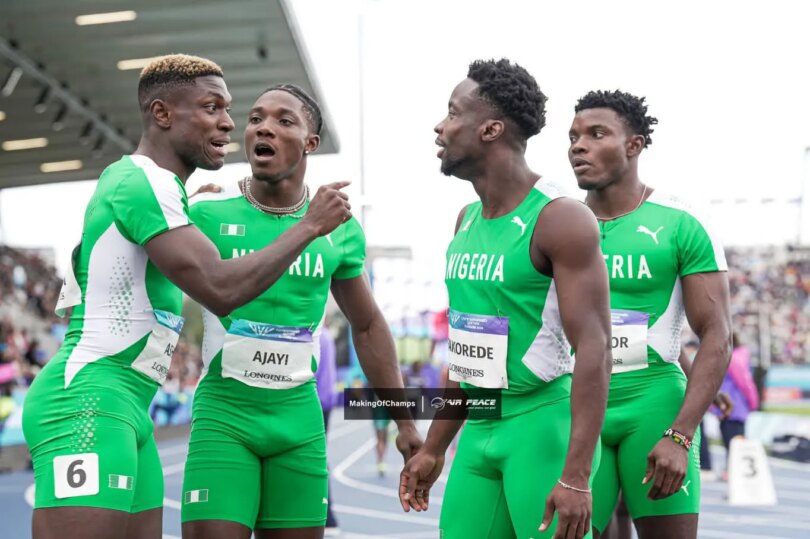
At the 2026 Commonwealth Games in Glasgow, Nigeria’s men matched the women in gold medals for the first time in many years, signalling a new era for Team Nigeria.
For many years, Team Nigeria followed a familiar pattern at major international competitions.
That trend was most evident at the Birmingham 2022 Commonwealth Games, where all 11 of Nigeria’s gold medals were won by female athletes.
At the 2018 Commonwealth Games in Gold Coast, Australia, Nigerian women won six of the country’s nine gold medals, while the men claimed three. Interestingly, the Nigerian contingent had more men (51) than women (37).
The same pattern had been visible at several other international competitions.
The story was similar at the 2023 African Games in Ghana. Although women made up less than half of Team Nigeria’s athletes, they won 35 of the country’s 47 gold medals and accounted for 71 of Nigeria’s 121 medals, which is almost 59 per cent of the total haul.
From athletics and weightlifting to wrestling and para powerlifting, Nigeria’s women consistently carried the nation’s medal hopes while the men often struggled to match their success.
Unlike the Olympic Games, where Nigeria usually struggles for medals, the country has traditionally enjoyed greater success at the Commonwealth Games.
Before Glasgow 2026, Team Nigeria had won 269 medals across 15 Commonwealth Games editions.
More than 60 per cent of those medals came in the last three decades. Since Manchester 2002, and before Glasgow 2026, Nigeria had amassed 162 Commonwealth Games medals. Women contributed 90 of those medals, while the men won 72.
The gap was even wider in gold medals. Female athletes won 34 gold medals during that period compared to just 17 by the men.
There were exceptions. At Manchester 2002 and Melbourne 2006, the men finished with more gold medals than the women. However, from New Delhi 2010 onwards, the balance shifted heavily in favour of the women.
Athletes such as Blessing Okagbare, Tobi Amusan, Ese Brume, Odunayo Adekuoroye, Blessing Oborududu, Rafiatu Lawal, Folashade Oluwafemiayo and many others became Nigeria’s most reliable medal winners.
By the time Birmingham 2022 ended, every Nigerian gold medal had been won by a woman, although the country later lost the women’s 4x100m relay gold after Grace Nwokocha failed a doping test.
That long-established pattern changed in Glasgow.
When the Games ended, Team Nigeria finished seventh overall with 24 medals, which consisted of 10 gold, seven silver and seven bronze, which made the country emerge as Africa’s highest-ranked nation.
More importantly, the gold medals were evenly shared.
The men won five gold medals, the same number as the women.
It was one of the clearest signs that Nigerian sport is becoming more balanced.
National Athletics Head Coach Solomon Aliyu believes the transformation was impossible to miss.
Speaking with PREMIUM TIMES in Glasgow, Mr Aliyu said the performances reflected a team that had accepted greater responsibility.
“The results speak for themselves,” he said.
![Coach Solomon Aliyu with Tobi Amusan [Credit: MakingofChampions]](https://i0.wp.com/media.premiumtimesng.com/wp-content/files/2026/08/1003775057.jpg?resize=2048%2C1365&ssl=1)
“One of the biggest highlights was our performance in the men’s 400 metres. We all know how long it has taken Nigeria to return to the top level in that event, and the performances we saw here were encouraging.”
His comments captured one of the defining stories of Glasgow.
For years, Nigeria struggled to produce male quarter-milers capable of consistently competing for major international medals.
Glasgow suggested those difficult years may finally be over.
Samuel Ogazi became the face of that revival.
The 20-year-old stormed to victory in the men’s 400m final in 44.25 seconds to become the first Nigerian man to win the Commonwealth Games title in the event.
![Ogazi and Udo [Credit: MakingofChampions]](https://i0.wp.com/media.premiumtimesng.com/wp-content/files/2026/08/1003775036.jpg?resize=2048%2C1365&ssl=1)
His success was backed by Edidiong Udo, who also reached the final on his Commonwealth Games debut, showing that Nigeria is once again building real depth in one of its traditional events.
Together, they revived hopes that Nigeria can once again compete with the world’s best over one lap.