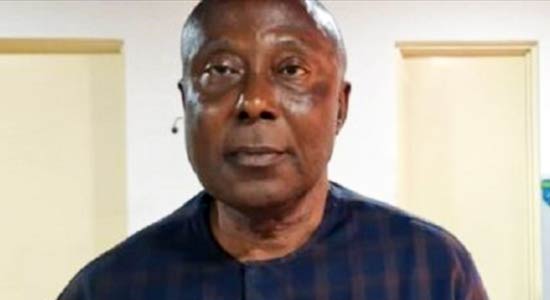
The Federal High Court in Abuja on Wednesday ordered the final forfeiture of multi-billion naira assets and investments linked to a convicted former acting Accountant-General of the Federation, Chukwunyere Nnabuoku, to the federal government.
The order followed a motion on notice filed by the Economic and Financial Crimes Commission (EFCC) seeking confiscation of properties traced to proceeds of unlawful activities.
“The properties of the convict, established to have been purchased with the proceeds of crime, are hereby finally forfeited to the Federal Government,” Judge James Omotosho ordered in a ruling.
The same judge sentenced Mr Nnabuoku, on 23 March, to eight years in prison without an option of fine.
Aside from the Nwabuoku’s case, Mr Omotosho has handled several high-profile corruption, political and national security cases.
In November last year, he sentenced former leader of the proscribed Indigenous People of Biafra (IPOB), Nnamdi Kanu, to life imprisonment.
Earlier on Wednesday, he sentenced former Minister of Power, Sale Mamman, to 72 years in prison.
On 1 April, months after Nnabuoku was convicted and jailed, EFCC filed a forfeiture request against assets recovered from him.
Mr Omotosho ruled on Wednesday that the forfeiture application was meritorious.
He said forfeiture of proceeds of crime is a natural consequence of conviction in money laundering cases.
“In crimes such as money laundering, forfeiting the proceeds of crime is deemed to be a natural consequence of conviction,” the judge noted since a convict cannot retain benefits of unlawful conduct.
Mr Omotosho also explained that forfeiture is meant to ensure that a convict does not continue to benefit from illegal gains.
He stressed that the “convict will not be allowed to enjoy those properties” traced to proceeds of crime. He held that the assets had been established as products of unlawful activities.
On the argument that the matter was subject of appeal, the judge said the filing of a notice of appeal does not stop a forfeiture order.
He described forfeiture as part of the judgement process and “similar to sentencing” after conviction.
According to him, conviction is the trigger, not the appeal process. “Where a person has been convicted and a notice of appeal has been filed, would that preclude such person from being sentenced? The answer is no,” he said.
“Consequently, this forfeiture order will be granted regardless of the filing of a notice of appeal.”
On the allegation of abuse of court process, the judge held that no evidence was placed before the court to show any existing conflicting forfeiture order over the same assets. He therefore dismissed that objection.
The judge subsequently ordered forfeiture of the assets listed in Schedules 1, 2 and 3 of the EFCC’s application.
The forfeited assets comprise landed properties, cash held in bank accounts and company shares.
EFCC said the total market value of the shares as of 29 March stood at N1.94 billion.
Schedule 1 contains funds in several bank accounts. They include: N12,526,206.55 in Temeeo Synergy Concept Ltd’s Zenith Bank account (1016901286); N4,102,570.25 in Turge Global Investment Ltd’s Zenith Bank account (1016901279); and N682,904.36 in Laptev Bridge Ltd’s Zenith Bank account (1016727695).
Others are N51.3 million in Arafura Transnational Afro Ltd’s Zenith Bank account (10167277640) and N220 million in an EFCC Recovery Account with the Central Bank of Nigeria, said to be a refund by Nnabuoku.
Schedule 2 covers a five-bedroom duplex at No. 20 City Gate Estate, Kukwaba, Abuja, valued at N64 million, with an additional N3 million paid as infrastructural levy.
EFCC said the house key was voluntarily surrendered by Mr Nnabuoku as part of restitution.
Schedule 3 lists investments in quoted companies.
They include 10,000,000 shares in Access Holdings; 7,521,860 in First Bank Holdings; 4,500,000 in GTCO; and 10,045,035 in UBA.
Others are 5,000,000 shares in Zenith Bank; 279,620 in Berger Paints; 140,183 in Cadbury; 1,000,000 in Dangote Sugar; and 500,000 in Nascon Allied Industries.
Also listed are 551,039 shares in Dangote Cement; 500,754 in Africa Prudential; 410,603 in United Capital; and 395,000 in Dunlop.
After the ruling, lawyer to the EFCC, Ogechi Ujam, and counsel to the convict, Isodore Udenko, commended the court.
Mr Omotosho became a judge of the Federal High Court in 2015, during Goodluck Jonathan’s administration.