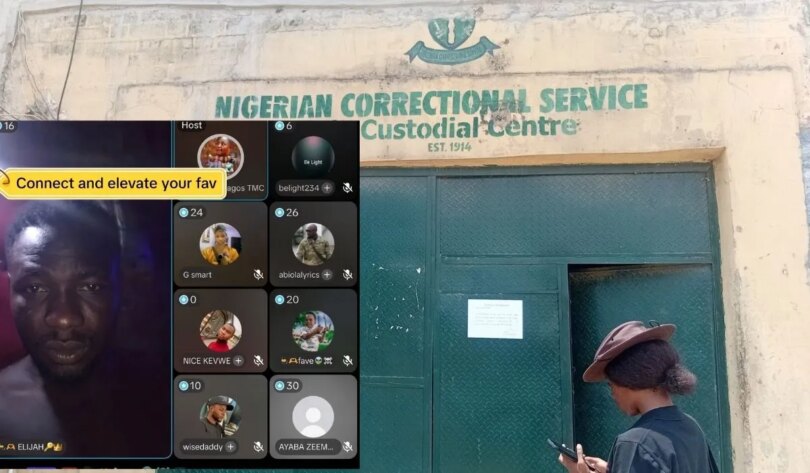
The TikTokker is on death row, having been found guilty in 2019 of murder.
The concrete walls of Ibara prison rise grey and absolute against the skyline of Abeokuta, the Ogun State capital. Barbed wire crowns its perimeter fence as armed officers patrol the walkways. But on an evening in early 2026, a man serving time inside those walls opened a TikTok account, tapped a screen, and went live.
On 22 December 2016, according to a Certified True Copy of court proceedings at the Osun State High Court — Suit No. HIK/6C/2017, Mr Oyebode conspired to kill Rofiat Adebisi, a final-year student of Osun State University’s Ipetu Ijesha campus. She stood by a roadside on the said day waiting for a vehicle to Osogbo. Mr Oyebode carried her in his car and took her to a place where he had her murdered for rituals.
The court’s CTC, obtained by this reporter, shows that Mr Oyebode gave conflicting accounts of Ms Adebisi’s death.
In one statement to investigators, he said he negotiated a sexual agreement with the deceased for ₦2,000, drove her to his rented apartment, had sex with her, and went to bathe. On returning, he claimed he found her motionless on his bed and later dumped her body by the roadside.
In a separate extra-judicial statement, however, he claimed he used a charm supplied by a herbalist, who was also standing trial as the third accused person, to hypnotise the victim after picking her up. He said he then drove her to the herbalist’s shrine, where both men raped her. According to this account, he was later called back to help remove her body, which was dumped on a lonely road under the cover of darkness.
At trial, Mr Oyebode disowned both versions, denied involvement in the crime, and repudiated the statements he had made to operatives of the State Security Service (SSS) and the police.
The court rejected his denial during the trial. In its judgment, the court held that medical evidence showed Ms Adebisi died from cardiac arrest caused by suffocation through strangulation. Justice S. O. Falola found Mr Oyebode responsible for Ms Adebisi’s murder and sentenced him to death by hanging in 2019.
While death row is designed to be the state’s ultimate expression of confinement, Mr Oyebode has cultivated an active presence on social media, particularly on TikTok, where he has amassed followers, participated in livestreams watched by thousands of viewers, received monetary gifts from supporters, and interacted freely with people outside prison walls.
As of Friday, Mr Oyebode maintained at least two TikTok accounts. One of them, operating under the handle @ayola.oluwafu, remained active to date. Through livestreams and audience gifts, the account attained Level 20 gifting status on the platform, a milestone that requires substantial financial activity and suggests spending and transactions running into millions of naira.
His online presence was not hidden. He appeared on livestreams, interacted with users in real time, and attracted an audience that, in many cases, had no idea they were watching a man sentenced to death for murder.
Mr Oyebode’s second account was identified through forensic analysis and witness testimony. The account was actively used to impersonate Omolola Awoyele, a prominent TikTok Live host and activist. “Elijah created an account using my name and uploaded my picture, which meant he could potentially use it to scam people online,” Ms Awoyele told Saturday Tribune. After she conducted a private investigation and confronted him, he admitted to operating the clone. “He apologised, removed my picture, and edited the account name,” she said. Analysis of TikTok’s Snowflake IDs showed that videos posted by this secondary account on 14 February were uploaded within the same time window as content from Mr Oyebode’s primary account, @ayola.oluwafu.
Ms Awoyele first encountered Mr Oyebode when a friend shared his livestream, noting that he regularly appeared online claiming to be an inmate soliciting funds. “When I joined the live, I heard someone saying he was in prison,” Ms Awoyele recalled. “I immediately wondered what a prisoner was doing on TikTok. He responded that social media was his only means of getting food and survival support.”
Initially sceptical of his claims, Ms Awoyele demanded proof. “At first, I did not believe him,” she said. “I asked if he had WhatsApp because I wanted to confirm his claims through a video call. Through the video call, I confirmed that he was indeed in prison.”
The digital access allowed Mr Oyebode to manipulate external actors to fight his legal battles. Ms Awoyele, acting in her capacity as an activist, initially believed his claims of innocence and contacted lawyers to help file an appeal. It was only after she independently obtained the court’s Certified True Copy and confronted him that he confessed to her on a call that he had, in fact, taken ₦10,000 from the herbalist and facilitated the victim’s death. Following this admission, his appellate lawyer withdrew from the case. Ms Awoyele eventually severed contact after Mr Oyebode began using his smuggled phone to issue threats against her from inside the prison.
In one of Ms Awoyele’s live sessions on TikTok on 16 April 2026, which lasted over an hour, Mr Oyebode joined and disclosed that many inmates in Ibara prison have access to mobile phones and internet connections.
“An individual may be in possession of two to three phones,” the inmate mentioned on the livestream, which was monitored by Saturday Tribune. “Facebook and TikTok are full of prisoners. They will not disclose their location to anyone. If they do video calls and people see a nice background, they will not know where they are,” he explained.
On his own earnings, he said: “I get a lot of people sending money to me from the internet; only a few are my family. The bet I won last month was ₦85,000.”
While the court’s CTC, seen by our reporter, shows that Mr Oyebode sold his victim’s iPhone in 2016, he now operates multiple smartphones inside a maximum-security prison.
The Nigerian Correctional Service Act 2019 places responsibility on custodial centres for the “safe custody and reformation of offenders.” But at Ibara, that mandate appears to have been overtaken by a parallel economy that is internally governed, officer-mediated, and digitally connected to the outside world.
According to Mr Oyebode, the gateway to that economy is the correctional officer. “The warders are not the ones selling phones to us,” Mr Oyebode explained during the live session in April. “They only get them for us at the tarmac and smuggle them in for us.”
The relationship then loops into extortion.
“Even if it is the warder that brought it in for you, if another warder sees it, he will seize it and demand a certain amount from you before you get it back. Because it [phone] is our companion, we will definitely pay for its release.”
The warder functions simultaneously as both a supplier and a creditor, extracting money on both sides of the same transaction.
The same channels, Mr Oyebode claimed, are used to move drugs into the facility. “Warders smuggle drugs in for inmates,” he said during that live session on 16 April 2026. “The inmate might buy the drugs for about ₦500,000, and the warder who smuggled them in might collect ₦100,000 from them. So, after repackaging and reselling, the inmates can make ₦2 million from the drugs.”
“There are some inmates here who are building hotels outside the prison and always go there for supervision with the aid of the warders while facing the death penalty,” he claimed. “The warders take them to their various houses and hotels and bring them back. Some will meet people, especially women, on social media and settle the warders to meet with them.”
After nearly a decade inside the facility, Mr Oyebode offered a blunt assessment of the institution.
“I will not deceive you; it is no longer a correctional centre. It is corrupting people more,” he said on the livestream.
Before weighing the technological failures, these activities must be measured against the law. The Nigerian Correctional Service Act 2019 strictly governs the conduct of both inmates and officers. The claims of digital freedom, active phone usage, and inmates leaving the facility for building projects do not merely point to a porous perimeter—they represent severe, punishable felonies under Nigerian law.
The Act provides specific statutory penalties for correctional officers found conniving with inmates. Under Section 29(1)(c), any officer who procures or facilitates the use of communication devices—such as the smartphones Mr Oyebode uses for his TikTok broadcasts—commits an offence punishable by a fine of up to ₦3,000,000, imprisonment for up to three years, or both. Similarly, Section 29(1)(a) stipulates up to 12 months imprisonment and a ₦1,000,000 fine for smuggling drugs into the facility.