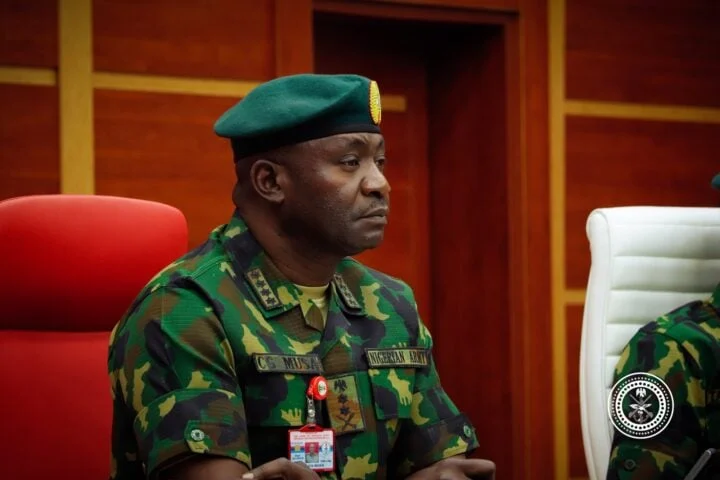
According to the minister, the alleged plotters were driven largely by financial interests rather than an ideological or political objective.
The Minister of Defence, Christopher Musa, has confirmed that suspects arrested in connection with the alleged plot to overthrow President Bola Tinubu’s administration have been taken to court and are currently facing trial.
He stated the plot was authentic and that investigators had confirmed the suspects’ intention to seize power.
“The coup was genuine, and they truly intended to carry it out,” Mr Musa said.
According to the minister, the supposed plotters were mainly motivated by financial gain rather than ideological or political aims.
The attempt was genuine, and they truly wanted to do it for some reason. And again, when you hear why they wanted to do it, you realise that they’re just a bunch of misguided individuals who went into it for money alone,” he said.
Mr Musa said the suspects were initially held while security agencies investigated the allegations, but have since been transferred to the courts for prosecution.
He stated that the matter was no longer under military control.
I believe they have been investigated. They have taken them to court, so it remains with the courts. It is not with us; it is still with the courts,” he said.
The suspected coup plot was uncovered in late September 2025, resulting in the arrest of military officers and other suspects.
PREMIUM TIMES previously reported that the investigation eventually expanded to include serving and retired military officers, civilians, and other individuals allegedly connected to the plot. The government subsequently acknowledged that there had been a plan to overthrow the Tinubu administration and said indicted officers would face prosecution.
This newspaper also reported that the alleged plotters had identified senior political and military officials as targets. Mr Musa, who was then the chief of defence staff, was among those reportedly targeted. In February, he said intelligence gathered during the investigation indicated that he was to be arrested and, if he resisted, shot.
Several individuals have been linked to the alleged plot. PREMIUM TIMES reported that six suspects, including retired military officers and a police officer, were charged before the Federal High Court in Abuja, while 36 serving military personnel faced separate proceedings before a General Court Martial.
Asked whether the alleged plot was politically motivated, Mr. Musa said he believed the suspects might have been influenced by memories of Nigeria’s military regimes, when soldiers who seized power later became governors and ministers.
He said there was no concrete justification for their actions.
“I think the intent of the plotters is just… probably they saw the reminiscences about the past military regimes, how they became governors and became ministers and all this.
“And they felt, man, it’s been a long time. Maybe it’s time for us to be able to benefit from that. Otherwise, there’s really no concrete reason.”
Mr Musa said the investigation also examined people who allegedly assisted in the area around the Presidential Villa.
“We’re hearing more details about those hit men, or the men who were on guard at the presidential villa, near the villa clinic. Those who were involved, those who helped, and how they received aid and all that,” he said.
PREMIUM TIMES has reported that investigators identified alleged plans involving the Presidential Villa, military formations and other strategic locations as part of the proposed takeover. Recent reports based on investigation documents also showed that some suspects allegedly had specific assignments around the Villa and the residences of senior military officers.
The minister also linked the recent increase in attacks across the country to the approach of the 2027 general elections.
He said previous security trends showed that attacks tend to decline after elections and rise again as another election approaches.
“Why did we have a spike in the number of attacks in August? In August, well, like I told you, elections in January, campaigns are beginning,” Mr Musa said.
Asked whether there was empirical evidence linking the attacks to political activities, he said the pattern had been consistent over successive election cycles.
“If every year we could get, after elections, it goes down, and then gradually builds up to an election, and it has been consistent. It has been consistent,” he said.
Mr Musa said security agencies were responding to the renewed attacks and had reduced their intensity.
“If you go through the record, it has been consistent. This year, it’s not anything different. But the good news now is that the security forces are working very, very well to ensure we stop this.
“You will not totally, in one day, stop everything. But I can tell you the intensity has reduced, and we are pushing further to make sure that we address these issues.”
The minister had made a similar connection between rising insecurity and the 2027 elections in an earlier interview on Channels Television, when he was chief of defence staff. He said the increase in violence could be exploited by political actors seeking to discredit the government.
Mr Musa also said security agencies were tracing the sources of funds used by terrorist groups, including through cryptocurrency and foreign networks.