After the ruling admitting the judgement as an exhibit, the prosecution pushed for the deferment of the hearing of the defence’s challenge to the jurisdiction of the court to sit over the case till the end of the long-running trial.
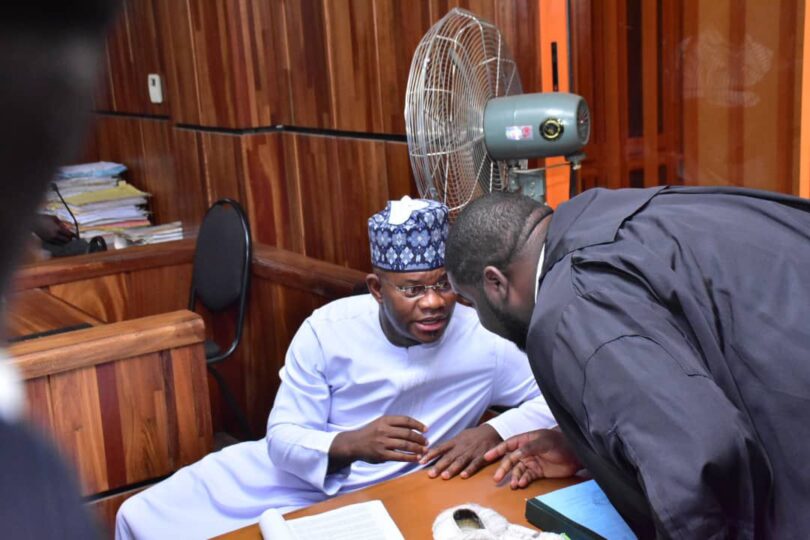
The Federal Capital Territory (FCT) High Court in Maitama, Abuja, on Tuesday, admitted a previous judgement as evidence in the ongoing trial of former Kogi State Governor, Yahaya Bello, over an alleged N110.4 billion fraud.
Mr Bello is being prosecuted by the EFCC alongside Umar Shuaibu Oricha and Abdulsalami Hudu on a 16 counts of criminal breach of trust and money laundering.
Earlier on Tuesday, the 14th prosecution witness, Nicholas Okehone, who is an internal auditor with the American International School, Abuja, told the court he was aware of a suit filed by Ali Bello against the school and the judgment delivered in the case.
The prosecution led by Kemi Pinheiro, a Senior Advocate of Nigeria (SAN), who led the witness in his evidence-in-chief, tendered the certified true copy of the judgement in suit marked FCT/ST/CB/6574/2023 and a payment receipt.
Defence lawyers Joseph Daudu, a SAN, and Z.E. Abbas did not oppose the move.
The judge, Ms Anineh, admitted the documents as Exhibits AY and AY2.
Led in evidence by the prosecution lawyer, the witness confirmed that Ali Bello, a nephew of former Governor Bello and Chief of Staff to the incumbent Governor Usman Ododo of Kogi State, was the claimant in the suit and identified him as the father of a prospective student, Zayyan Bello. He, however, clarified that Ali Bello was not the father of four other children referenced in the documents.
“From our record, Yahaya Adoza Bello is the father of the four children,” the witness said.
He further disclosed, while reading from the admitted judgement, that arrangements were made for the payment of the children’s school fees up to graduation through an upfront payment plan.
According to him, $569,864.12 was paid into the school’s account domiciled in TD Bank, adding that receipts were issued for the transactions.
Under cross-examination, defence lawyer, Mr Daudu, confirmed from the witness that the American International School is located in the Durumi District of Abuja and that Mr Okehone had worked as an internal auditor at the institution for about eight to nine years.
The witness also told the court that his role did not involve interfacing with students and that he did not represent the school in the suit whose judgment was tendered.
Following cross-examination by both defence teams and with no re-examination, the court discharged the witness.
After the witness was discharged, the prosecution urged the court to suspend hearing of a pending application by the first defendant, Mr Bello, challenging the court’s jurisdiction.
Mr Pinheiro, relying on provisions of the Administration of Criminal Justice Act (ACJA), argued that criminal trials should not be stalled by interlocutory applications.
He cited Sections 111, 221 and 396(2) and (3) of the law, maintaining that objections raised after arraignment should be incorporated into final written addresses and determined in the final judgement.
“It has become a judicial policy that courts do not entertain interlocutory applications that interrupt trials,” he said, noting that the case, which began in 2014, had progressed substantially.
But Mr Daudu opposed the application, citing the case of Shema vs FRN (2019) and arguing that the prosecution’s position was misconceived.
In response, Mr Pinheiro dismissed the authority as inapplicable, insisting it did not address the relevant provisions of the ACJA.
After hearing both sides, the judge, Ms Anineh, adjourned the case until 8 May for ruling on the application and continuation of trial.