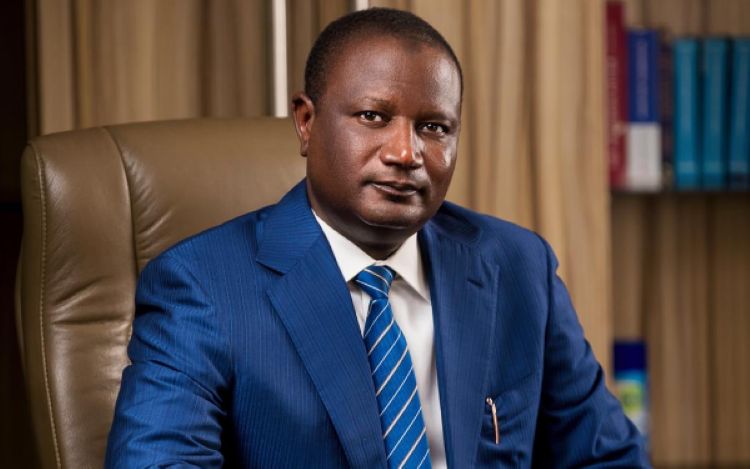
Nigerian oil magnate, Abdulrahman Musa Bashar and his firm, Ultimate Oil & Gas FZCO, are currently facing a battle over an alleged multimillion-dollar unpaid gasoil debt.
A United Kingdom (UK) High Court has granted a post-judgment worldwide freezing order against Abdulrahman Musa Bashar and Ultimate Oil & Gas FZCO over an unpaid gasoil debt.
The order followed an application by Petrichor Energy FZCO, a UAE-based oil trading company, which sought to recover outstanding sums arising from the supply of gasoil to Ultimate, alongside a personal guarantee issued by Bashar.
According to court documents, Petrichor had previously secured summary judgments against the parties in February 2025, with the court ordering Ultimate to pay AED 22.8 million and Bashar to pay AED 122.1 million under the personal guarantee, in addition to interest and costs.
The dispute originates from a series of contracts between Petrichor and Ultimate involving the sale of several parcels of gasoil and Jet A1 fuel.
The business relationship reportedly began with five spot contracts, followed by a term contract executed on April 25, 2023.
While Ultimate eventually settled payments for products supplied under the spot contracts, it allegedly failed to pay the associated interest as well as demurrage charges under the first and fourth spot contracts.
On November 22, 2023, Petrichor initiated arbitration proceedings at the Dubai International Arbitration Centre (DIAC), seeking recovery of the unpaid interest and demurrage tied to the spot contracts.
Subsequently, two cargoes were delivered under the term contract. However, according to court filings, Ultimate again failed to meet its payment obligations, leading to further breaches.
On January 14, 2024, the parties entered into a payment agreement aimed at restructuring Ultimate’s outstanding debt under both the spot and term contracts. Under this arrangement, Petrichor agreed to continue supplying additional cargoes, subject to compliance with the agreed repayment schedule.
As security for Ultimate’s obligations, the company issued nine undated cheques, all signed by Bashar, who also provided a personal guarantee backing Ultimate’s obligations under the agreement.
Following partial compliance with the payment agreement, Petrichor agreed to supply an additional cargo of gasoil under a new spot contract.
However, Ultimate defaulted again, prompting Petrichor to issue a notice of breach on March 20, 2024, which Ultimate denied.
On April 4, 2024, Petrichor presented seven cheques for payment and demanded settlement under the personal guarantee. The cheques were returned unpaid two days later due to “irregular” signatures.
Petrichor subsequently filed a criminal complaint over the dishonoured cheques, resulting in Bashar’s conviction in absentia and a one-year prison sentence, which was later revoked at the parties’ request.
In April 2025, the parties entered into a new payment agreement involving structured instalments, with limited grace periods for delayed payments.
The court said Ultimate defaulted on multiple instalments despite extensions and partial payments.
“The sum of AED 120,089,582.69 and £94,025.56 (approximately US$32.7 million) is owed by Mr Bashar in respect of summary judgment in the PG Proceedings,” the court briefing reads.
“The sum of AED 27,491,540.66 and £63,859.28 (approximately US$7.5 million) is owed by Ultimate in respect of summary judgment in the New Spot Proceedings.”
Issuing the freeze order, the judge said there was sufficient evidence to establish a risk that the respondents could dissipate assets.
Central to this finding was a March 15, 2026, conversation in which Bashar allegedly threatened to “dispose of his assets” if Petrichor did not accept Ultimate’s payment terms.
“I consider that this does, indeed, provide direct evidence of a risk of dissipation,” he said.
The court also took into account the respondents’ continued failure to comply with court orders, along with prior findings of contempt in separate proceedings.
The judge noted that Bashar sold properties in the UAE and the UK worth about US$3,812,117 and AED 13,420,000 (approximately US$3,656,675.75).
He added that there is now “a good arguable case” that assets could be moved, concluding that “it is appropriate to grant a worldwide freezing order post-judgment in the terms sought”.