“The legal barrier to their employment has been completely swept away by the constitutional grace of the pardon; the Plaintiffs have a clear, enforceable right to be reinstated,” the judge ruled.
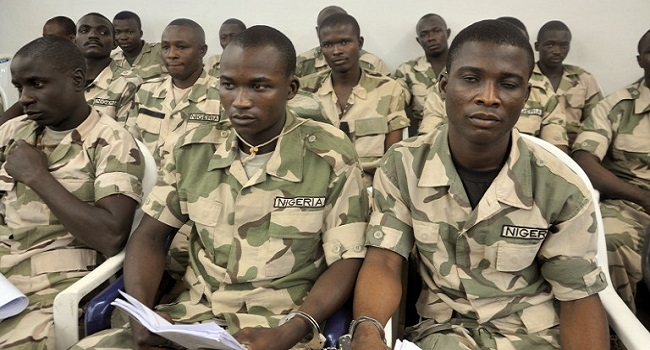
The National Industrial Court of Nigeria (NICN) in Lagos has ordered the reinstatement of 70 dismissed soldiers into the Nigerian Army following a presidential pardon granted by former President Muhammadu Buhari in 2022.
He also ordered the Chief of Army Staff to reinstate them “into the Nigerian Army with effect from 18 July 2022 (the date of the presidential pardon).”
He further directed that all their salaries, emoluments, and allowances shall be paid from the date of the presidential pardon to when they are officially reinstated, the judge pronounced.
The military personnel were dismissed from the military after the courts martial convicted them of mutiny between 2013 and 2014.
Their mutiny trial had stemmed from their refusal to fight in battles against Boko Haram at the time when their lawyer said they were starved of equipment to confront the insurgents.
Following the pardon they secured through a request by Femi Falana, a Senior Advocate of Nigeria who wrote to the then-President Muhammadu Buhari, they instituted their suit to seek reinstatement into military service and recovery of remunerations they were denied of during their dismissal.
In agreement with the soldiers’ prayers, Judge Yelwa ruled that the pardon “has wiped out their conviction, sentence, and dismissal from the Nigerian Army.”
He therefore ordered that the soldiers are entitled to reinstatement and full financial remuneration from 2014 (when they were convicted of mutiny).
In 2014, the 70 soldiers were sentenced to death for mutiny for disobedience to military directives and absconding from battle. The soldiers argued that they were not provided with appropriate equipment to fight Boko Haram insurgents.
Human rights lawyer Falana represented 58 of the 70 soldiers during their court-martial.
In 2015, army authorities which must confirm the decisions of the general court martial, commuted the death sentence to 10 years’ imprisonment. But Mr Falana insisted on unconditional and immediate release of the soldiers.
“Although the soldiers were charged with mutiny, the only allegation proved against them at the courts-martial was that they protested the refusal of the military authorities to provide weapons to fight insurgency,” Mr Falana wrote at the time.
“Unlike many soldiers who deserted the army, the convicts were ready to defend the territorial integrity of the country. They only made a legitimate demand for equipment to fight the insurgents who were better equipped and motivated.”
In September 2021, Mr Falana wrote a letter to former President Buhari asking that they be pardoned.
In the letter, he argued that their dismissal from the army was ill-advised by the military authorities and their demand for weapons was legitimate.
In July 2022, Mr Buhari granted the request. The soldiers had served their time in prison.
However, the 70 soldiers, despite writing to the Chief of Army Staff requesting reinstatement, were not reinstated. This formed the basis of their suit.
Through their lawyers, Funmi Falana, SAN, and C.H. Onwuemene, the claimants sued the Attorney General of the Federation (AGF) and the Chief of Army Staff.
The AGF’s office, through its lawyer Omobolanle Aina, argued that a pardon does not nullify the historical fact of conviction.
The government’s lawyer maintained that pardon “does not automatically revive an employment relationship that was lawfully terminated as a consequence of that conviction.”
“Reinstatement, according to counsel, remains dependent on the specific regulations of the employer, such as the Public Service Rules or the Nigerian Armed Forces Rules of Engagement,” she added.
Similarly, Ms Aina noted that a pardon does not “operate retroactively to create financial entitlements” that were lost during dismissal or suspension except by an order from the employer or court.
The Chief of Army Staff had no representation in court and did not file any process or address.
After hearing the submissions of the plaintiffs and the AGF’s office, the judge noted that the presidential pardon granted to the 70 soldiers is absolute and unconditional.
“The legal barrier to their employment has been completely swept away by the constitutional grace of the pardon; the Plaintiffs have a clear, enforceable right to be reinstated,” he said.
He also noted that the failure of the Chief of Army Staff to respond to the request for reinstatement “is an administrative omission which this Court as a court of law and court of equity has the power to correct.”
However, the judge said that the pardon does not back-pay for services the 70 soldiers rendered before the presidential pardon and there is no clause in the Instrument of Grant of Pardon of an “executive directive or condition for the payment of salary arrears.”
“The plaintiffs’ entitlement to emoluments can only commence from the date their legal capacity was restored, which is the date of the presidential pardon.”
He held that the pardon returned the 70 soldiers to “the position of a ‘new man’ (novus homo).”