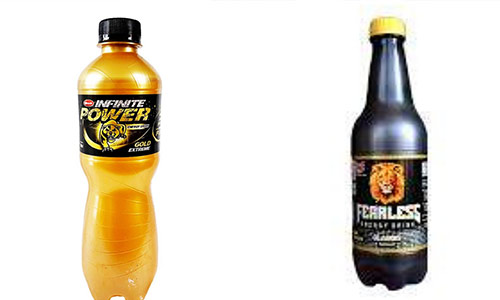
A Federal High Court sitting in Abuja has restrained Mamuda Beverages Nigeria Limited from further producing its Pop Power Energy Drink in a bottle design alleged to be confusingly similar to Rite Foods Limited’s Fearless Energy Drink.
The order was made by Justice Binta Nyako in Suit No. FHC/ABJ/CS/705/2025, following a fresh trademark and product design dispute between Rite Foods and Mamuda Beverages.
The court refused a preliminary objection filed by Mamuda Beverages, in which the company had challenged the suit on the grounds of abuse of court process. Mamuda had argued that Rite Foods’ fresh complaint was different from an earlier suit between the parties, where the company had already entered into terms of settlement over alleged infringement.
However, the court held that Mamuda’s new bottle design still bore a striking resemblance to Rite Foods’ Fearless Energy Drink product.
Consequently, the court granted an order restraining Mamuda Beverages from further producing Pop Power Energy Drink pending the final determination of the substantive suit.
The court also ordered Mamuda to immediately cease production of the product, destroy all existing products, and directed the court bailiff, in conjunction with the parties, to take inventory of the products marked for destruction and file same before the court.
Justice Nyako further ordered that the injunction would remain in force until the end of the year or pending the determination of the substantive suit.
The matter was adjourned to September 23, 2026, for hearing of the substantive case.
The latest order follows an earlier legal battle between both companies in January 2025, when Rite Foods sued Mamuda Beverages over alleged infringement of the trademark and design of its Fearless Energy Drink through the launch of Pop Power Energy Drink.
In that earlier suit, marked FHC/ABJ/CS/139/2025, Mamuda opted for settlement after the court granted injunctive reliefs, including Anton Piller orders.
The terms of settlement were later adopted by Justice I.E. Ekwo as a consent judgment on March 4, 2025.
Under the settlement, Mamuda Beverages agreed to desist from further violation of the Fearless Energy Drink trademark and identity, destroy all infringing products, and change its product design to avoid any form of imitation.
However, Rite Foods alleged that Mamuda later reintroduced Pop Power into the market with only minor cosmetic changes that did not cure the original concerns of consumer confusion.
According to Rite Foods, the revised Pop Power bottle still looked too similar to Fearless Energy Drink and was still being informally referred to in the market as “small Fearless.”
The company maintained that the issue goes beyond brand rivalry, insisting that its major concern is consumer protection, as some consumers may mistake Pop Power for Fearless Energy Drink.
Rite Foods also argued that Mamuda’s alleged conduct raised broader concerns about compliance with court judgments, respect for intellectual property rights, fair competition and consumer clarity in the Nigerian market.
In a letter dated April 3, 2025, addressed to Mamuda’s counsel, O.E.B. Offiong, counsel to Rite Foods, Wale Babalakin, SAN, alleged that Mamuda had violated the terms of settlement and consent judgment.
The letter acknowledged that Mamuda had made some changes, including changing borderlines from yellow to white and replacing the word “Classic” with “Original,” but maintained that other key terms had not been complied with.
Mamuda Beverages, however, denied any breach of the consent judgment. Its counsel, O.E.B. Offiong, SAN, said the company took its obligations seriously and was complying with the terms of settlement as a law-abiding corporate citizen.
The company has also reportedly described Rite Foods’ fresh legal move as “bullying,” insisting that it complied with the earlier judgment by making changes to the product design.
The dispute has again brought attention to the importance of trademark protection, passing off, product identity and fair competition in Nigeria’s commercial environment.
Legal experts say passing off occurs when a business presents its product in a manner likely to mislead consumers into believing it is associated with another established brand.
Commenting on the controversy, Mr. Kabir Akingbolu, Principal Partner at Salawu, Akingbolu & Co., Lagos, said the similarity between both products raised serious issues of passing off and trademark infringement.
According to him, Fearless Energy Drink had been in the market for years and had become known to consumers, making it improper for another company to adopt a design that could benefit from its market identity.
“Passing off is a strict and serious commercial offence and infringement when it borders on trademark. Looking at the issues at hand, the two bottles, Fearless and Pop Power, is a clear case of passing off,” he said.
He argued that from the cover to the bottle, size and colour, Pop Power appeared positioned to benefit from the market identity built by Fearless over the years.
Akingbolu further stated that the issue could mislead vulnerable consumers, especially those who may not be able to distinguish between the two products easily.
“For instance, if you put the two products before illiterates and kids who could neither write nor read, the probability that they would choose indiscriminately is very high,” he said.
He added that Rite Foods could claim damages and seek further injunctive reliefs if it believes Mamuda has repeated conduct already addressed by the earlier consent judgment.
The ongoing dispute is not the first time Mamuda Beverages has faced a trademark controversy. In 2022, The Coca-Cola Company sued Mamuda over alleged infringement relating to the use of “Pop” in connection with its fizzy drink product, Pop Cola.