The judge issued the summons following the affidavit of facts the lawyer filed on 22 May.
A Federal High Court judge in Abuja, James Omotosho, on Wednesday, ordered Mohammed Ahmed, lawyer to convicted former Minister of Power, Saleh Mamman, to appear over an affidavit he swore casting the judgement convicting the former minister as an emotional outburst of the judge.
Mr Ahmed is expected to appear before the court on 24 June, the date set for hearing in a post-conviction forfeiture proceedings targeting assets suspected to be proceeds of Mr Mamman’s criminal activities.
Judge Omotosho convicted the former minister on all counts on 7 May, and sentenced him on 13 May to 75 years’ imprisonment on money laundering charges involving public funds.
He also issued a warrant for his arrest over repeated absences from court, including during his conviction and sentencing.
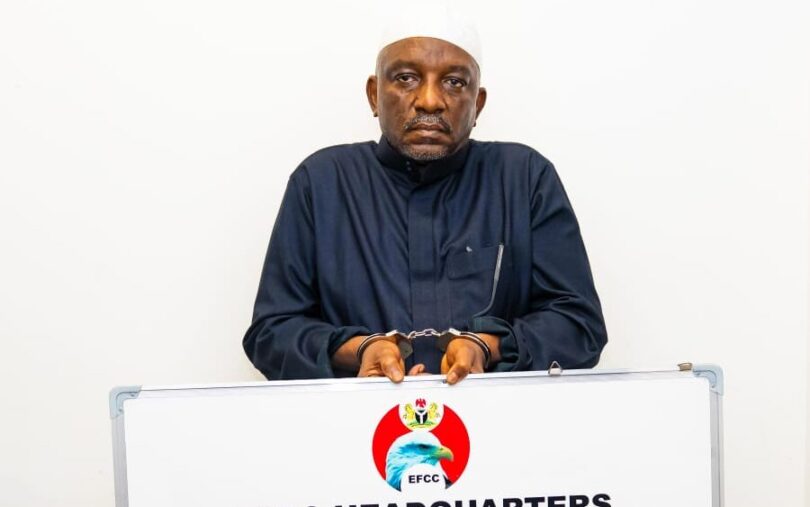
Following surveillance and intelligence operations, EFCC operatives arrested Mr Mamman on 19 May, in his hideout in the Rigasa area of Kaduna State.
They also arrested one Shamsudeen Mohammed, a relative found with him.
The EFCC later brought him before the court on 26 May, when the judge ordered that he be remanded at the Kuje Custodial Centre in Abuja to begin his sentence. On the same day, the judge fixed 8 June for hearing of the EFCC motion seeking forfeiture of five additional properties linked to him.
Judge Omotosho said he fixed the date in the interest of fair hearing after being informed that a defence lawyer left the courtroom without notifying the court or the prosecution.
The properties include Walijam Apartments at No. 43, Plot 435 Lobito Crescent, Wuse 2, Abuja, and Bloom Luxury Suites Nigeria Limited at No. 5 Amana Crescent, New Estate Unguwan Rimi, Kaduna State.
Others are a mansion at No. 11 Misratah Street, Wuse 2, Abuja; a mansion at No. 13 Misratah Street, Wuse 2, Abuja; and A.U.A. Plaza at Plot 734 Kade Street, Wuse 2, Abuja.
On 8 June, EFCC lawyer, Rotimi Oyedepo, a Senior Advocate of Nigeria (SAN) and the Director of Public Prosecution (DPP) who led the prosecution that secured the ex-minister’s conviction, told the court the motion sought permanent forfeiture of properties linked to the convict.
Meanwhile, Mr Omotosho drew attention to an affidavit sworn by Mr Ahmed stating that the 7 May judgement was delivered when the judge “became enraged”.
But Mr Oyedepo said he had not been served with the affidavit. The judge then ordered Suleiman Yakubu, who appeared for Mr Mamman on the said date to serve the prosecution.
The judge also directed that Mr Ahmed must appear in court to clarify paragraphs in the affidavit. He adjourned the matter until 10 June.
However, at Wednesday’s hearing, Mr Yakubu told the court that Mr Ahmed was absent due to illness and apologised on his behalf.
“He has been coughing, and we do not know if it is tuberculosis because the cough has defied all drugs,” Mr Yakubu said.
He added that Mr Ahmed had travelled to his village for treatment and asked for adjournment.
But the judge questioned the claim of tuberculosis diagnosis.
Mr Oyedepo also criticised the defence team’s conduct while noting that lawyers must act responsibly within the justice system.
He said the prosecution’s motion was ready for hearing and faulted lack of communication from the defence. “But this antics will not work,” he said.
Responding, Mr Yakubu rejected the remarks as unfair, saying it was wrong to suggest bitterness within the defence team.
After Mr Omotosho reviewed the chain of events that led to the judgement, he decided to give Mr Ahmed another opportunity to appear in court.
He adjourned the matter until 24 June for hearing of the EFCC motion and for the appearance of the deponent.