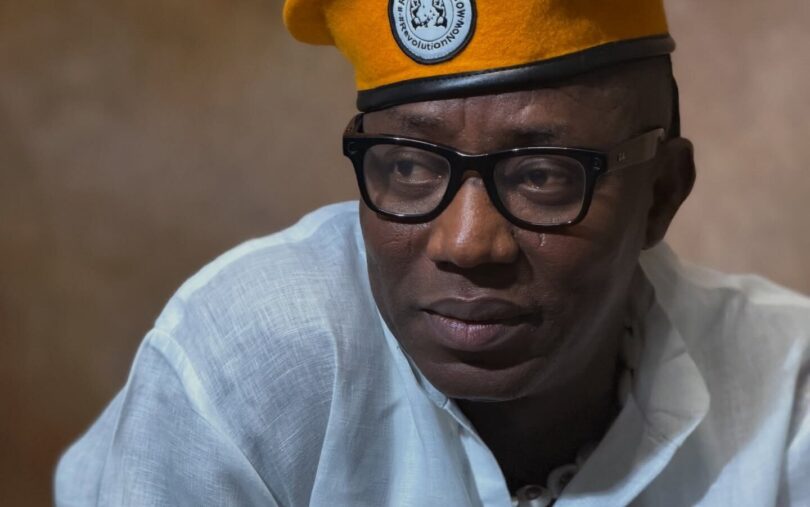
Mr Sowore, who was arrested shortly after Monday’s proceedings and was immediately remanded in Kuje Correctional Centre in Abuja, is challenging the court’s 16 June decision revoking his bail and issuing a bench warrant for his arrest following his absence from court on that date.
The Federal High Court in Abuja on Wednesday fixed 30 June for ruling on an application by activist and presidential candidate Omoyele Sowore seeking the restoration of his bail, which was revoked last week and led to his remand in prison on Monday.
Mr Sowore, who was arrested shortly after Monday’s proceedings and was immediately remanded in Kuje Correctional Centre in Abuja, is challenging the court’s 16 June decision revoking his bail and issuing a bench warrant for his arrest following his absence from court on that date.
Arguing the application, defence lawyer R.O. Adakole, who held brief for Adeyinka Oloyede-Fusika, a Senior Advocate of Nigeria (SAN), urged the court to “restore the status quo that existed before 16 June.”
The lawyer adopted a motion on notice dated 17 June and filed on 19 June, alongside a 25-paragraph affidavit deposed to by Emmanuel Larry.
He also relied on a further affidavit filed on Wednesday and a reply on points of law dated 23 June.
Mr Adakole urged the court to grant the application “in the interest of justice” and discountenance the counter-affidavit filed by the prosecution.
The prosecution, led by Akinlolu Kehinde, also SAN, opposed the application.
Mr Kehinde said the prosecution filed a 25-paragraph counter-affidavit and a written address urging the court to refuse the request.
He argued that Mr Sowore had not placed sufficient and truthful facts before the court to justify the exercise of the court’s discretion in his favour.
The prosecution asked the court to dismiss the application.
After listening to both sides, Judge Umar adjourned the matter until 30 June for ruling.
Shortly after the adjournment, the defence asked the court to release Mr Sowore to his lawyers pending the ruling.
Mr Adakole argued that the defendant was represented by a senior advocate of “impeccable character” whose undertaking to produce him in court should be sufficient.
The prosecution objected, arguing that such a request could not be made orally.
In response, the judge questioned whether releasing Mr Sowore would amount to determining the substantive application before the court.
“If I release him, won’t that mean I have ruled on the application?” the judge asked.
He declined the request and ordered that the existing arrangement remain pending the ruling.
The SSS filed the cybercrime charges against Mr Sowore for his X and Facebook posts last year calling President Tinubu a criminal.
The agency arraigned him before the Federal High Court in Abuja in December 2025. He pleaded not guilty and was granted bail on self-recognition.
On 13 May, the court dismissed his no-case submission and ordered him to open his defence.
Mr Sowore subsequently filed an application asking Judge Umar to withdraw from the case, alleging bias.
The judge fixed 15 June for ruling on the application. However, the court did not sit on that date despite Mr Sowore’s appearance in court.
According to the defence, Mr Sowore later informed court officials that he would travel to Lagos and requested that any new hearing date be fixed in July.
The matter was, however, rescheduled for 16 June. When Mr Sowore failed to appear, the court revoked his bail and issued a bench warrant for his arrest.
On Monday, the court dismissed his application seeking the judge’s recusal and ordered his remand at the Kuje Correctional Centre pending the hearing of his application challenging the bail revocation and arrest warrant.
Meanwhile, PREMIUM TIMES reported that the revocation of Mr Sowore’s bail drew criticism from several political and civil society groups including Amnesty International Nigeria, SERAP, the #EndBadGovernance movement and the African Action Congress.
The critics argued that the decision raised concerns about due process, freedom of expression and the treatment of government critics.
The African Action Congress (AAC), Mr Sowore’s political party, described the decision as unfair and politically motivated, arguing that he had appeared in court on 15 June before the matter was rescheduled.