“Reclaiming African Civilizational Voices: The Arochukwu Renaissance and the Future of Indigenous Knowledge in a Global Information Age.”
Executive Summary.
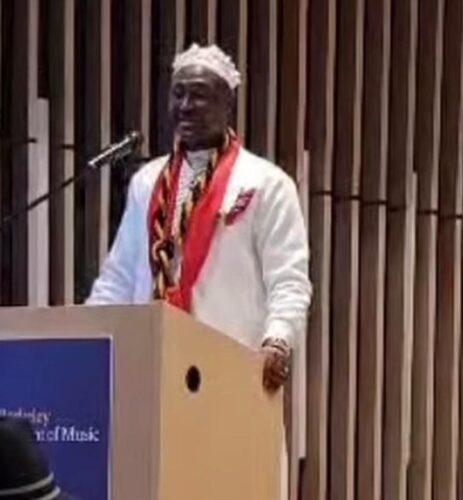
Earlier this year, His Eminence, Dr. Eberechukwu Oji, Eze Aro of the Ancient Kingdom of Arochukwu, delivered a landmark lecture at the University of California, Berkeley titled ‘Reclaiming African Civilizational Voices: The Arochukwu Renaissance and the Future of Indigenous Knowledge in a Global Information Age.’ The lecture was not some ceremonial diplomacy dressed in academic language; it was, indeed, a policy paper delivered in royal regalia, articulating a civilizational roadmap for how African indigenous institutions can engage modernity without self-erasure. In essence, the address positions the Aro Kingdom not as a museum piece but as a living archive of governance, jurisprudence, and epistemology with urgent contemporary relevance.
I. Cultural Preservation and Historical Reclamation:
From Object to Subject
Content Analysis
The Eze Aro opens with an epistemological provocation: “Who produces knowledge? Whose histories survive?” This frames the entire lecture as an intervention in the politics of knowledge production.
The address systematically dismantles the colonial historiographical conceit that portrayed African societies as “static, fragmented, primitive, or ahistorical.”
The characterisation of Arochukwu as a “civilizational archive” is particularly potent. It reclaims the kingdom from ethnographic curiosity to world-historical significance. The lecture documents:
– The Aro Confederacy (c. 17th century) as an indigenous model of regional integration predating modern federalism.
– The Ibini Ukpabi oracle not as superstition but as a “powerful institution of moral arbitration, conflict mediation, ritual diplomacy, and intercommunal legitimacy”
– The Ekpe Society as a transregional governance network extending into Cuba as the Abakuá Society, demonstrating civilizational continuity across the Black Atlantic.
Critical Assessment
Strengths:
The address achieves what decolonial scholars have long advocated, as it shifts Africa from the object to the subject of history. The call for a Center for Arochukwu History and Cultural Renaissance is concrete and actionable, spanning oral history preservation, digital archiving, language documentation, and museum partnerships.
Tensions: The lecture’s candour about Aro role in the trans-Atlantic slave trade (“the same networks that facilitated migration, diplomacy, commerce, and cultural exchange also became entangled in the tragic machinery of the trans-Atlantic slave trade”) is intellectually courageous. However, this moral complexity is somewhat underdeveloped. The address gestures towards “historical honesty without simplification” but does not fully articulate what healing accountability would look like.
Implied Issues
1. Epistemic Justice:
The address raises the question of who controls the digitisation of African knowledge. The Eze Aro warns that “entire civilizations risk digital invisibility” as AI systems are trained overwhelmingly on Western archives. This implies a need for data sovereignty frameworks and indigenous digital rights.
2. Museum Repatriation:
The call for “museum partnerships” implies, but does not explicitly demand, the repatriation of Aro cultural artifacts held in Western institutions.
3. Language Endangerment:
The reference to “thousands of African languages remain poorly digitized” points to a crisis of linguistic extinction that the proposed Center must address through computational linguistics and NLP development for low-resource languages.
II. Traditional Institutions and Nation Building: The Governance Paradigm
Content Analysis
The address presents the Eze Aro institution as one of West Africa’s oldest continuous hereditary offices, emphasizing its unique synthesis of monarchy and republican consultation. The governance model described involves:
– Councils of elders and titled men
– Lineage heads and spiritual custodians
– Age-grade institutions and communal consensus mechanisms
The 73-year reign of Eze Kanu Oji (1914-1987) is deployed as evidence of institutional resilience across colonialism, independence, civil war, and postcolonial transition.

Critical Assessment
Strengths:
The lecture makes a sophisticated theoretical contribution by distinguishing between legal authority (the modern state’s claim) and relational legitimacy (the indigenous system’s foundation). This is a genuinely important intervention in governance studies. The Aro model demonstrates that “societies can sustain political order through cultural trust, shared norms, symbolic authority, and negotiated consensus.”
Limitations:
The address idealises the consultative nature of the Eze Aro institution without examining its exclusionary dimensions. Who was excluded from these councils? How did gender, class, and slave status structure participation? The lecture’s silence on women’s roles in Aro governance is a notable omission for an address delivered in 2026.Given that Queen Mgbokwo Udo Omini once sat as Eze Aro.
Contemporary Relevance:
The argument that “sustainable development in Nigeria must integrate indigenous leadership structures with democratic institutions” is timely. Nigeria’s postcolonial state has struggled with legitimacy crises precisely because statutory governance often operates without relational embeddedness. The Eze Aro’s claim that traditional rulers are “custodians of peace, mediators in conflict, and partners in grassroots development” aligns with empirical evidence
that customary institutions often provide more effective dispute resolution than overstretched formal courts.