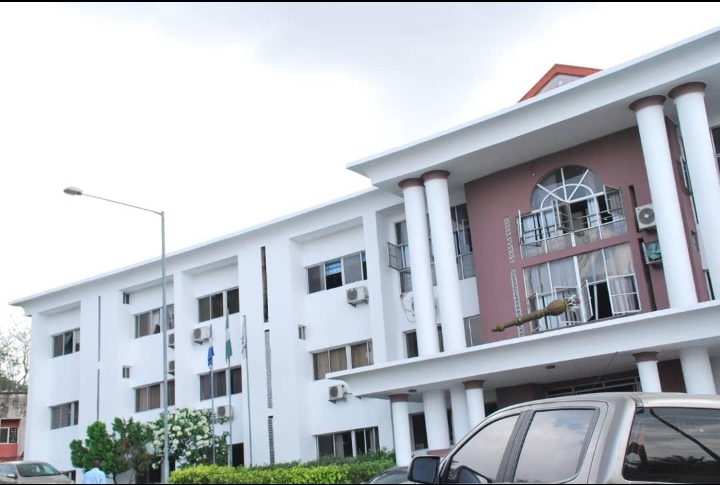
The appeal was presented as the Cross River delegation joins governments, development partners, financial institutions and environmental organisations at COP17 to discuss land restoration, climate resilience and financing.
The Cross River State Government has taken its July–August 2026 landslide and flood disasters to the United Nations Convention to Combat Desertification (UNCCD) COP17 in Ulaanbaatar, Mongolia, seeking $25 million in international support for emergency response, ecological restoration and long-term resilience.
In the document reviewed by PREMIUM TIMES, the government said its proposal would address the immediate humanitarian needs arising from the disasters while tackling underlying environmental and infrastructure vulnerabilities that have worsened flooding, erosion and landslide risks.
The appeal was presented as the Cross River delegation joins governments, development partners, financial institutions and environmental organisations at COP17 to discuss land restoration, climate resilience and financing.
According to the state’s evidence note prepared for the conference, prolonged heavy rainfall triggered a series of landslides and floods across Calabar and surrounding communities between July and August.
At Ikot Anwatim in Calabar Municipality, the government said a landslide reportedly killed five people, including four children from the same family, while destroying two houses and injuring other residents.
Days later, it said another landslide at Boro Pit/Satellite Town killed a child and destroyed residential property.
The state also reported that a one-month-old baby was swept away by floodwaters at Elijah Henshaw Street.
By late July, a major mudslide at Diamond Hill near the Calabar Jetty prompted state authorities to warn that the scale of the ecological threat was beyond the capacity of a single institution.
Under the proposed initiative, Cross River is seeking a catalytic $25 million over 36 months.
The state proposed allocating $3 million to humanitarian protection, shelter, water, sanitation and hygiene (WASH) and household recovery.
Another $6 million would go to emergency slope stabilisation, critical drainage and erosion-control works, while $4 million would support risk mapping, geotechnical and hydrological studies and early-warning systems.
The plan also proposes $6 million for watershed, forest, riparian, wetland and urban nature-based restoration, $4 million for resilient community infrastructure and livelihood recovery, and $2 million for programme management, safeguards, monitoring and contingency.
The state stressed that the $25 million figure was an advocacy and planning target rather than a final engineering cost, saying it would need to be validated through detailed damage-and-needs assessments and technical investigations.
Cross River said its proposal was designed to move beyond repeated emergency relief to a broader programme of prevention and restoration.
The initiative has five pillars: protecting vulnerable people, stabilising critical sites, making Calabar and other priority towns flood-resilient, restoring forests and wetlands, and building a risk-informed state.
The state is seeking support for geotechnical investigations of high-risk locations, hydrological and drainage modelling, multi-hazard mapping, satellite and drone-based monitoring, early-warning systems and risk-informed land-use planning.
It also wants restoration of degraded watersheds, riparian buffers, mangroves, wetlands and unstable slopes to be integrated with engineering interventions.
“Cross River is not asking partners to fund repeated emergency clean-up,” the state said in its COP17 appeal. “It is asking for a transition from response to resilience: protect people, repair systems, restore land, reduce exposure and create the institutions that keep risk from rebuilding.”
The state argued that its ecological importance makes the crisis relevant not only to Nigeria but also to global restoration efforts.
Cross River is home to more than half of Nigeria’s remaining tropical high forest, according to UN-REDD, and contains lowland rainforest, freshwater swamp forest, mangroves, wetlands and montane ecosystems.
But the state said its ecological assets are under growing pressure, citing a recent sustainable development report which estimated that Cross River lost about 134,000 hectares of tree cover between 2001 and 2023.
It said forest loss and land degradation could reduce watershed and slope resilience, while unplanned development, excavation, blocked drainage and poor waste disposal could intensify local runoff and flooding.
However, the state cautioned against attributing the 2026 disasters solely to climate change.
“Heavy rainfall is an immediate trigger in several reported incidents, but the precise contribution of climate change, soil conditions, slope geometry, land-use change, drainage obstruction and other human pressures cannot be assigned without event-specific hydrometeorological and geotechnical analysis,” the report said.
It added that the documented exposure and vulnerability were sufficient to justify urgent intervention.
The Cross River delegation is asking COP17 partners to recognise the state’s landslide and flood emergency as an urgent land-restoration and human-resilience issue.
It is also seeking a multidisciplinary technical mission involving geotechnical, hydrological, ecological, urban-planning and humanitarian experts to validate priority sites and develop an investable recovery plan.
Other demands include immediate humanitarian and anticipatory-action financing for vulnerable communities, funding for stabilising critical slopes and drainage corridors, establishment of a geospatial risk and early-warning platform, and a multi-year landscape restoration programme.
The state said such investments would help protect its forests, watersheds, wetlands and livelihoods while reducing future flood and erosion risks.