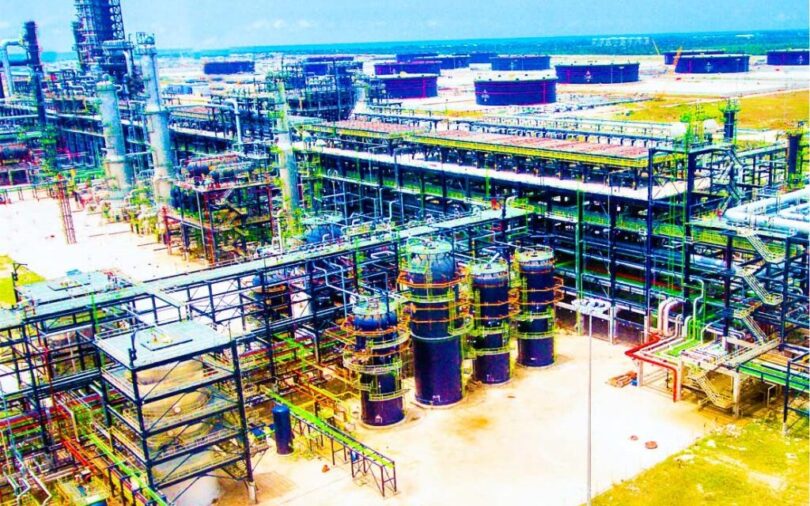
Analysts say Dangote Refinery’s rising jet fuel exports highlight Nigeria’s growing refining capacity, even as domestic airlines continue to grapple with high aviation fuel prices and operational strain.
The Dangote Petroleum Refinery exported an estimated 57 million barrels of jet fuel between April 2024 and April 2026, according to Kpler data cited during Channels Television’s Business Morning programme on Thursday.
The figures underscore the growing role of refined petroleum exports in Nigeria’s energy sector, particularly aviation fuel, as the country seeks to deepen local refining capacity and reduce reliance on imported products.
Speaking during the programme, Dumebi Oluwole, Manager at Financial Derivatives Company Limited (FDC), described the development as an important milestone for Nigeria’s energy sector.
“It’s a big deal because it strengthens Nigeria’s external balance position,” she said, noting that exporting refined products represents a major step in value addition within the oil and gas sector.
According to her, refined petroleum products generate greater economic value than crude oil exports because they serve industries and households directly.
“What we use on a daily basis that has the high demand for industries and households is the refined product. If Nigeria does not add value to its natural resource, we will still make a lot less in terms of export revenue,” she added.
The export growth comes amid persistent concerns within Nigeria’s aviation sector over the rising cost of Jet A1 fuel.
PREMIUM TIMES has reported extensively on the mounting pressure facing domestic airlines as aviation fuel prices surged sharply in recent months, triggering warnings of possible disruptions and operational shutdowns.
Several operators, including Air Peace, United Nigeria Airlines and Ibom Air, have repeatedly complained about soaring Jet A1 costs, saying the situation has strained airline operations and affected flight schedules.
The crisis also prompted intervention by the Minister of Aviation and Aerospace Development, Festus Keyamo, after airline operators warned that continued increases in fuel prices could threaten the survival of some carriers.
Despite those interventions, airlines have continued to report operational challenges linked to fuel costs, including delays, cancellations and reduced flight frequencies.
While praising Dangote Refinery’s export performance, Ms Oluwole cautioned against viewing the development as sufficient on its own to transform Nigeria’s refining sector.
“What Dangote Refinery has done is a stellar performance and a very big deal for the company. But Nigeria as a nation cannot necessarily ride on the success of the Dangote Refinery alone,” she noted.
She said that investors remain cautious about Nigeria’s refining ambitions given the country’s long history of failed refinery rehabilitation efforts and underperforming state-owned facilities.
According to her, sustained refining output and broader industry reforms would be necessary before the country fully realises the economic benefits of local refining.
Ms Oluwole noted that refined petroleum exports could significantly increase the contribution of the oil sector to Nigeria’s economy if refining capacity continues to improve.
She added that refined petroleum products could become strategically important to Nigeria’s export earnings over time if the country succeeds in expanding domestic processing capacity.
On global oil prices, Ms Oluwole said geopolitical tensions involving Iran and the United States are likely to keep the oil market volatile in the near term.
She also highlighted that Brent crude prices could remain around $100 to $105 per barrel unless there is clearer progress in ceasefire negotiations and easing tensions in the Middle East.