Journalists were denied access to the courtroom as proceedings commenced behind closed doors, while several civil lawyers were seen arriving at the venue ahead of the inauguration, indicating that legal representatives were present for the accused.
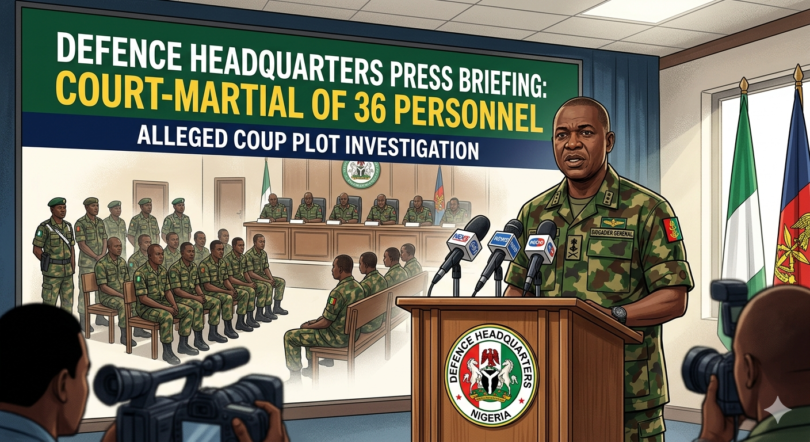
The Defence Headquarters has confirmed the inauguration of a General Court Martial (GCM) to try 36 serving military personnel over allegations bordering on mutiny and a plot to overthrow the elected government of President Tinubu.
Journalists were denied access to the courtroom as proceedings commenced behind closed doors, while several civil lawyers were seen arriving at the venue ahead of the inauguration, indicating that legal representatives were present for the accused.
In a statement issued on Friday, the spokesperson for the Defence Headquarters, Samaila Uba, said the court-martial was formally inaugurated as part of ongoing efforts to reinforce “discipline, accountability and the commitment of the Armed Forces to safeguarding national integrity and constituted authority.”
Last October, this newspaper reported that 16 military officers were arrested for the alleged coup plot. The arrests, made late September, culminated in the decision to cancel the Independence Day parade, according to sources familiar with the matter.
As investigation continued, more officers including former soldiers and civilians were arrested. By the end of January, sources said that 40 people had been arrested so far, while other suspects including a former governor and a retired military officer remain at large.
The Nigerian government, on Monday, filed 13 charges against the civilians and ex-military personnel at the Federal High Court in Abuja on Wednesday. The charges, including treason, terrorism, failure to disclose information and money laundering, were instituted by Rotimi Oyedepo, Director of Public Prosecutions of the Federation, acting on behalf of the Office of the Attorney-General of the Federation.
Those listed in the charge include Mohammed Ibrahim Gana, a retired major-general; Erasmus Ochegobia Victor, a retired navy captain; Ahmed Ibrahim, a police inspector; and Zekeri Umoru, an electrician at the Presidential Villa. Others named are Bukar Kashim Goni and Abdulkadir Sani, a Zaria-based Islamic cleric. They all pleaded not guilty to the charges.
Initially, authorities dismissed the report of the alleged coup. In a statement on 26 January, the Defence Headquarters admitted that there was a plan to oust the government of President Tinubu from office, saying officers involved would be investigated and prosecuted.
The Defence Headquarters noted that the trial is a continuation of its January announcement concerning the alleged breach of national security involving the affected personnel.
According to the military high command, the proceedings “marks a significant step in reinforcing discipline, accountability and the commitment of the Armed Forces to safeguarding national integrity and constituted authority.”
The Defence Headquarters assured that the trial would be conducted in line with established legal procedures, emphasising that fairness, impartiality and due process would guide all proceedings under the military justice system.
It also reiterated that the rights of the accused personnel would be respected, with provisions for fair hearing strictly observed throughout the trial.
It added that it remains resolute in maintaining discipline, professionalism and adherence to the rule of law across the armed forces while ensuring that justice is served without fear or favour.
According to a previous report by this newspaper, the panel was constituted under the Armed Forces Act.
A convening order cited by Sahara Reporters states that the proceedings venue will be secured by military police, naval police, air police and guards brigade personnel. The order also notes that no one is allowed to bring weapons into the courtroom except the court guards who are only allowed to carry arms around the court premises on every day of proceedings.
The panel is said to comprise senior officers drawn from the Nigerian Army, Nigerian Navy, and Nigerian Air Force, and is headed by a senior-ranking officer, with other members serving as directing staff and legal officers to oversee prosecution and procedure.
The panel is headed by Air Vice Marshal HI Alhaji as President, with members including Major Generals UT Opuene, IB Abubakar, NUC Ogili, SA Emmanuel and FU Mijinyawa; Rear Admirals DM Ndanusa and MK Igwe; as well as Air Vice Marshals MA Isah and AO Kotun. Air Vice Marshal MM Omar is mentioned as the waiting member.
The convening order also details key support roles, including the appointment of a liaison officer, prosecuting officers drawn from the Nigerian Army, Nigerian Navy and Nigerian Air Force, alongside a technical team, supervising officers and a court secretariat responsible for administrative functions.
The order emphasises that proceedings will be conducted under the authority of the Armed Forces Act and stipulates that, upon conclusion of the trial, the President of the General Court Martial must transmit the official record within a specified timeframe.
While the order does not spell out the specific charges, it notes that “the charges are to be served on the accused persons individually.”
It further affirms that both the prosecution and defence may call witnesses in line with the Evidence Act 2023, while guaranteeing the accused the right to legal representation of their choice.