In the second part of this three-part series, PREMIUM TIMES found that while governments approved budgets for HIV programmes, critical funds often failed to reach the health system.
Grace* never saw a state budget document, she never read a federal appropriation law or examined a budget implementation report.
What she knew was simple: the community health worker who discreetly delivered her antiretroviral medicines stopped coming, the counselling sessions ended, and the confidential support that allowed her to avoid the crushing weight of stigma vanished.
Forced to collect her medication at a public treatment centre, Grace was recognised, felt exposed, and eventually withdrew from care.
Her experience raises the central question at the heart of this investigation.
As international donors began scaling back community HIV programmes, were governments, particularly in Rivers and Akwa Ibom, two of Nigeria’s highest HIV-burden states, prepared to fill the gap?
A PREMIUM TIMES investigation, based on official budget documents, budget implementation reports, government expenditure records and interviews with government officials, programme managers, health advocates and people living with HIV, found little evidence that they were.
Instead, the newspaper found a practice that raises troubling questions about responsibility and accountability.
Year after year, governments at both the state and federal levels approved budgets for HIV response. Each year, much of that money was not released.
The consequence is weakened health systems, interrupted community services, and patients who disappear from care without raising an alarm.
As donor support shrank, the expectation was that governments would step in and take ownership of the response.
However, PREMIUM TIMES did not see evidence that this happened in Rivers and Akwa Ibom. Instead, both states continued to make budgetary provisions for the HIV response while implementation lagged.
Official budget documents and implementation reports reviewed by PREMIUM TIMES reveal a recurring pattern in both Akwa Ibom and Rivers states: governments consistently budgeted for HIV programmes, but the approved funds often failed to reach the agencies responsible for implementing them.
In Akwa Ibom, the State Agency for the Control of AIDS received capital allocations in every budget cycle reviewed by PREMIUM TIMES.
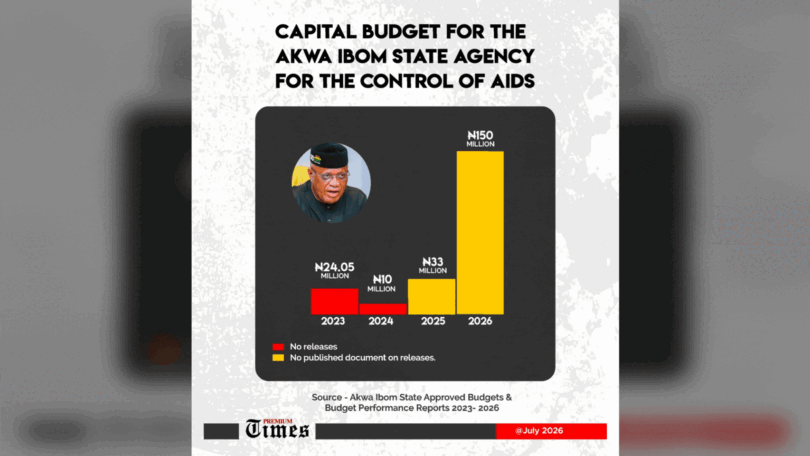
The agency was allocated capital budgets of N24.05 million in 2023, N10 million in 2024, N33 million in 2025 and N150 million in the 2026 budget.
The allocations covered activities central to HIV response, including the procurement of antiretroviral medicines, HIV rapid test kits, condoms and screening consumables.
On paper, the commitments suggested a government preparing to strengthen HIV services, although the approved funds were less than one per cent of the health sector’s total capital budget in each of the fiscal years reviewed by PREMIUM TIMES.
Conversely, budget performance reports reviewed by PREMIUM TIMES show that despite the budgetary allocations, the agency received no capital releases between 2023 and 2024.
The state has also not published the capital budget implementation report for 2025 or the first half of 2026, making it impossible for the public to independently determine whether subsequent releases were made and, if so, how the money was spent.
When contacted by PREMIUM TIMES, the Commissioner for Health, Ekem Emmanuel, said the agency received some support towards the end of 2025.
However, neither the commissioner nor the officials of the State Agency for the Control of AIDS provided documentary evidence of the amount released, the source of the funds, or the specific programmes financed.
However, the National Agency for the Control of AIDS (NACA), which conducts annual reviews of each state’s HIV investment through its state counterparts, told PREMIUM TIMES that Akwa Ibom had released only 1 per cent of its total 2024 and 2025 HIV appropriations.
Since the commissioner said funding was provided in 2025, the one per cent reported expenditure suggests that the oil-rich state spent no more than N330,000 out of its N33 million capital budget.
Across the border in Rivers State, PREMIUM TIMES found a similar pattern.
Official budget documents show that the state appropriated N180 million for HIV interventions in 2023 and another N230.66 million in 2024
The allocations covered procurement of HIV rapid test kits and consumables, community HIV counselling and testing, condom distribution and even the development of a state HIV anti-stigma law.
Yet the corresponding budget implementation reports
For 2025 and 2026, the Rivers State government has not published the approved fiscal documents necessary for independent scrutiny of HIV spending.
Repeated requests by PREMIUM TIMES seeking clarification from officials of the State Agency for the Control of AIDS yielded no explanation on whether subsequent releases had been made.