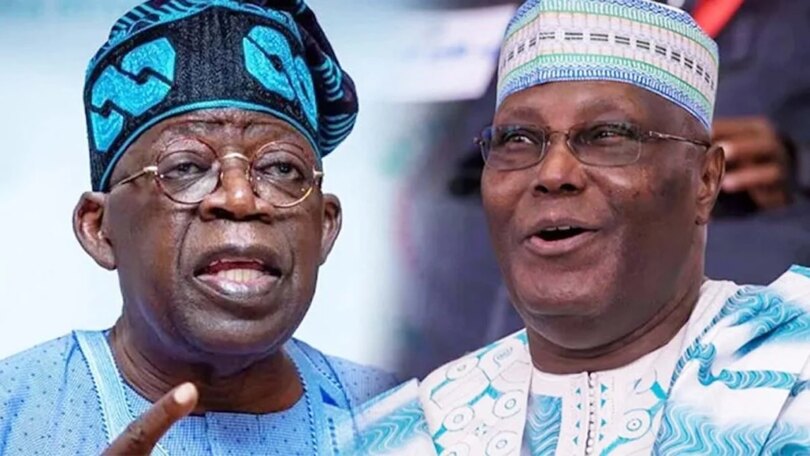
The Presidency has in a recent statement rejected former Vice President Atiku Abubakar’s criticism of President Bola Tinubu’s economic policies.
The present government insists that the country’s economy has improved significantly and warned the opposition leader against judging the administration based on events that occurred in 2024.
Special Adviser to the President on Information and Strategy, Bayo Onanuga, in the statement released on Sunday, said Atiku’s assessment of the economy was based on outdated figures and failed to acknowledge the progress made since the Federal Government introduced its economic reforms.
According to Onanuga, political disagreements are normal in a democracy, but they should be based on current facts rather than old data.
“Politics thrives on disagreement. Democracy demands it. But disagreements must be rooted in facts, not frozen snapshots of history,” he said.
The presidential spokesman was responding to allegations by Atiku that the Tinubu administration had been fiscally reckless through excessive borrowing, poorly managed the removal of fuel subsidy, introduced punitive tax reforms and concealed an alleged ₦7.98 trillion oil windfall.
While acknowledging that Atiku had raised concerns, Onanuga insisted they were misplaced and deserved clarification so Nigerians could have a better understanding of the country’s economic situation.
He argued that the former vice president’s analysis remained tied to developments recorded during the 2024 fiscal year, despite the fact that the economy had changed considerably since then.
“It is curious that in the middle of 2026, the opposition’s principal economic argument remains anchored to developments in the 2024 fiscal year.
“Economies are dynamic. Reforms are processes, not events. Judging a reform programme solely by its earliest and most painful phase is like judging chemotherapy by the nausea it induces while ignoring the remission it seeks to achieve,” Onanuga stated.
He said the Nigerian economy had recovered significantly from the difficult adjustment period that followed the exchange rate reforms, adding that figures from national statistics agencies and international institutions such as the International Monetary Fund now placed the country’s economy at about 377 billion dollars.
On borrowing, Onanuga maintained that Nigeria’s debt level remained within acceptable limits and should not be viewed in isolation.
“What matters are the size of the economy, our revenue-generating capacity, debt servicing costs, the purposes for which funds are borrowed, and whether borrowed resources finance productive investments or recurrent consumption.
“Nigeria’s debt-to-GDP ratio remains relatively modest at barely 40 per cent compared with many peer economies and advanced countries,” he said.
He also disclosed that the government’s debt service-to-revenue ratio had fallen from nearly 100 per cent in December 2022 to below 60 per cent under the Tinubu administration.
“This is a remarkable achievement that shows that Nigeria’s revenue efficiency has improved, while debt management remains conservative and astute,” he added.
Defending the decision to remove fuel subsidy, Onanuga described the policy as one that previous administrations were unwilling to implement despite the huge burden it placed on the nation’s finances.
“The current administration deserves commendation for being able to get rid of something that has become a lodestone around the neck of our collective patrimony,” he said.
According to him, subsidy removal has increased allocations to states and local governments, enabling them to spend more on roads, schools, hospitals, salaries, pensions and social welfare programmes.
Responding to Atiku’s criticism of the administration’s tax reforms, Onanuga dismissed the claims as misleading.
“This is blatantly false, and the statement is an attempt to deceive and dissemble.
“The objective of the tax reforms is not merely to increase collections but to create a broader, more equitable tax system,” he stated.
He explained that the reforms were designed to reduce the burden on low-income earners and small businesses while ensuring that wealthier individuals and profitable companies contributed more through taxation.
The Presidency also highlighted what it described as achievements in the health sector, saying more than 3,000 primary healthcare centres had been revitalised by April 2026, while over 78,000 frontline health workers had been retrained. It added that more than 100 health facilities now provide free caesarean sections for indigent mothers, while three cancer treatment centres are operational in Kubwa, Enugu and Katsina.
On education, Onanuga said more than 1.64 million students had benefited from the Nigerian Education Loan Fund (NELFUND), with over ₦303 billion disbursed across more than 300 higher institutions. He also claimed that university strikes had effectively become a thing of the past under the current administration.
The presidential spokesman also dismissed Atiku’s allegation that the government concealed a ₦7.98 trillion oil windfall.
“There is no such windfall of ₦7.98 trillion,” he said.
He explained that although global crude oil prices exceeded the government’s benchmark, lower oil production and existing crude-backed loan obligations reduced the expected gains.
“The production shortfall partly offset the price premium,” he said, before challenging the former vice president to provide evidence to support the allegation.
“Atiku will do well to show the workings for his ₦7.98 trillion oil windfall.”
Looking ahead, Onanuga maintained that the Tinubu administration’s reforms were beginning to produce positive results despite the initial hardship experienced by Nigerians.
“The worst is over, as the effects of the necessary economic chemotherapy were more severe in 2023 and 2024,” he said.
He added that inflation was expected to continue declining towards 12 per cent before the end of the year.
Concluding the statement, Onanuga said Nigeria was not yet where it hoped to be economically but insisted that the country had moved beyond the period of structural distortions and fiscal waste.
“Nigeria’s economy is not yet where it aspires to be. But neither is it where it stood at the height of its structural distortions or in the bygone years of fiscal waste and slackness.
“The fundamental reforms will continue to expand opportunity, strengthen institutions, and deliver tangible improvements in the lives of Nigerians. That is the focus of President Tinubu. All else is an attempt by political carpetbaggers to gain attention,” he said.