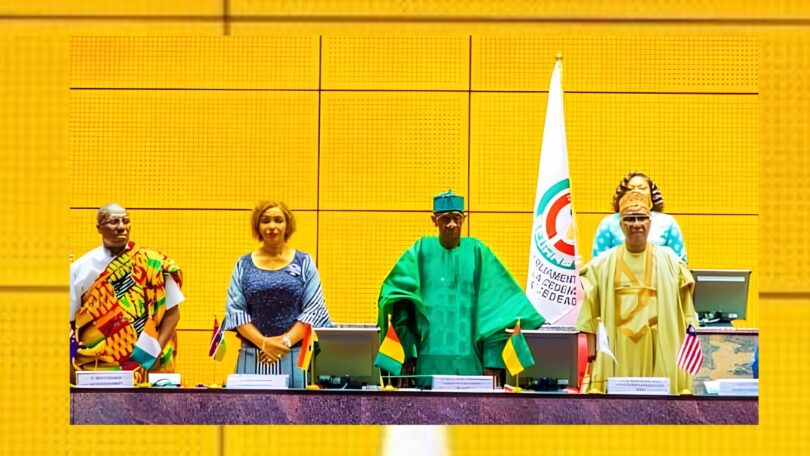
The regional parliament, at the close of its First Ordinary Session in Abuja, adopted a resolution urging member states to deepen intelligence sharing, improve border security coordination and strengthen joint military operations.
Coordinated terrorist attacks that struck military positions and civilian areas in Mali last month appear to have spurred a fresh push by the Parliament of the Economic Community of West African States (ECOWAS) for stronger regional cooperation against violent extremism across West Africa.
The attacks in Mali have resulted in severe humanitarian tightrope, with terrorists enforcing blockades across major city roads and attacking those showing resistance.
The attacks, staged by Jama’at Nusrat al-Islam wal-Muslimin (JNIM)—an al-Qaeda affiliate in the Sahel—and the Azawad Liberation Front (FLA), a Tuareg-dominated rebel alliance, claimed the life of the country’s Defence Minister, Sadio Camara. Many soldiers and members of paramilitary forces have also been taken hostage by the assailants.
At least eight counties are currently facing either active terrorist attacks, cross-border insurgent threats or sustained violent extremist infiltration, across the Sahel and the Lake Chad region. Many of these countries and Nigeria are under ECOWAS.
According to reports, the regional parliament, at the close of its First Ordinary Session in Abuja, on Sunday, adopted a resolution urging member states to deepen intelligence sharing, improve border security coordination and strengthen joint military operations (including with breakaway countries) to curb the growing wave of terrorism in the sub-region.
The parliament also mandated the Speaker of the ECOWAS Parliament, Memounatou Ibrahima, to forward the resolution to the ECOWAS Commission for implementation.
Daily Trust reports that the resolution was adopted in line with “relevant provisions of the Protocol relating to the Mechanism for Conflict Prevention, Management and Resolution, Peacekeeping and Security.”
The regional parliament said it was also “mindful of the provisions of Articles 6 and 13 of the Revised Treaty relating to ECOWAS institutions and the Community Parliament’s establishment.”
In addition, it said it was “mindful of the Declaration of Political Principles by the Authority of Heads of State and Government of ECOWAS, adopted in July 1991 in Abuja.”
Dominic Napara, who represented Ghana, told reporters at the end of the meeting that security threats in the Sahel will have direct consequences for neighbouring countries, including Nigeria and Ghana. He noted that terrorism is a common enemy that demands a united response.
This reporter understands that northern Ghana is now facing what could be described as infiltration of JNIM terrorists from Burkina Faso.
“Whatever happens in those countries affects all of us,” Mr Napara was quoted as saying. “Terrorism is a common enemy, and we must work together to confront it.”
His Gambia counterpart, Amodu Camera, said the Sahel crisis is one the most pressing challenges facing the ECOWAS.
He said the Parliament’s Committee on Political Affairs had thoroughly reviewed the security situation and subsequently submitted its recommendations to the ECOWAS Commission and the Council of Ministers for necessary action.
Mr Camera noted that although the ECOWAS Parliament performs advisory and oversight functions, responsibility for implementing its resolutions lies with the ECOWAS Commission, the Council of Ministers and member states.
The security concerns have been compounded by the diplomatic crisis that followed the withdrawal of Niger, Mali and Burkina Faso from ECOWAS after a series of military coups in the three Sahel states.
Analysts have repeatedly warned that the breakdown in relations between ECOWAS and the junta-led governments has disrupted regional counterterrorism coordination, particularly within the Multinational Joint Task Force (MNJTF).
The MNJTF was established to combat Boko Haram and Islamic State West Africa Province (ISWAP) activities in the Lake Chad Basin. The force is headquartered in N’Djamena, Chad, and was restructured in 2015 under African Union authorisation.
Countries participating in the MNJTF include Nigeria, Chad, Cameroon, Niger and Benin.
However, following the coup in Niger and the sanctions imposed by ECOWAS, the francophone country withdrew from MNJTF, a move widely seen as a setback for regional counterterrorism operations around the Lake Chad region including the Sahel at large.
It is believed that Nigeria, Chad, Cameroon and Benin remain active participants in the MNJTF, continuing cross-border operations against insurgent groups operating around Lake Chad.
However, analysts have continued to argue that Niger’s disengagement created operational gaps along critical border corridors previously covered by Nigerien troops, especially in areas bordering North-eastern Nigeria.
ECOWAS officials have warned that the withdrawal of the three Sahel states from the bloc risks undermining long-standing security cooperation mechanisms and weakening coordinated responses to terrorism and transnational organised crime in the region.
Over the years, the bloc has developed multiple collective security mechanisms in response to civil wars, coups and the growing threat of jihadist violence across West Africa.
The regional body established the ECOWAS Standby Force as part of efforts to create a rapid-response military framework for crises within member states, while its Political Affairs, Peace and Security architecture has coordinated policies on conflict prevention, intelligence sharing and counterterrorism cooperation.
ECOWAS has also backed multinational military operations, including the MNJTF in combating insurgency in the Lake Chad Basin. Beyond counterterrorism, ECOWAS has previously deployed military interventions in Liberia, Sierra Leone and The Gambia, reinforcing its long-standing role as a regional security actor rather than merely an economic union.