Despite receiving at least ₦2.934 trillion in 38 months, the Akwa Ibom government has stopped publishing detailed capital expenditure records. This makes it impossible to independently track project spending, despite repeated claims of massive infrastructure delivery.
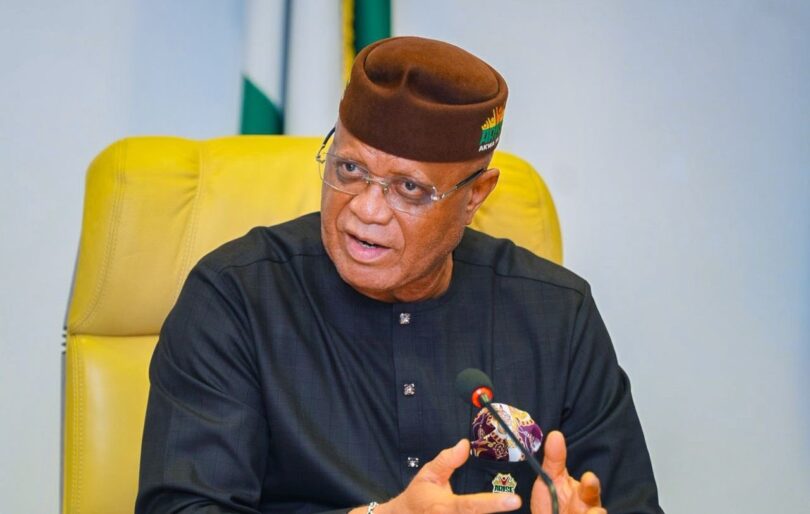
Governor Umo Eno’s administration in Akwa Ibom State has received at least N2.934 trillion in public revenue within its first 38 months in office. However, key government financial documents do not disclose how these funds were spent on capital projects and programmes, an analysis by PREMIUM TIMES has found.
This omission makes it difficult for citizens, researchers, civil society organisations, and the media to independently verify government claims on infrastructure delivery and assess how public funds have been utilised.
The total revenue figure covers the period from May 2023, when Mr Eno assumed office, to June 2026.
An analysis of the state’s Second Quarter 2026 budget performance report shows that between January and June this year, Akwa Ibom generated N394.83 billion in revenue. This excludes the N234.25 billion opening balance from the 2025 fiscal year.
The budget performance report indicates that ₦334.8 billion came from the state’s share of the Federation Account Allocation Committee (FAAC), ₦51.43 billion from internally generated revenue, ₦8.51 billion from grants and aids, and ₦ 100 million from borrowing.
A review of the state’s 2023 budget performance records and FAAC receipts also shows that between May and December 2023, Akwa Ibom received ₦286.7 billion, excluding internally generated revenue and the state’s 13 per cent derivation refunds for May and June 2023.
The state’s audited financial statements further show that it earned ₦1.110 trillion in 2024 and ₦1.144 trillion in 2025.
Combined, the records show that the Eno administration has received at least ₦2.934 trillion since assuming office.
This figure excludes internally generated revenue and the 13 per cent derivation refunds for May and June 2023 because no publicly available disaggregated records were found for those receipts, suggesting that the administration’s total revenue exceeds ₦2.934 trillion.
PREMIUM TIMES earlier reported that in 32 months of Mr Eno’s administration, the Akwa Ibom government t already surpassed the eight years of revenue received by the previous administration in the oil-rich state. Missing capital expenditure records
Although the Akwa Ibom government frequently highlights completed projects and ongoing infrastructure development, the state’s published financial records since the first quarter of 2025 no longer provide detailed information on capital expenditure.
Governor Eno has repeatedly stated that his administration is executing 85 “audacious projects” across the state.
During his third-anniversary media briefing, an Arise Television journalist asked the governor how his administration had spent the more than N2.53 trillion received in its first 32 months in office.
Responding, the governor said, “I don’t know those asking what we have done with the money. We have infrastructure; schools, model health centres that we have built, and we have 85 audacious projects on the ground that we are working on.
“When you look at our account yearly, and our budgetary performance, you see our performance.”
However, y PREMIUM TIME review found that the state’s audited financial statements for 2023, 2024, and 2025 contain no detailed capital expenditure schedules.
Similarly, budget performance reports published from the first quarter of 2025 through the second quarter of 2026 omit capital expenditure performance.
Before then, Akwa Ibom’s quarterly budget implementation reports routinely contained detailed information on capital spending, allowing the public to monitor project implementation against approved budgets.
That level of disclosure is no longer available. Other details omitted
Beyond omitting capital expenditure in budget performance reports, the report, for the sixth consecutive quarter, from the first quarter of 2025 through the second quarter of 2026, lacks a breakdown of revenue and expenditure by administrative, economic, functional, and programme classifications.
The government began publishing three-page summaries that merely aggregate figures. In 2026, it improved to five-page summaries, whereas reports published by other states are at least 40 pages.
The implications are profound. Without disaggregated data, citizens cannot see how much each ministry generates internally, how revenues flow from sources such as statutory allocation, VAT, derivation funds, or taxes, or how spending priorities tilt between social sectors like health and education and administrative centres of power. Worsening transparency concerns
The absence of capital expenditure data means there is no publicly available official record showing the projects funded by the administration, the amounts spent on individual projects, or the ministries and agencies responsible for implementing them.
Without such records, independent verification of government spending claims becomes difficult.
A review by PREMIUM TIMES of publicly available financial records from Nigeria’s 36 states found that Akwa Ibom is now an outlier in the level of detail it publishes.
With Rivers State’s financial disclosures disrupted by the state’s prolonged political crisis, the remaining states generally continue to disclose capital expenditure through audited financial statements, quarterly budget performance reports, or both.
PREMIUM TIMES had earlier reported that fiscal transparency has weakened under the Eno administration as key public financial disclosures have become less comprehensive, with some no longer published.
The lack of detailed capital expenditure records also appears to contrast with Governor Eno’s campaign promises and the state’s fiscal transparency law.
In his election manifesto, the ARISE Agenda, Mr Eno pledged to “promote accountability and transparency by ensuring compliance with h Fiscal Responsibility and Public Procurement Acts.”