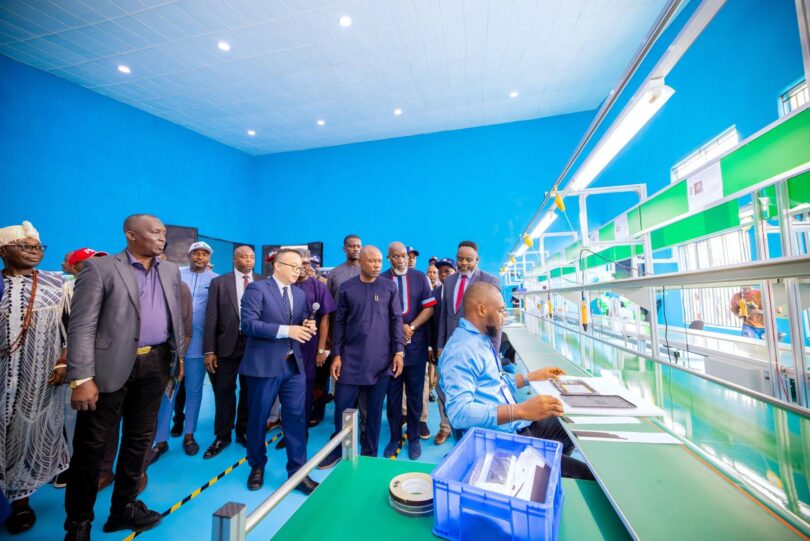
The training aimed at equipping Enugu students with practical technological skills for self-reliance and entrepreneurship after graduation.
The Enugu State Government, in partnership with Chinese firm Haier Factory in Enugu, has launched a digital training programme for secondary school students across the state.
The programme, tagged “Enugu-Haier Joint School-Enterprise Cooperation Training Programme (JSECT-P)”, was organised by the State Ministry of Education in collaboration with Haier Factory on Tuesday in Enugu.
Speaking at the event, the State Commissioner for Education, Ndubueze Mbah, said the initiative was part of the state government’s broader reforms to transform the education sector through innovation and experiential learning.
Mr Mbah, represented by the Permanent Secretary in the ministry, Nkechi Ewoh, said the establishment of the digital factory was intended to deepen experiential learning from basic to post-basic education levels.
The commissioner explained that the first phase of the programme would run for three months, while the entire training cycle would last nine months.
He said students would attend the programme after school hours from 2 p.m. to 4 p.m. to avoid disrupting the academic calendar.
According to him, the programme commenced with Senior Secondary School Two students from science, technical and vocational schools, while students from conventional secondary schools would join subsequently.
“The expected outcome is that the students will become self-reliant and digitally skilled. By the time they complete secondary school, they will be far ahead of their peers in other states,” he said.
He added that the government planned to empower the trainees financially after the programme to enable them to establish startups and practical ventures.
The commissioner disclosed that students would participate in batches of 40 to ensure effective learning and proper supervision.
Also speaking, the Chairman of the Science Technical and Vocational Schools Management Board (STVSMB), Amaka Ngene, described the programme as a bold initiative aligned with the vision of Governor Peter Mbah to reposition education for productivity, innovation and global competitiveness.
Mrs Ngene, represented by Ngozi Chibuoke, director of Administration and Supply/Private Public Partnership Unit, said the collaboration with Haier International would expose students to smart manufacturing, robotics, electronics and industrial production systems.
She urged the students to take advantage of the opportunity by demonstrating discipline, curiosity and creativity throughout the training period.
The Executive Director of Haier Factory in Enugu, Rich Chime, said the project was designed to facilitate knowledge transfer from Chinese technology companies to Nigerian youths and industries.
Mr Chime said the factory had already produced over 30,000 desktop computers, laptops and other devices deployed to support the state’s smart school initiative.
He added that the company had also produced about 5,000 interactive smart screens for schools and institutions.
“We are building a smart factory to support the smart school initiative of the state government. The students will also benefit from training in renewable energy and modern production systems,” he said.
According to him, the Government Technical College, Enugu, is the first beneficiary of the training programme.
On his part, Haier instructor, Andrew Yuang, said the factory was committed to building local content capacity and exposing students to cutting-edge technologies.
Mr Yuang said the students would undergo both theoretical and practical sessions, including exposure to automated production lines and industrial manufacturing processes.
“We want to combine real production experience with textbook knowledge to empower the students for future careers and industrial development,” he said.
One of the students, Michael Maduemesi, expressed excitement over the training, describing it as an eye-opening experience.
“We have learned about machines used for printing and labelling on devices and ID cards.
“This place provides opportunities for youths like us and gives us technical knowledge for the future,” he said.
(NAN)