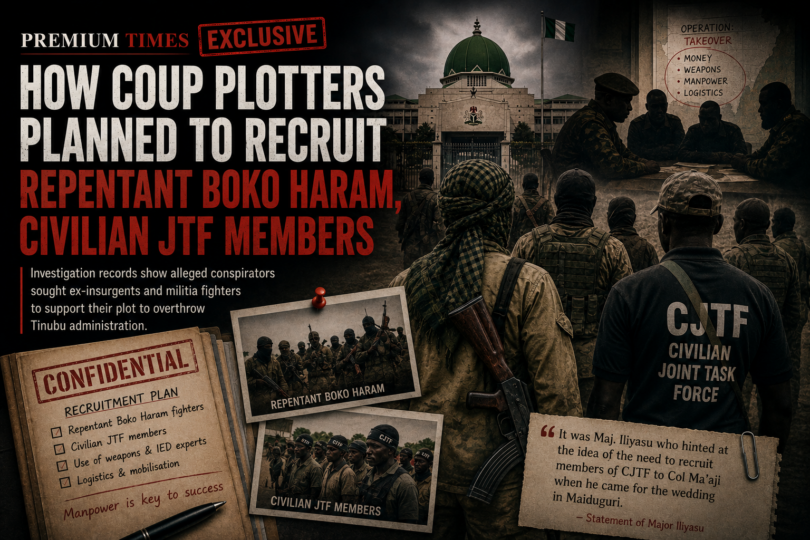
This report, a part of an extensive PREMIUM TIMES exclusive reporting series on last year’s failed coup plot against President Tinubu, reveals how and why the alleged leaders of the conspiracy planned to recruit repentant Boko Haram fighters and members of the Civilian Joint Task Force (CJTF).
A trove of documents, including statements authored by a group of disgruntled senior military officers arrested for allegedly plotting a coup against the administration of President Bola Tinubu, indicates that they planned to recruit repentant Boko Haram fighters and members of the Civilian Joint Task Force (CJTF) to support the operation.
PREMIUM TIMES reported that the plot was uncovered in September 2025, starting with the arrest of 16 serving military officers. Four months later, about 40 people, including a police officer and civilians allegedly involved in the plot, had been arrested.
Initially, the military authority said the officers were arrested for indiscipline and breach of service regulations. The Defence Headquarters later confirmed that they were involved in the coup plot, adding that they would be prosecuted.
Currently, the serving military officers are being tried in a General Court-Martial, while the civilians, including the ex-military officers, are being prosecuted at the Federal High Court in Abuja.
The federal government in April filed 13 charges against six individuals accused of being part of the coup plot. They are Mohammed Ibrahim Gana, a retired major-general; Erasmus Ochegobia Victor, a retired navy captain; Ahmed Ibrahim, a police inspector; and Zekeri Umoru, an electrician at the Presidential Villa.
Others are Bukar Kashim Goni and Abdulkadir Sani, a Zaria-based Islamic cleric.
Although their statements form part of the prosecution’s case, their admissibility remains contested after several defendants told the court they were not made voluntarily. This, however, prompted the court to order a trial-within-trial to determine their voluntariness before deciding their admissibility as evidence in the substantive trial.
Details gleaned from the documents showed that Mohammed Ma’aji, a Nigerian Army colonel alleged to be the leader of the plot, first received the suggestion to recruit repentant Boko Haram and CJTF members from a suspected co-conspirator, Jamilu Ilyasu.
 The CJTF, a state-backed militia established to assist security forces in counter-insurgency operations in the North-east, now has a strength of 26,000 fighters in Borno State alone.
It started as a community resistance against Boko Haram insurgents. Initially CJTF members were mainly wielded sticks, which is why they were known as “Yan Gora” — “People with Sticks” in Hausa, according to a report by the Centre for Civilians in Conflict.
However, Mr Ma’aji said the plan to mobilise them to Abuja was not finalised.
“It was Maj. Iliyasu who brought up the discussion of using repentant Boko Haram who are already using their weapons,” Mr Ma’aji, a Nigerian Army colonel, said. “Before this, I did not know that repentant Boko Haram were involved in our military operations.”
PREMIUM TIMES understands that some former Boko Haram and Islamic State West Africa Province (ISWAP) fighters who surrendered to the Nigerian military have, after undergoing screening and rehabilitation, been deployed in limited support roles alongside security forces in parts of the North-east.
These former insurgents are commonly referred to as hybrid forces by military personnel and local communities. They are participants in the Borno Model, a Disarmament, Demobilisation, Deradicalisation and Reintegration (DDRR) programme established by the Borno State Government to rehabilitate and reintegrate repentant insurgents into society.
In 2024, this newspaper reported that 13 repentant Boko Haram members fighting alongside the military, escaped with rifles and motorcycles given to them by the Borno State government.
“The recruitment of CJTF was Iliyasu’s idea,” Mr Ma’aji continued. “When I went to the North East for a wedding, Maj. Iliyasu met me and asked how far about the movement. I complained that there was no manpower. He then said he had CJTF working for 7 Division, and that we could use them.”
Asked by interrogators about the plan to use Improvised Explosive Devices (IEDs), Mr Ma’aji said, “If there was any discussion of IED, it was Maj Iliyasu who said he had some Boko Haram technicians working in the theatre to make IED, but I told him that would not be necessary.”
In his own statement, Mr Ilyasu, a major, did not speak about his involvement in recruiting repentant Boko Haram fighters. But he confirmed that he was the one who introduced the idea of bringing CJTF members on board.
“I was the one who hinted at the idea of the need to recruit members of CJTF to Col Ma’aji when he came for the wedding in Maiduguri. Col Ma’aji excused me outside his hotel room and was asking me about the possibility of recruiting CJTF, and I said yes, that I only knew Saminu, and he said I should get in touch with him,” Mr Iliyasu stated.
He wrote that a CJTF member identified as Ali was brought to work with him when he was in 212 Battalion in the North-east.
“When I went to 7 Division, he (Ali) kept in touch that he needed to know where he and his boys would keep working, and I promised him I had a task for him,” Mr Iliyasu continued. “When Col Ma’aji called me to inquire about getting the CJTFs, I forwarded my voice conversation with CJTF Ali to him to assure him that I was getting boys.”
The rationale behind recruiting repentant Boko Haram fighters and CJTF members is not immediately clear. However, Messrs Ma’aji and Ilyasu suggested in their extrajudicial statements that they saw them as strategic assets because many already possessed firearms legally issued under counterinsurgency arrangements and had operational experience from years of fighting on opposite sides.
 There is no public database that shows the quantity of firearms with civilian volunteers fighting under the umbrella of CJTF and vigilantes. However, in his research supported by the United Nations Institute for Disarmament Research (UNIDIR), Eric Berman, the director of Safeguarding Security Sector Stockpiles (S4), documented that about 25,000 firearms are in possession of 55,000 civilian volunteers participating in the fight against insurgency in Borno State alone.
He identified the Borno State Hunters Association (BoSHA), the CJTF, the Kesh Kesh vigilante group and the Vigilante Group of Nigeria (VGN) as the four major Volunteer Security Outfits (VSOs) operating [mainly] in Borno and other northeastern states.
 Mr Berman said VSO weapons were sourced either from local gunsmiths or government authorities and include locally made Dane guns, foreign hunting rifles, pump-action shotguns and, in some cases, industrially manufactured assault rifles recovered from insurgents on the battlefield.
He expressed concern about how the weapons are managed, saying it remains unclear whether national legal frameworks, including the 1959 Firearms Act, are followed in arming VSOs. While some VSO members and government officials told him the process for surrendering battlefield weapons “seems to be largely respected,” he said it is “possible that some individuals serving in VSOs may hold on to some of the recovered ammunition.”
Mr Berman estimated that about 10,000 recovered firearms—mainly assault rifles—were “likely” handed to some VSO members temporarily by Borno and federal authorities, who also monitored their use. However, he said attempts to account for weapons issued between 2015 and 2019 were unsuccessful because Borno authorities “understood the country’s 1959 Firearms Act as prohibiting the provision of most types of firearms to civilians, but the security situation was deemed to require the arming of civilians.”
Among other recommendations, the researcher admonished the army to uniquely mark firearms furnished to the VSOs based on regional and international commitments and obligations undertaken by Nigeria, particularly Article 18 of the ECOWAS SALW Convention.
“Unmarked arms can be included in ongoing Nigerian programmes to mark all small arms and firearms in the country,” he advised, adding the army should store details about distributed firearms in a “centralised secure database or register in accordance with Articles 9 and 14 of the ECOWAS SALW Convention. Additional information to include in the database can include the location of the arms.”