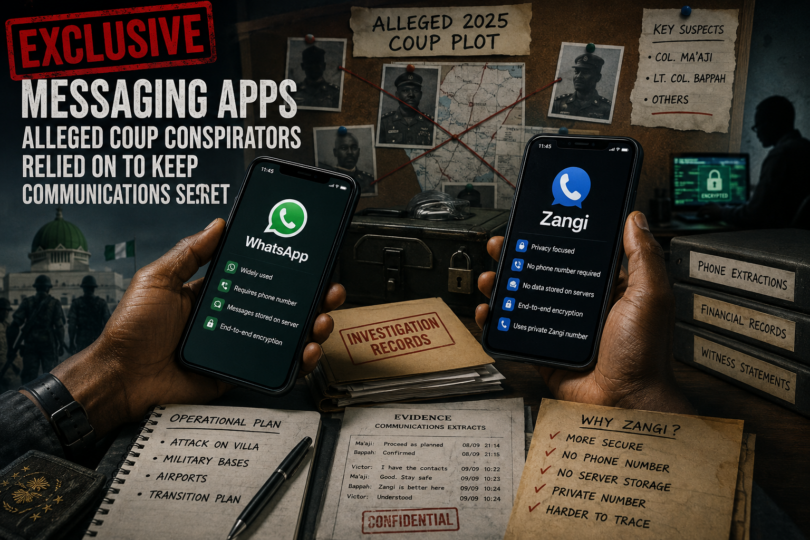
Suspected conspirators behind the alleged 2025 failed coup were believed to be conscious of keeping their communications secret. This part of the PREMIUM TIMES’ series of exclusive reports reveals the tech platforms some key members of the alleged conspiracy chose for private communications.
The means of communication chosen to hatch a plot or stage a surprise is critical to the success of the plan.
The distinction is important.
WhatsApp is one of the world’s most widely used messaging platforms, familiar to virtually everyone with a smartphone.
Zangi is, however, different. Its appeal is centred more explicitly on private communication. The application has built much of its identity around private communication, with the company saying it does not store users’ communication histories on its servers and that messages and calls are protected with end-to-end encryption.
The choice of platforms is significant because it was not simply a case of military officers communicating through whatever application happened to be on their phones.
Against the backdrop of an alleged plot to overthrow President Bola Tinubu’s government, the platforms were more than communication tools. They became part of the leads investigators followed while trying to reconstruct the alleged conspirators’ plans and determine who played what roles in the alleged plot which the authorities busted in September last year.
A retired navy captain, Erasmus Victor, who is charged alongside five others with 13 counts, including treason, stemming from the alleged plot, gave an insight into how one of the messaging applications came into the picture.
He detailed what he knew about the alleged plot in his extrajudicial statement, which he wrote during interrogation by military investigators.
PREMIUM TIMES reported Mr Victor’s account of how he was allegedly drafted to recruit financiers for the coup, a role he said he subtly avoided.
He said he was asked to pitch the coup to several potential sponsors, including Mr Wike, to get their buy-in and financial support, but never contacted any of them.
Mr Victor, a military officer-turned-politician who served as the chairman of the Ogu/Bolo Local Government Area of Rivers State between 2018 and 2021 while the incumbent Minister of the FCT Nyesom Wike was the governor, also stated that he did not take the alleged coup plot seriously but regretted not reporting it to the authorities.
The account is contained in tons of investigation records obtained exclusively by PREMIUM TIMES.
Mr Victor told investigators that the suspected mastermind, Mohammed Ma’aji, a Nigerian Army colonel, introduced him to Zangi because he considered it more secure than conventional telephone calls.
Mr Victor said he downloaded the application specifically to communicate with Mr Ma’aji and Shamsuddeen Bappah, a serving lieutenant colonel and officer of the Nigerian Army Signals Corps whose name later featured prominently in the investigation.
That detail is significant.
It suggests that it was introduced in the context of communication with particular people.
Zangi is considerably less familiar to Nigerians than WhatsApp, but privacy is central to the product’s identity.
The tech company which owns the platform says it does not store communication histories on its servers. Instead it says users’ communication history is stored locally on their devices. It also says its end-to-end encryption is enabled by default and that decryption takes place on users’ devices.
Zangi also differs from WhatsApp in another potentially important respect: a mobile telephone number is not required for registration. Users are instead assigned a private Zangi number. However, WhatsApp’s developers are on the verge of incorporating that feature into the messaging app.
That does not mean that a conversation conducted on Zangi is beyond investigation.
In fact, the architecture described by Zangi makes the device itself particularly important.
If communication history is held locally rather than on a central server, investigators looking for evidence could potentially be more interested in the phones used by the participants than in expecting a messaging company to produce a complete archive of conversations.
The proof of evidence filed in support of the prosecution of suspects at the court martial and the Federal High Court in Abuja contains piles of printouts of phone messages exchanged between suspects.
The word “encrypted” can make communication records sound almost impenetrable. It is not.
End-to-end encryption is intended to prevent unauthorised parties from reading the content of messages while they are being transmitted. It does not erase the physical devices on which communications may be stored, nor does it automatically eliminate every piece of information surrounding a communication.
A phone can contain conversations, contacts, photographs, files, notifications and other material. Depending on the application and the device, there can also be information about when a communication occurred or who was involved.
That distinction becomes particularly important in an investigation built around reconstructing relationships.
Investigators do not necessarily need to recover every sentence exchanged between two people to establish that the two were communicating.
A communication trail can become meaningful when placed beside financial records, movements, meetings, witness accounts, recovered documents and other electronic evidence.