This report captures hidden and pivotal bits of the personal life of the Army colonel who rallied fellow military officers to stage a coup against the Nigerian government last year, as told by his allies.
A Nigerian Army officer has told investigators how he lost confidence in the prospect of the alleged 2025 coup plot, saying he was discouraged by the alleged mastermind’s promiscuity and over-reliance on traditional spiritualists and Islamic clerics.
The statement is among over 7,400 pages of documents investigators gathered for the prosecution of the suspects linked to the alleged plot at the General Court Martial convened by the military, and the Federal High Court in Abuja.
The piles of confidential files contain the statements of several other suspects, bank records, secret notes, documentary evidence of the alleged conspirators’ secret conversations, and other exhibits assembled by investigators.
PREMIUM TIMES has reviewed the treasure trove of documents obtained exclusively to report for the first time an extensive, in-depth series of untold stories about last year’s failed putsch against the President Bola Tinubu administration.
Mr Bappah, a 41-year-old officer from Bauchi State and a member of the 56 Regular Course of the Nigerian Defence Academy (NDA), opened up on insider knowledge regarding the alleged coup when investigators interrogated him over his alleged role in it.
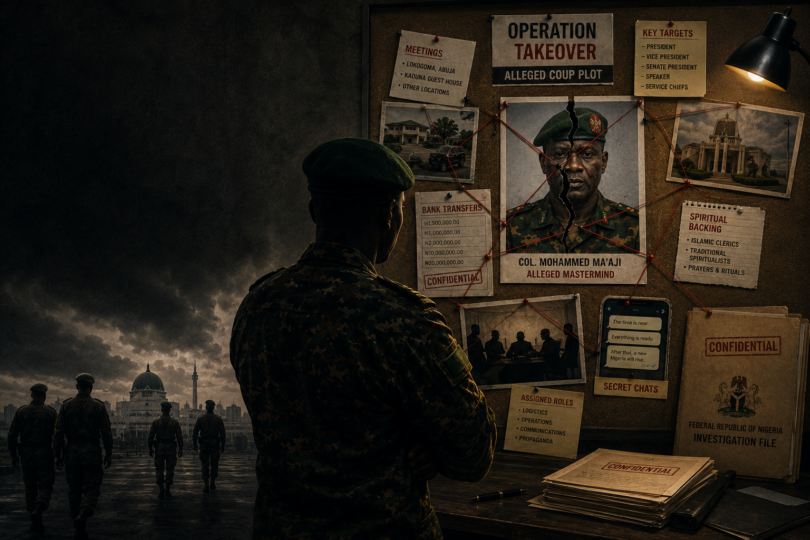
According to investigators, Mr Bappah admitted attending meetings where the alleged coup was discussed and receiving money from Mohammed Ma’aji, a colonel in the Nigerian Army, whom investigators identified as one of the central figures in the alleged plot.
Security agencies launched the probe after receiving intelligence in September 2025 that serving and retired military officers, alongside some civilians, were allegedly planning a violent takeover of government.
PREMIUM TIMES previously reported that investigators believed the alleged conspirators planned to assassinate President Tinubu, Vice President Kashim Shettima, Senate President Godswill Akpabio, Speaker Tajudeen Abbas and several senior military commanders before seizing power.
Investigators also believed different members of the network were assigned responsibilities ranging from logistics and funding to propaganda, reconnaissance visits and military operations. PREMIUM TIMES has recently detailed in one part of the series of indepth, exclusive reporting on the alleged coup the key targets and the ringleaders assigned to oversee the operations there.
According to Mr Bappah’s statement, he was among those expected to play an operational role. This newspaper revealed that he was assigned to seize and hold 102 Battalion, Zuma, Niger State.
Mr Bappah told investigators that he had known Mr Ma’aji since they were cadets at the Nigerian Defence Academy, where the senior officer later became his instructor and Battalion Adjutant.
According to him, discussions about changing the government did not begin overnight.
Instead, he said the conversations stretched over several years.
“We always discussed the situation of the country and the way things are going,” he said.
“So he told me that one thing that can solve it is to change the government, and we have been discussing it for like four to five years.”
He alleged that during a meeting at Command Guest House in Kaduna around 2022 or 2023, Mr Ma’aji became more direct.
“He told me that something will happen and the military will take over.”
Despite his involvement in the meetings, Mr Bappah said his confidence in Mr Ma’aji gradually began to fade.
The turning point, according to him, had nothing to do with military planning.
Instead, he said he became disturbed by what he considered Colonel Ma’aji’s personal conduct.
“I started having doubts when I saw his consistency on the issue of carrying women becoming too much, even in Abuja where his wife is,” he told investigators.
“I felt that he’s not being loyal to his family.”
According to Mr Bappah, those concerns soon extended beyond Colonel Ma’aji’s private life.
“I started wondering if he can handle Nigeria at large without betrayers,” he said.
The lieutenant colonel suggested that a person he believed could not remain faithful within his own household might also struggle to command loyalty while leading a country.
Mr Bappah went further, telling investigators that some of Colonel Ma’aji’s interactions with women deeply unsettled him.
He stated that Mr Ma’aji related with women in a manner he would never have allowed his children to be treated.
He continued: “Col Ma’aji has a mature daughter, but will never for once bring her… for anybody to use.”