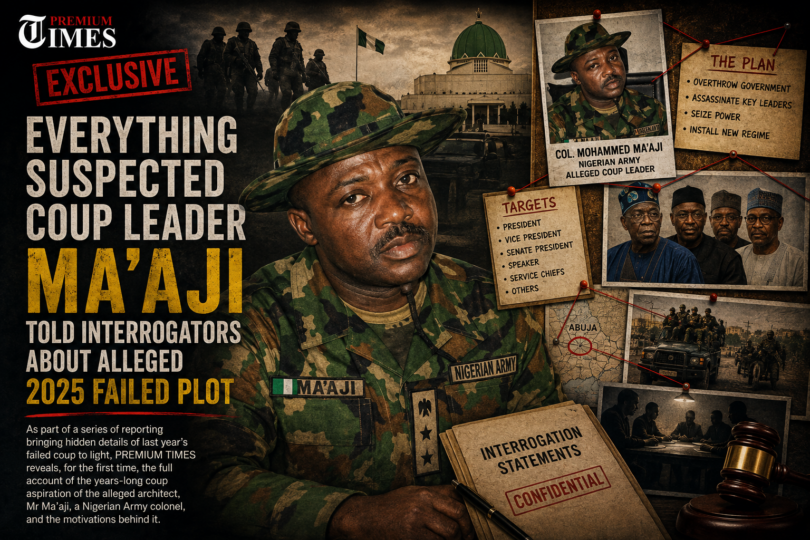
PREMIUM TIMES reveals for the first time the full account of the alleged architect of the 2025 failed coup, Mr Ma’aji, a Nigerian Army colonel.
Nigerian Army colonel Mohammed Ma’aji allegedly spearheaded a plan to overthrow Nigeria’s democratically elected government in a coup d’état last year. But the alleged plot reportedly collapsed before it ever became public knowledge.
In 2025, after over three decades of the nation’s clean break from coup d’etats, another alleged attempt ended in a series of arrests and interrogations of serving and retired military officers, including civilians suspected of playing various roles in the plot to topple the President Bola Tinubu administration.
In its first official reaction to the matter, the Defence Headquarters ( DHQ), in a statement, did not categorically deny that the military officers were involved in an alleged coup plot. It rather explained that the “ongoing investigation involving” the arrested officers was “a routine internal process aimed at ensuring discipline and professionalism is maintained within the ranks.”
The foiled plot, uncovered in late September 2025, unsettled the Tinubu government, which, among other things, cancelled the 1 October Independence Day Parade and reshuffled the military hierarchy, including the sacking of then Chief of Defence Staff (CDS) Christopher Musa. Although media reports linked the cancellation of the parade to the alleged plot, the DHQ explained that it was called off to allow the President to “attend a strategic bilateral meeting outside the country.”
The DHQ finally admitted that there was indeed a coup to oust Mr Tinubu’s government, adding that the indicted officers will be arraigned before military judicial panels.
Drawing on interviews with intelligence sources, PREMIUM TIMES has extensively reported on the conspiracy starting with the initial arrest of 16 serving military officers in September. By February, 40 people, including senior military officers across the armed forces, a police officer, and civilians allegedly involved in reconnaissance, funding and propaganda operations, had been arrested in connection with the conspiracy.
But for the first time, this newspaper is reporting authoritatively in a series of exclusive publications about the matter, drawing on a trove of confidential documents totalling about 7,424 pages. These documents include bank account statements, chat exchanges on encrypted messaging platforms, receipts of hotels used for meetings and items purchased, as well as statements by participants and non-participants with financial dealings linking them to the alleged coup planners.
Mr Ma’aji, a 50-year-old Nigerian colonel who has failed his promotion to the rank of brigadier general twice, explained how he conceived the plot and the motivation behind it.
Mr Ma’aji was arrested on 29 September 2025, the day the Nigerian government cancelled the Independence Day parade. He was interrogated between 18 October 2025 and 19 February, according to statements signed by him and a military investigator at the headquarters of the Nigerian Army Corps of Military Police (NACMP) in Asokoro, Abuja.
In April, the federal government filed 13 charges against six individuals accused of being part of the coup plot. They are Mohammed Ibrahim Gana, a retired major-general; Erasmus Ochegobia Victor, a retired navy captain; Ahmed Ibrahim, a police inspector; and Zekeri Umoru, an electrician at the Presidential Villa.
Others are Bukar Kashim Goni and Abdulkadir Sani, a Zaria-based Islamic cleric.
While the ex-military officers and civilians are being tried in a civil court, the serving military officers, including Mr Ma’aji, are facing trial at a court-martial.
According to the documents reviewed for this report, more than 30 officers and civilians were interrogated by military investigators. Their statements form part of the prosecution’s case, but their admissibility remains contested after several defendants told the court they were not made voluntarily.
This prompted the court to order a trial-within-trial to determine whether the statements were obtained voluntarily before deciding whether they could be admitted as evidence in the substantive trial.
In his statement, Mr Ma’aji, a 50-year-old officer from Niger State, told military investigators that the plot dated back to 2023, towards the end of President Muhammadu Buhari’s administration.
“Things particularly got out of control towards the end of Buhari’s administration when corruption and nepotism became the order of the day. Insecurity started spreading from the North (east) to the North-west and North-central parts of the country. Kidnapping and banditry engulfed the whole of northern Nigeria,” Mr Ma’aji, an infantry officer who had served at several military formations across the country, stated.
“The structure became critical and precarious with lives of troops and innocent citizens being lost on a daily basis,” he wrote, adding that this was when “the idea of military intervention started.”
He added that “ it was expected that the higher hierarchy of the military could have acted to save the situation. Unfortunately, there was no action from the top.”
Mr Ma’aji explained that the movement started by identifying officers who share “the same concerns and worries about the deteriorating situation of the country and co-opting them into the scheme.”
“Most of the officers involved share the same sense of patriotism, love of country and genuine desire for positive change,” he said.
Mr Ma’aji said lack of funds, logistics and manpower forced him and his military co-conspirators to shelve the plans he hoped to execute in 2023.
“Most of the money spent were my personal resources generated through sells [sic] of my personal property coupled with sacrifice and contributions from some members,” Mr Ma’aji said.
The colonel told investigators that AJ Ibrahim, a major, contributed N1 million through his First Bank account. He added that AA Yusuf, an army captain, donated some US dollars on a few occasions.
Mr Ma’aji told investigators that he sold three houses in Kaduna State and a students’ hostel he had in Ahmadu Bello University (ABU), Zaria.
They soon revived the plan after Mr Ma’aji failed his second attempt at promotion in 2024.
“When I missed my second attempt at promotion to brigadier general in 2024, some of the boys started disturbing and calling on me that we needed to revive the movement again,” Mr Ma’aji said. “They were afraid that I might be retired prematurely and that all of us will regret it.”
He said Shamsuddeen Bappah, a lieutenant colonel, was one of the passionate officers who was particularly at the forefront of the revival of the movement.
“I could remember he had to travel from his unit in Ibadan down to Abuja just to convince me that we have no option than to revive the movement and carry out the plan,” Mr Ma’aji.
Mr Ma’aji said he raised concerns about logistics and manpower.