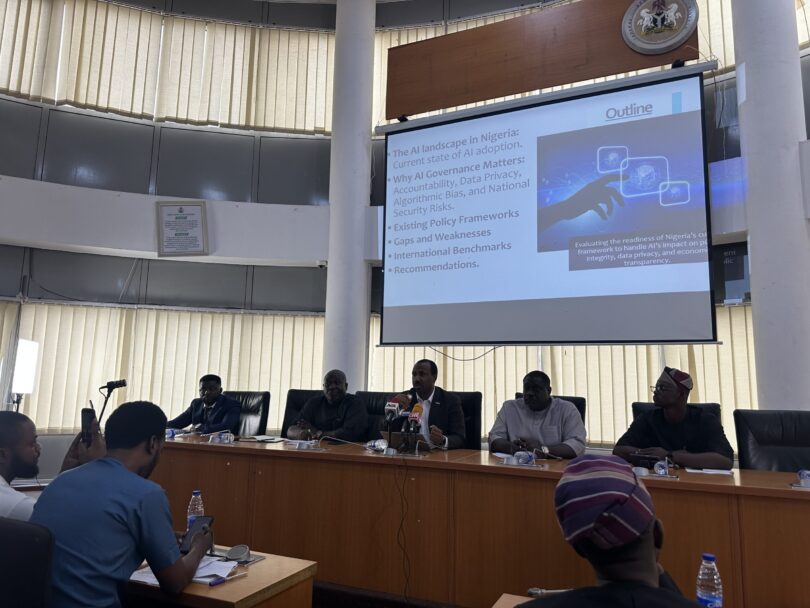
Experts raised security concerns that Nigeria lacks AI-specific standards to address threats such as fraud, disinformation, data poisoning, and automated cybercrime.
Nigeria still lacks a binding law governing the use of artificial intelligence, experts warned on Thursday, even as the technology is rapidly spreading across the country’s banking, healthcare, agriculture, and education sectors.
The event brought together regulators, policymakers, technologists, and development partners to examine how Nigeria can manage the risks and opportunities of AI in public life.
In his remarks, the Executive Director of the Centre for Fiscal Transparency and Public Integrity, Umar Yakubu, told the forum that AI is already deeply embedded in Nigeria’s economy but largely without oversight.
He cited examples of AI in the financial sector, referencing that UBA launched its AI chatbot, Leo, in 2018, followed by Zenith Bank’s Ziva in 2021. By February 2024, 13 deposit money banks had deployed AI-powered chatbots. The Central Bank of Nigeria also formally integrated AI into its anti-money laundering compliance framework, he said.
Beyond finance, precision farming technologies are emerging in agriculture, teaching hospitals are deploying AI diagnostic tools, and online learning platforms are integrating AI into education, Mr Yakubu said.
PREMIUM TIMES reports that in 2024, the National Centre for Artificial Intelligence and Robotics and Google jointly launched a N100 million fund to support Nigerian AI startups. Nigeria also climbed 31 places to 72nd in the 2025 Oxford Government AI Readiness Index, up from 103rd in 2023.
Nigeria also signed the Bletchley Declaration on AI safety in 2023, joining 27 other nations in committing to the safe development of advanced AI systems.
But serious Gaps remain.
Mr Yakubu said Nigeria’s regulatory environment has not kept pace.
He said two AI bills introduced in 2021 and 2023 never completed the legislative process. AI systems in public services currently operate without dedicated oversight. While the Nigeria Data Protection Act 2023 covers personal data used in AI, its operational rules only took effect in September 2025, and AI-specific enforcement remains weak.
The Nigeria Deposit Insurance Corporation flagged algorithmic bias as a risk in 2024 and called for monitoring frameworks, but no mandatory standards have been set.
“Regulatory responsibility is also fragmented, with the CBN, NCC, and NITDA each overseeing AI independently within their sectors. A draft National AI Strategy proposes a National AI Steering Committee, but it has not been established,” he said
Mr Yakubu also raised security concerns, saying Nigeria lacks AI-specific standards to address threats such as fraud, disinformation, data poisoning, and automated cybercrime.
Earlier, in his opening address, the Director General of the Bureau of Public Service Reforms, Dasuki Arabi, said AI had moved from a futuristic concept to a present reality shaping economies, governance, and social life.
“Governments across the globe are increasingly leveraging AI to improve service delivery, enhance decision-making, and drive efficiency in public administration,” he said.
He acknowledged that Nigeria’s adoption of AI in public finance management, policy formulation, and service delivery was growing, but warned that without a clear governance framework, the technology could lead to exclusion, discrimination, and a loss of public trust.
The official said BPSR would work to translate the forum’s outcomes into concrete reforms. “Our goal is to support the development of a governance framework that promotes innovation while safeguarding public interest,” he said.
Experts at the event agreed that AI governance is not purely a technical matter. It is also, they said, a policy, legal, and ethical issue that requires a holistic response combining sound public policy with strong institutions.
Mr Yakubu made eight recommendations.
First, he called for a dedicated AI Act covering risk classification, liability, and algorithmic impact assessments. Second, an independent National AI Regulatory Authority should be created with enforcement powers and civil society oversight.
Third, that federal agencies should be required to publish model cards, audit logs, and explainability reports, a step, he said, hasalready been adopted in Ghana’s 2023–2033 AI strategy.
He also called for the mandate of the Nigeria Data Protection Commission to be expanded to explicitly cover AI profiling and automated decisions, and for inter-agency collaboration. He called on the CBN, NCC, NITDA, and NDPC to formalise cooperation through memoranda of understanding, similar to the UK’s sector-regulator coordination model.
Other recommendations include enabling civil society to independently monitor AI systems, building a national AI skills strategy, and requiring both government and private institutions to implement AI governance and risk management frameworks.