Mr Falana said making the crude available to domestic refiners would reduce Nigeria’s dependence on imported petroleum products and help ease the hardship caused by the removal of petrol subsidy.
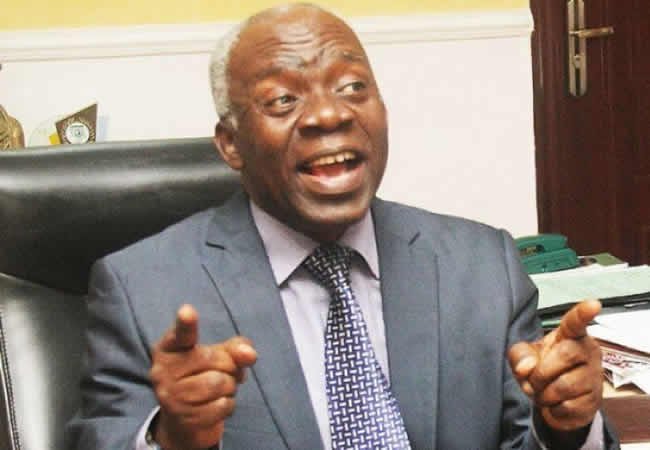
Human rights lawyer and Senior Advocate of Nigeria, Femi Falana, has urged the federal government to end petrol importation and ensure that the 450,000 barrels of crude oil reportedly allocated daily for domestic consumption are supplied to local refineries.
The lawyer spoke on Channels Television’s Sunday Politics on Sunday amid renewed debate over the economic impact of President Bola Tinubu’s decision to remove petrol subsidy in May 2023.
Mr Falana argued that although the subsidy regime was unsustainable and was plagued by alleged fraud, Nigerians have yet to see sufficient benefits from the additional revenue accruing to the three tiers of government since its removal.
“State governors are getting more allocations. The federal government is getting more money. Local governments are getting more funds on paper. It is the duty of the Nigerian people now to demand accountability,” he said.
He questioned the basis for some of the consumption figures previously used to justify petrol subsidy payments, citing discrepancies between reported daily consumption and volumes supplied to the market.
“At a point, we were told that local consumption, the rate of local consumption, was 68 million litres per day. Yet the NNPC claimed then that it was supplying the market to the tune of over 98 million litres per day,” Mr Falana said.
The senior lawyer also questioned why Nigeria continues to import petroleum products despite having operational local refineries.
He said the continued dependence on imports was difficult to justify when the country had crude oil and growing refining capacity.
“As of last week and today, fuel importation into Nigeria is about 43 per cent of consumption. Why? There are local refineries that are importing fuel into Nigeria,” he said.
Mr Falana also referred to the Dangote Refinery, which has increasingly supplied refined petroleum products to the Nigerian market while also exporting some products.
The Nigerian Upstream Petroleum Regulatory Commission also reported in August that domestic refiners received 53.7 million barrels of crude and condensate in the second quarter of 2026, with the Dangote Refinery accounting for about 98 per cent of the volume eventually supplied to local refiners.
The lawyer said the federal government should focus on making crude available to domestic refiners rather than continuing to spend scarce foreign exchange on imported petrol.
“The country sets aside 450,000 barrels of crude oil for local consumption. We must ask NNPC what has happened to that allocation,” he said.
The lawyer also challenged the government to account for the additional revenue generated since the removal of petrol subsidy.
He said the Federal Government had previously earmarked about $10 billion annually for fuel imports and argued that the savings should have translated into tangible improvements in the lives of Nigerians.
“Now, the money earmarked for fuel importation by the government, $10 billion per annum, ought to have been saved, but the bulk of this money goes for servicing of debt. That’s where the problem lies,” he said, adding that the floating of the naira also gulped the subsidy savings.
Mr Falana said Nigerians should therefore demand explanations from the federal government, state governments and local councils on how the increased allocations are being used.
He cited the example of a road leading to Afe Babalola University in Ekiti State, saying residents were still asking the federal government to intervene even though the relevant local government had received substantial allocations.
“So you can’t fix a road with less than N500 million? And in any case, state governments were fixing roads, and they would then go to Abuja to ask for a refund. So, we must begin to ask questions of the local government, the state government and the federal government,” he said.
“Where are the benefits? It’s a fallacy being told to wait and wait and wait. People are dying.”
The debate over subsidy removal has intensified as the country approaches the 2027 general elections.
Former Vice President Atiku Abubakar, the presidential candidate of the African Democratic Congress, has promised to partially restore the subsidy if elected, while Peter Obi of the Nigeria Democratic Congress has backed its removal but called for the funds to be used judiciously.
Mr Falana also criticised what he described as the influence of international financial institutions on Nigeria’s economic policies.
He accused the International Monetary Fund and World Bank of effectively dictating major economic decisions, including the removal of petrol subsidy and increases in electricity tariffs.
“Who is in charge? They tell us when to remove subsidies, when to remove electricity tariffs, or when to increase electricity tariffs, even in darkness,” he said.
The lawyer described Nigeria’s current economic structure as a “brand new colonialist economy” and criticised the devaluation of the naira, arguing that an import-dependent economy would struggle to benefit from currency devaluation.
“If you are going to make life better for the people, it is to abandon some of these policies that are meant to promote poverty,” he said.
Asked what he would do if he were to formulate Nigeria’s petrol policy, the lawyer proposed two immediate measures.
First, he said the NNPC should account for the 450,000 barrels of crude oil allocated daily for domestic consumption.