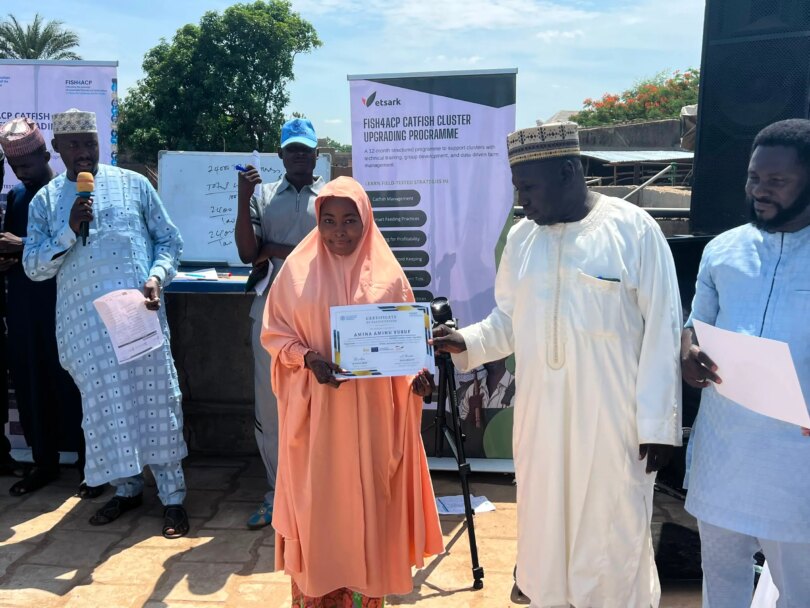
The Food and Agriculture Organization of the United Nations, FAO, has concluded a year-long capacity-building programme that equipped more than 100 fish farmers in Kano State with modern aquaculture, business management and data-driven farming skills.
The programme, tagged FISH4ACP Catfish Cluster Upgrading Programme, was implemented by Vetsark with support from FAO to strengthen fish farming clusters through technical training, group development and improved farm management practices.
Speaking at the third and final demonstration day held in Kumbotso Local Government Area of Kano State, FAO Programme Specialist in Nigeria, Aisha Ibrahim, said the initiative was designed to improve the technical and business management capacity of fish farmers to enhance productivity and profitability.
She explained that the beneficiaries underwent intensive training over the past year on best aquaculture management practices, business development and the use of the Aquaculture Data Management System, ADMS, to enable them make informed business decisions.
According to her, the programme also focused on improving record-keeping, financial literacy and data management, which she identified as major gaps limiting the growth of fish farming enterprises.
“The essence of this programme is to strengthen the fish farmers’ skills in best management practices and data-led management so they can make informed decisions in their businesses.
“You cannot make decisions if you don’t keep records, which is one of the weakest areas for many farmers. That was our entry point—record-keeping, best management practices and financial literacy,” she said.
Mrs Ibrahim noted that the organisers initially targeted 100 participants but eventually trained more than that due to the overwhelming interest shown by fish farmers across the state.
She urged the beneficiaries to sustain the knowledge acquired and share it with other farmers, stressing that the success of the programme would be measured by its impact on the wider aquaculture sector.
“The training has ended, but your journey is just beginning. I have a special message for the Lead Farmers. Continue to train other farmers and demonstrate best practices. Ensure that the knowledge you have gained does not remain within this group but spreads across Kano State.
“At the beginning of this journey, we said aquaculture must go beyond production. Today, I want to add that you should not focus on profit alone. Build businesses that will bring prosperity to your families, your communities and Kano State as a whole,” she said.
She also appreciated the Kano State Government for supporting the implementation of the programme.
Earlier, the Programme Manager of Fish4ACP, Mayowa Ajayi, said the training, which commenced in May 2025 and ended in July 2026, had already begun yielding measurable results for participating farmers.
According to him, farmers who previously recorded mortality rates of between 30 and 40 per cent have reduced losses to below 10 per cent through the adoption of improved management practices.
“Most of our farmers are already recording good profits in their businesses. Mortality rates used to be as high as 30 to 40 per cent but have dropped below 10 per cent for most of these farmers, and that’s a huge achievement,” he said.
Mr Ajayi added that the project identified outstanding participants as Lead Farmers to ensure the sustainability of the initiative through peer-to-peer knowledge transfer.
“We selected Lead Farmers who excelled during the training. We expect them to mentor and train new entrants into the fish farming business, ensuring that the knowledge continues to spread beyond this programme,” he said.
One of the beneficiaries described the training as transformative, saying it had equipped participants with practical knowledge on water quality management, stocking density, fish nutrition, disease prevention and treatment.
“We have learned how to maintain water quality, determine the right stocking density, identify fish diseases and apply the right treatment. We also now understand the proper quantity of feed and the appropriate feeding methods.
“Before FAO came, many of us had abandoned the business because of repeated losses. Today, we have regained confidence and can now run profitable fish farms,” she said.