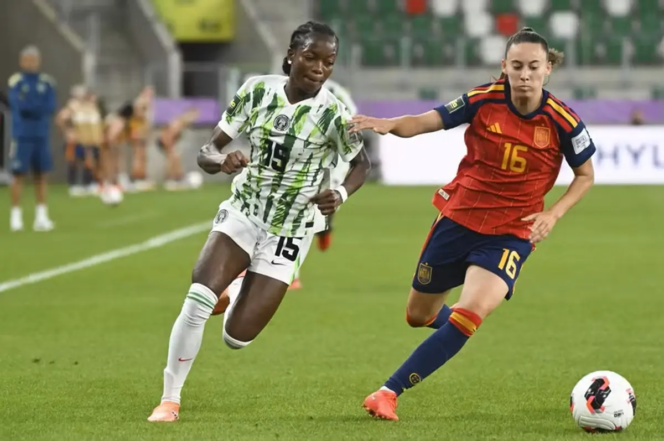
The Falconets must produce their own response; against China, they need to be sharper, more connected, more clinical and far more assertive
Nigeria’s Falconets will be under pressure to respond when they face China in their second Group F fixture at the 2026 FIFA U-20 Women’s World Cup, following their disappointing 2-0 defeat to Spain in the opening game.
The defeat has left Nigeria with little room for another below-par performance against China, particularly with New Caledonia still to come.
Aduku was brutally honest in his assessment after the loss, admitting that his players failed to perform at their expected level.
“We did not come to the party today, we did not play.”
However, the coach remains confident that the Falconets can recover and progress to the knockout rounds.
With China next, PREMIUM TIMES looks at five areas Nigeria must correct if they are to get their campaign back on track.
The biggest concern against Spain was Nigeria’s inability to impose themselves on the match.
The Falconets struggled to establish control, particularly in possession, and spent long periods reacting to Spain rather than dictating the contest.
That cannot happen against China as Nigeria must start with greater intensity and purpose, move the ball quicker and ensure the midfield is involved from the opening whistle.
Against Spain, there were periods when the midfield virtually disappeared, making it difficult for the forwards to receive quality service.
The Falconets have the technical ability and physical strength to cause problems, but those qualities will count for little if they cannot establish a rhythm.
Spain demonstrated an important lesson in tournament football: chances have to be converted.
The Europeans did not need a barrage of opportunities to win the game. Marisa Garcia opened the scoring in the 13th minute after clever work from Noe Bejarano, before substitute Alba Cerrato doubled the advantage in the 73rd minute.
Cerrato had been on the pitch for only seven minutes when she produced a neat left-footed finish to put Spain in control.
Nigeria, meanwhile, struggled to make their attacking moments count, as the clearest opportunity came seven minutes from time when Precious Oscar fired just wide from about 10 yards, in a position where it appeared easier to score than miss.
Against China, the Falconets cannot afford such wastefulness.
The lack of service to the forwards was another major issue against Spain.
The Falconets’ attackers spent large portions of the match huffing and puffing without receiving the quality balls needed to threaten the Spanish defence consistently.
That problem was partly caused by the midfield failing to establish control.
Nigeria need better connections between defence, midfield and attack, with quicker movement off the ball and more accurate final passes. The forwards cannot be expected to create opportunities on their own.
If Nigeria are to break China down, the midfield must provide them with better service and greater support around the penalty area.
The opening goal against Spain changed the complexion of the contest, and Nigeria struggled to produce the response required.
Once Garcia put Spain ahead, the Falconets needed to increase the pressure and force the European champions onto the back foot.
Instead, Spain remained composed and eventually doubled their advantage through Cerrato in the second half.
The second goal made the comeback considerably harder and left Nigeria chasing the game. Against China, the Falconets must show greater resilience if they fall behind.
Better game management, quicker reactions and a stronger response to setbacks will be crucial. The players showed desire and passion, but against Spain they were ultimately out-thought and out-fought in key moments.
Spain’s ability to deal with Nigeria’s physical qualities was another warning sign.
Aduku had expected a difficult contest, while Spain coach David Aznar acknowledged before the game that his team would have to cope with Nigeria’s physical strength.
But Spain refused to allow the Falconets to dictate the contest physically. They chased down Nigerian players, closed spaces quickly and denied them time on the ball, particularly during transitions.