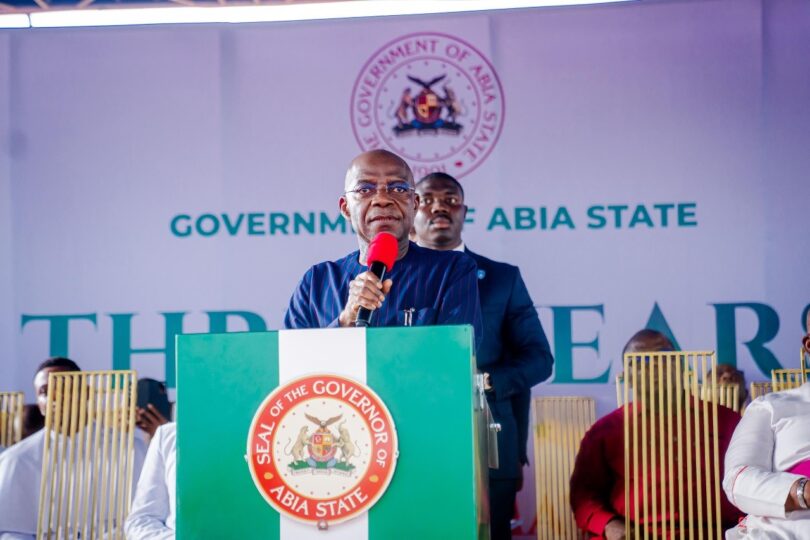
“I have watched the things happening in Abia under Otti, and one thing that is difficult to miss is the sheer volume of work going on across the state,” the former minister said.
Former Sports Minister Solomon Dalung has commended the Abia State Governor Alex Otti for accepting responsibility and apologising over the recent strike by the Academic Staff Union of Universities (ASUU) at Abia State University (ABSU).
He made the comments in a Facebook post on Sunday while reflecting on Mr Otti’s administration and its performance in Abia.
Mr Otti recently apologised to the ABSU community over the industrial action, describing the strike as avoidable and accepting responsibility for the failure to resolve the issues promptly.
The governor said ASUU’s demands had been approved by his administration but were delayed by bureaucratic processes.
“I failed them. I failed them,” Mr Otti said while apologising to the university community.
The ABSU-ASUU chapter began an indefinite strike on 11 August following the expiration of a 14-day ultimatum issued to the university’s Governing Council.
The union’s demands included the implementation of the 2025 Federal Government-ASUU agreement, the resolution of irregular promotion issues, the settlement of unremitted cooperative deductions, and the payment of outstanding Earned Academic Allowances dating back to 2009.
The strike was later resolved after intervention by a committee led by the Secretary to the Abia State Government, with the government announcing on 24 August that the outstanding issues had been addressed.
Mr Dalung said the apology was only one aspect of what he considered noteworthy about Mr Otti’s administration.
“I have watched the things happening in Abia under Otti, and one thing that is difficult to miss is the sheer volume of work going on across the state,” he said.
He cited roads, schools, healthcare and other infrastructure as areas where he said the administration appeared to have taken development seriously.
Mr Dalung said Nigerians should be able to acknowledge good governance irrespective of political affiliation, ethnicity or religion.
“We have become so used to measuring politicians by party, ethnicity, religion and political alignment that sometimes we struggle to acknowledge good work when we see it simply,” he said.
Mr Dalung acknowledged that Mr Otti’s administration would not get everything right, describing the ASUU dispute itself as evidence.
“But there is a difference between a government that makes mistakes while genuinely trying to deliver and one that spends four years explaining why nothing can be done,” he said.
He said he did not live in Abia and had no reason to join Mr Otti’s “political fan club”, but argued that visible changes in communities deserved attention.
Mr Dalung said political differences should not prevent Nigerians from recognising achievements or criticising failures.
“People don’t eat political party slogans,” he said. “They use the roads. They send their children to the schools. They go to the hospitals.”
He said a governor’s ability to acknowledge failure while delivering tangible projects should be considered in assessing leadership.
“Politics should not make us so blind that we can no longer recognise competence when we see it,” Mr Dalung said.