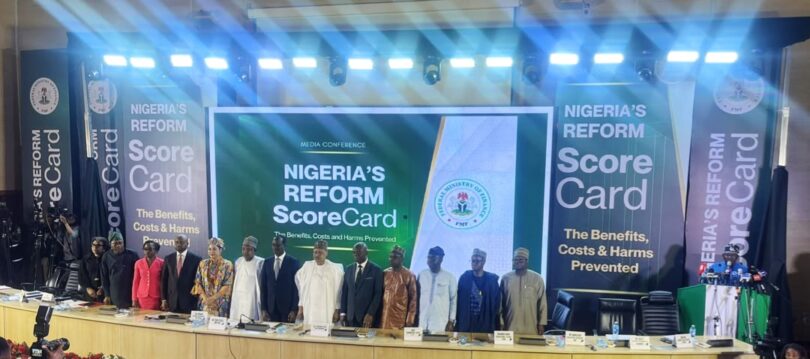
The Finance Minister says additional resources generated during the reform helped to fund higher wages, debt obligations and infrastructure, while acknowledging that household welfare remains a major unfinished task.
The Federal Government spent ₦30.64 trillion on incremental expenses between June 2023 and December 2025, with wage adjustments, external debt service and strategic infrastructure accounting for the largest portions, the Minister of Finance and Coordinating Minister of the Economy, Taiwo Oyedele, has said.
The presentation provided the government’s account of how additional resources generated during the reform period were raised and spent, while also outlining what it said were the benefits of the reforms and the economic problems they could have prevented.
According to the minister, the removal of the petrol subsidy and reforms to the foreign exchange market helped mobilise ₦15.8 trillion in subsidy savings for the Federation between June 2023 and December 2025.
The entire amount, however, did not accrue to the Federal Government.
Of the ₦15.8 trillion, ₦ 5.4 trillion went to the Federal Government, while ₦10.4 trillion was shared between state and local governments through the Federation Account.
In addition to its share of the subsidy savings, the Federal Government recorded ₦3.1 trillion in incremental independent revenue, mainly from remittances by government-owned entities.
It also obtained ₦11.9 trillion in incremental borrowing during the period.
Together, the three sources provided the Federal Government with ₦20.4 trillion in incremental resources.
Oyedele said the additional resources were used alongside funds from the government’s existing revenue base to meet incremental expenses totalling ₦30.64 trillion during the period.
The largest expenditure was ₦9.39 trillion spent on wage adjustments, increases in the national minimum wage and allowances for public servants.
The amount is higher than the ₦5.4 trillion the Federal Government received as its share of the subsidy savings.
The minister said the figure demonstrated that the subsidy reform was not introduced simply as a revenue-generating measure.
“That, in itself, is evidence that the reform was never introduced for revenue purposes, but to address entrenched corruption in an artificially managed fuel subsidy and foreign exchange market,” he said.
Another ₦9.37 trillion was spent on external debt service.
Oyedele said the cost of servicing the government’s foreign-denominated obligations increased substantially following the depreciation of the naira.
“So, if we’re paying ₦1 billion, but instead of ₦460, it’s now ₦1,415. That’s more naira than we need to incur,” he explained.
The government also spent ₦6.47 trillion on strategic infrastructure during the period.
Other incremental expenses included ₦3.14 trillion for additional electricity subsidy costs and ₦1.24 trillion in domestic debt service associated with higher monetary policy rates.
The minister also reported ₦423.8 billion in social welfare transfers; ₦419.1 billion for Federal Capital Territory development, the Ecological Fund, and natural resource investments; and ₦201.26 billion, representing higher naira costs of foreign obligations.
He said ₦20.404 trillion of the ₦30.64 trillion incremental expenditure was funded from the additional resources generated during the period.
The remaining ₦10.236 trillion came from the government’s existing revenue base.
Of the N20.4 trillion in incremental resources, borrowing accounted for 58 per cent, subsidy savings for 27 per cent, and other revenue for 15 per cent.
Oyedele explained that the ₦15.8 trillion in subsidy savings should not be interpreted as money that accumulated in a separate government account labelled “subsidy savings”.
Rather, he said, the impact of the reforms was reflected in increased resources available to the Federation through higher revenue collections.
The Federal Government’s ₦5.4 trillion share represented about 34 per cent of the ₦15.8 trillion.
States received ₦6.5 trillion, or about 41 per cent, while local governments received ₦3.9 trillion, or about 24 per cent.
The distribution meant that the two lower tiers of government received ₦10.4 trillion, almost twice the Federal Government’s share.
Beyond explaining how the resources were spent, the ministry used the scorecard to compare Nigeria’s current economic position with what it estimated could have happened if the reforms had not been implemented.
The scorecard examined 25 indicators across five areas: fiscal sustainability, external stability, investment climate, social impact, and growth and productivity.