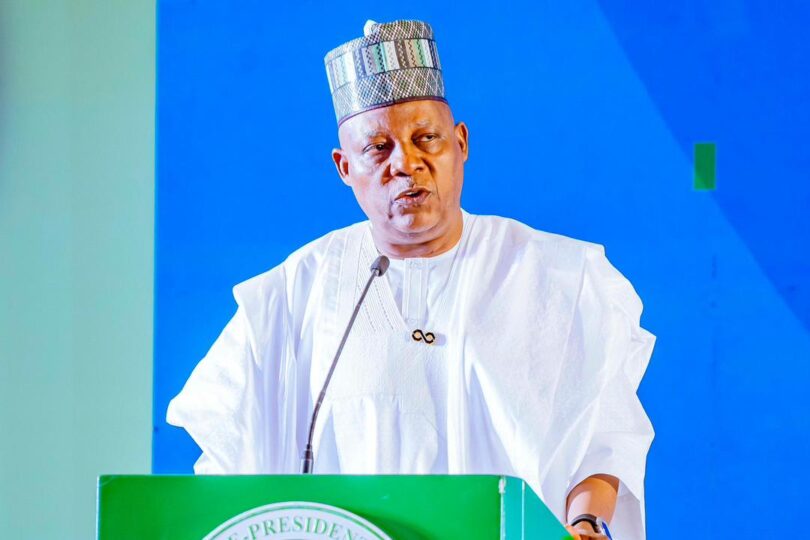
“Three months into our swearing in, some people told Tinubu I was planning to kill him to take over power. The president had called me and said, ‘Sit down! Your people came to me and said stop wearing those Shettima’s clothes,” he said.
Vice President Kashim Shettima has disclosed that shortly after President Bola Tinubu assumed office in 2023, some individuals from Borno State approached the president with claims that traditional outfits gifted to him during the election campaign had spiritually influenced him and could endanger his life.
The vice president spoke on Tuesday in Abuja while representing the president at the unveiling of “My Life of Duty and Allegiance,” the autobiography of former Head of State Yakubu Gowon.
Mr Gowon was the Nigerian leader between July 1966 and July, 1975.
Mr Shettima said President Tinubu dismissed the allegations outright and responded by wearing the outfits repeatedly for days to demonstrate his rejection of such claims.
“Three months into our swearing in, some people told Tinubu I was planning to kill him to take over power. The president had called me and said, ‘Sit down! Your people came to me and said stop wearing those Shettima’s clothes,” he said.
The VP explained that during the build-up to the 2023 elections, he arranged traditional Borno-style attire and caps for Mr Tinubu as the then-presidential aspirant toured northern states seeking political support.
The garments, he said, became a regular feature of Mr Tinubu’s campaign appearances across the region after aides confirmed they suited him well.
Recounting the episode, the vice president said the matter resurfaced after he returned from China, where he represented Nigeria at the 3rd Belt and Road Initiative Forum in October 2023.
Mr Shettima said the president informed him that a delegation had visited him with warnings about the clothing.
He quoted Mr Tinubu as saying the accusations “did not add up” and were baseless because, at the time the garments were given to him, neither of them occupied the positions they currently hold.
According to the vice president, the president subsequently continued wearing the attire publicly for about a week to counter the narrative and show he was not influenced by superstition.
Mr Shettima described the incident as evidence of growing mistrust and suspicion within Nigeria’s political space.
Drawing a contrast with earlier generations of leaders, he recalled the remarks by the Sultan of Sokoto, Muhammad Abubakar, of how families in Sokoto regularly sent bowls of fura to Mr Gowon at Dodan Barracks during his time as Head of State.
He said the former leader accepted the gesture freely because relationships at the time were built more on trust than suspicion.
“Suspicion smears our relationships, and it ought not to be. We are essentially one people tied to a common destiny,” Mr Shettima said.
The vice president praised Mr Gowon for promoting national unity during and after the civil war, particularly through the establishment of the National Youth Service Corps (NYSC) and his role in the formation of the Economic Community of West African States (ECOWAS).
He also called for peace in Plateau State, urging Nigerians to reject ethnic and religious divisions.
Describing Mr Gowon as one of the few surviving figures from Nigeria’s early military era, Mr Shettima said the autobiography arrived at a critical moment when the country needed reflection and historical memory.
He said some leaders are remembered because of the positions they held, while others endure in national memory because they used power to advance national purpose, adding that Mr Gowon belonged to the latter category.
Quoting American civil rights leader Martin Luther King, the vice president urged Nigerians to embrace unity.
“We must learn to live together as brothers or perish together as fools,” he said.